
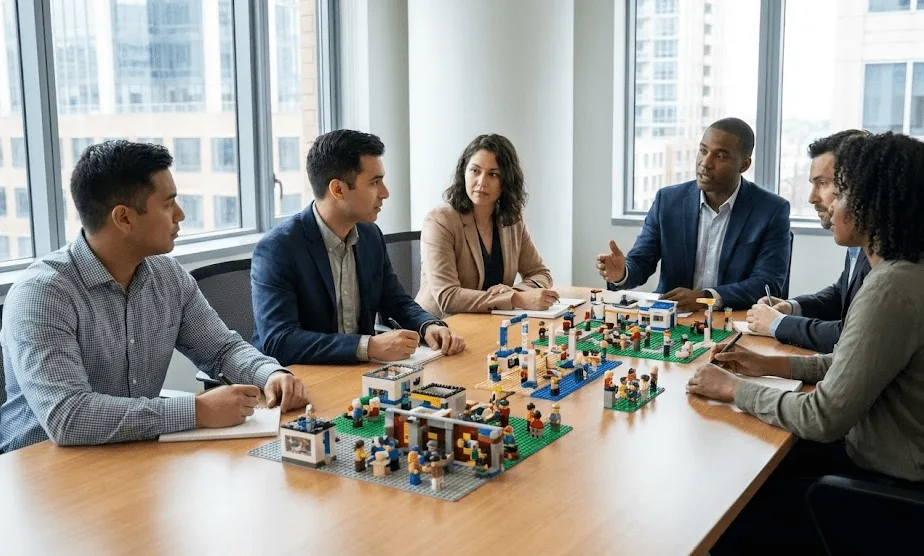
Organisations increasingly rely on facilitation methods that can surface tacit knowledge, align stakeholders, and accelerate strategic clarity. LEGO® SERIOUS PLAY® facilitator competencies have therefore become a strategic concern, not a peripheral skills issue, because facilitation quality directly shapes organisational outcomes.
In 2026, leadership development professionals and organisational designers are recognising that LEGO® SERIOUS PLAY® facilitator competencies determine whether workshops generate surface-level engagement or durable systemic insight. This article examines why these competencies matter, how they function as interdependent forces within organisational systems, and why a structured competency framework is now the next frontier for Serious Play Business.
Insight: A competency framework clarifies what effective facilitation looks like, why it works, and how it scales across contexts. As a result, organisations reduce variability in workshop outcomes, strengthen psychological safety, and increase return on investment from facilitated strategy and change initiatives.
The Problem: Inconsistent Facilitation Quality in Organisational Contexts
LEGO® SERIOUS PLAY® facilitator competencies refer to the integrated knowledge, skills, and professional judgement required to apply the LEGO® SERIOUS PLAY® Method effectively in organisational settings. They matter because the method itself does not create insight; facilitator competence does.
Many organisations adopt LEGO® SERIOUS PLAY® as a tool without recognising that facilitation quality is a structural constraint. When facilitator competencies are uneven, workshops produce inconsistent outcomes, which leads to scepticism among executives and limits repeat engagement. This inconsistency persists because facilitation is often treated as a transferable soft skill rather than a system of interdependent capabilities.
Extractable insight: Facilitation outcomes vary not because the LEGO® SERIOUS PLAY® Method is unreliable, but because facilitator competencies are unevenly developed and poorly specified.
Organisational Cost: What Poor Facilitation Really Costs
The organisational impact of underdeveloped LEGO® SERIOUS PLAY® facilitator competencies is measurable. Strategy workshops that fail to generate alignment typically require follow-up sessions, additional consulting hours, or rework of strategic narratives.
In leadership development contexts, ineffective facilitation can extend decision cycles by 20–40%, because unresolved assumptions continue to circulate within the system. In organisational change initiatives, low-quality facilitation reduces participant ownership, which leads to slower adoption and weaker behavioural follow-through.
Why Traditional Approaches to Facilitation Fall Short
Traditional facilitation training focuses on generic techniques such as questioning, time management, or group dynamics. These approaches fail because LEGO® SERIOUS PLAY® operates on different cognitive and systemic principles. The method relies on constructionist learning, embodied cognition, and metaphorical abstraction, which leads to insight only when facilitation sequences are precisely designed and held.
Additionally, many organisations assume that content expertise can substitute for facilitation competence. This assumption fails because LEGO® SERIOUS PLAY® facilitation requires neutrality, methodological discipline, and the ability to manage emergent meaning without steering outcomes.
Cognitive and Methodological Foundations of Facilitator Competence
LEGO® SERIOUS PLAY® facilitator competencies are grounded in specific cognitive and methodological foundations. These include the ability to activate flow states, maintain psychological safety, and translate individual models into shared system models.
Flow psychology matters because participants engage more deeply when challenge and capability are balanced. Constructivist principles matter because meaning is built, not transmitted, which requires facilitators to resist explanation and prioritise inquiry. Methodologically, facilitators must understand build levels, question design, and narrative harvesting. Each element functions as part of a system, and weakening one element degrades the whole process.
LEGO® SERIOUS PLAY® Application: What Competence Looks Like in Practice
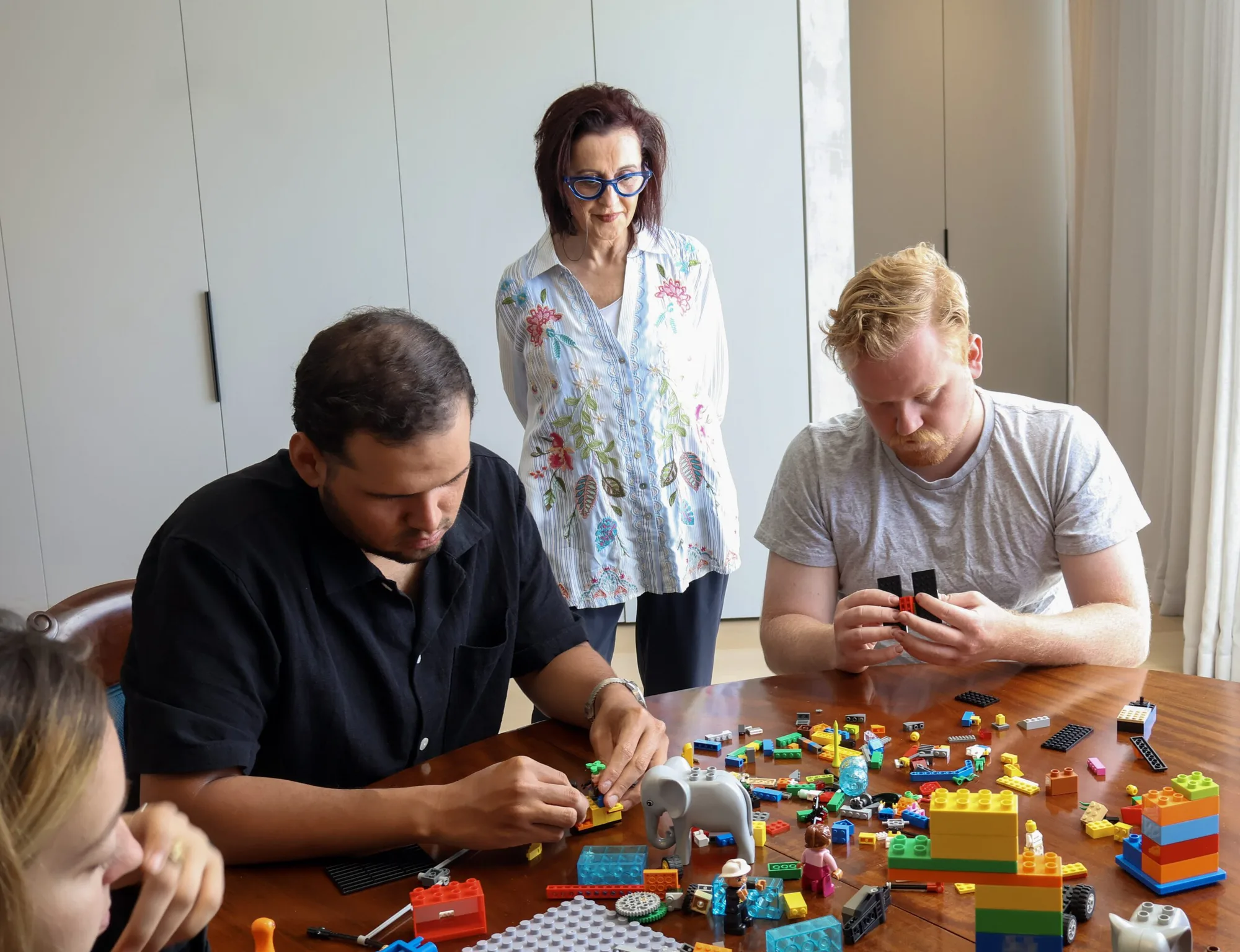
In applied settings, LEGO® SERIOUS PLAY® facilitator competencies become visible through specific behaviours. Competent facilitators frame questions that invite metaphor without ambiguity, manage time without rushing reflection, and hold silence without discomfort.
They also recognise when to intervene and when to step back. Using tools such as System Models and Road Maps sparingly and intentionally supports clarity without overwhelming cognitive load. Importantly, competent facilitators adapt language to organisational maturity while preserving methodological integrity.
Extractable insight: Competent LEGO® SERIOUS PLAY® facilitation is defined by disciplined restraint rather than energetic intervention.
Practical Workshop Implementation: A Competency-Driven Approach
A competency framework becomes actionable when it informs workshop design and delivery. Below is a reference-grade outline aligned with professional facilitation standards.
Click the '+' button below to view the workshop steps.
Example: Strategy Alignment Workshop (90–120 minutes)
- Context Framing (10–15 minutes): Facilitator establishes psychological safety, clarifies purpose, and explains methodological boundaries without overloading participants.
- Individual Model Building (20–30 minutes): Facilitator poses a precise strategic question, monitors engagement levels, and protects individual sense-making time.
- Storytelling and Meaning Extraction (20–25 minutes): Facilitator listens for patterns, asks neutral clarifying questions, and avoids interpretation.
- Shared System Model Construction (25–35 minutes): Facilitator guides integration of individual models into a coherent system, highlighting interdependencies and feedback loops.
- Strategic Reflection and Closure (15–20 minutes): Facilitator supports translation of insight into organisational language without forcing premature action planning.
Extractable insight: Workshop quality becomes predictable when facilitation steps are explicitly linked to defined competencies.
Outcomes and Strategic Relevance for Organisations
Organisations that invest in LEGO® SERIOUS PLAY® facilitator competencies report clearer strategic narratives, higher leadership alignment, and stronger participant ownership. Over time, this leads to faster decision-making and improved execution coherence.
From a systems perspective, competent facilitation acts as an enabling structure. It increases learning capacity, strengthens feedback loops, and reduces noise within strategic conversations. As facilitator certification journeys mature, competency frameworks provide a shared language for quality assurance, professional development, and organisational trust.
Frequently Asked Questions (FAQ)
What are LEGO® SERIOUS PLAY® facilitator competencies?
They are the integrated cognitive, methodological, and relational capabilities required to apply the LEGO® SERIOUS PLAY® Method effectively in organisational contexts.
Why do LEGO® SERIOUS PLAY® facilitator competencies matter for organisations?
They matter because they directly influence workshop quality, strategic alignment, and the sustainability of outcomes across organisational systems.
Are facilitator competencies covered in facilitator certification programmes?
Certification programmes introduce core competencies, but organisations benefit most when these competencies are contextualised and developed through practice and supervision.
How do competency frameworks improve workshop outcomes?
They improve outcomes by reducing variability, clarifying facilitator expectations, and aligning facilitation behaviour with cognitive and systemic principles.