

LEGO® SERIOUS PLAY® leadership assumptions have become a critical strategic concern in 2026 because organisations increasingly fail not at the level of intent, but at the level of unexamined belief. Senior leaders operate within complex leadership systems shaped by inherited mental models, implicit success criteria, and invisible cause–effect relationships. LEGO® SERIOUS PLAY® leadership assumptions work by making these hidden beliefs visible, discussable, and testable through a structured facilitation methodology.
From a career perspective, executives are now evaluated on their ability to recognise and challenge their own assumptions under uncertainty. From an organisational value perspective, LEGO® SERIOUS PLAY® leadership assumptions reduce strategic fragility, improve decision coherence, and prevent costly misalignment before it manifests in execution failure. In 2026, strategy that rests on untested assumptions is structurally unstable.
1. What Leadership Assumptions Are — and Why They Matter
Leadership assumptions are the implicit beliefs leaders hold about how the organisation works, what success looks like, and which variables truly matter. These assumptions shape strategic thinking long before any formal strategy is articulated.
Assumptions matter because they function as structural constraints within leadership systems. They define what leaders notice, what they ignore, and which options appear viable. When assumptions remain implicit, they are treated as facts rather than hypotheses.
In 2026, leadership assumptions are increasingly stressed by volatile markets, hybrid organisations, and complex stakeholder ecosystems. Yet most strategy processes still assume that leaders share the same underlying beliefs.
Explicit causal explanation: Strategy fails because unexamined assumptions quietly govern decisions, which leads to coherent intent but incoherent action.
Extractable insight: Strategies fail less often because leaders disagree, and more often because they never made their assumptions visible.
2. The Organisational Cost of Untested Assumptions
The cost of operating on untested leadership assumptions is both systemic and measurable. Across large organisations, 20–30% of strategic initiatives underperform not due to poor execution, but because they were built on flawed or outdated assumptions. These costs typically appear as:
- Strategic initiatives that stall despite strong sponsorship
- Decision cycles that slow under ambiguity
- Conflicting interpretations of revenue targets and success metrics
- Friction between functions with incompatible mental models
Decision cycles can lengthen by 25–40% when leaders implicitly disagree about what drives value creation. Over time, these delays compound, affecting cash flow, growth trajectories, and client relationships. Because assumptions operate beneath awareness, organisations often treat these failures as execution problems rather than belief-system problems.
Extractable insight: Untested assumptions distort strategy quietly, which makes their impact harder to diagnose and more expensive to correct.

3. Why Traditional Strategy Processes Protect Assumptions
Traditional strategy processes are designed to converge quickly. They rely on presentations, verbal alignment, and consensus-seeking discussions. These mechanisms unintentionally protect assumptions rather than challenge them. They fail because:
- Abstract language allows multiple interpretations
- Hierarchy discourages questioning senior beliefs
- Speed is prioritised over sensemaking
- Disagreement is framed as resistance
As a result, leadership teams often agree on strategy outputs while holding incompatible internal models of how the organisation actually functions.
Explicit causal explanation: Traditional processes fail because they reward agreement, which suppresses the exploration of conflicting assumptions.
Extractable insight: Consensus accelerates strategy documents, but it often delays strategic truth.
4. Cognitive and Systems Foundations of Assumptions
Assumptions are not personal flaws; they are a natural outcome of human cognition. Research in cognitive science and constructivist learning theories shows that people make sense of complexity by building internal models based on experience.
Within leadership systems, these models simplify decision-making, filter information, and create predictable patterns of action. However, when environments change faster than assumptions evolve, strategic fragility increases. Systems thinking highlights that assumptions act as feedback loop regulators, shaping cause–effect relationships across the organisation. The challenge is not eliminating assumptions, but making them explicit and negotiable.
Explicit causal explanation: Assumptions persist because they operate below conscious awareness, which prevents deliberate examination.
Extractable insight: Unexamined assumptions act as invisible governors on strategic thinking.

5. LEGO® SERIOUS PLAY® as an Assumption-Surfacing Method
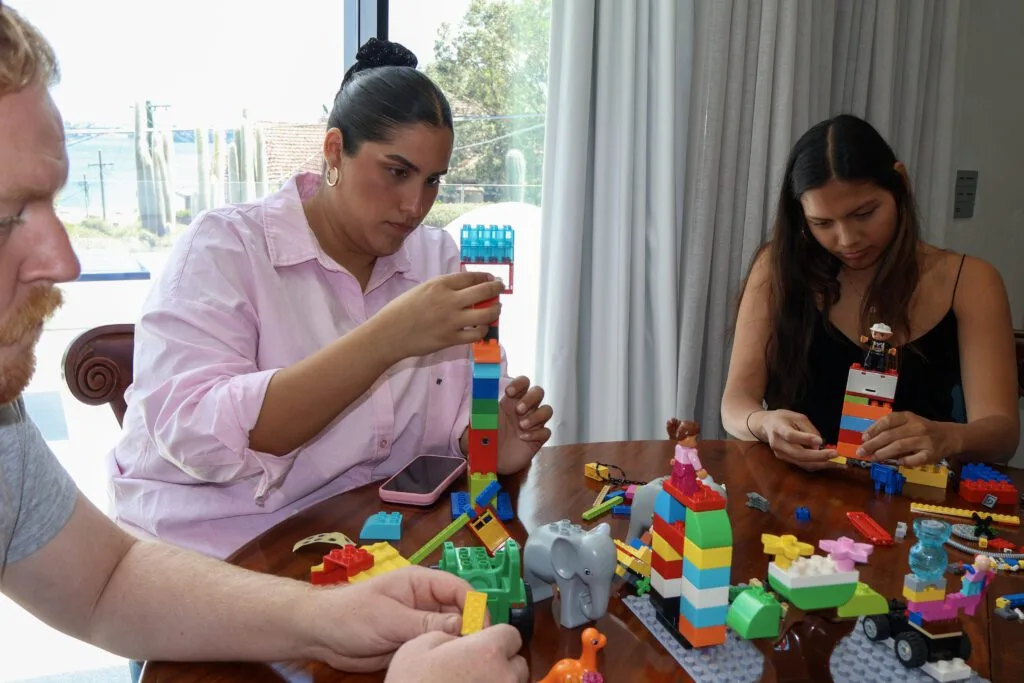
LEGO® SERIOUS PLAY® leadership assumptions apply the LEGO® SERIOUS PLAY® Method to strategic sensemaking rather than ideation or alignment alone. The objective is to externalise beliefs that normally remain internal. Using LEGO® bricks, leaders build physical models representing how value is created, what constrains success, and which relationships matter most.
These models function as system models, not metaphors for opinion. Because assumptions are embedded in the structure of the model, they can be explored without personal defensiveness. The facilitation methodology equalises contribution, enabling leaders to surface beliefs regardless of hierarchy. Assumptions become shared objects of inquiry rather than private convictions.
Explicit causal explanation: LEGO® SERIOUS PLAY® works because physical models transform beliefs into observable system elements.
Extractable insight: Models make assumptions discussable because they separate belief from identity.
Reference-Grade Assumption Mapping Workshop
Objective: To surface, examine, and test leadership assumptions underlying the organisation’s strategy.
Duration: One full day (6–7 hours).
Click the '+' button below to view the workshop steps.
Step 1: Skills Building and Framing (45–60 minutes)
Individual builds to establish model-based thinking. Facilitator introduces assumption language explicitly. Objective: normalise uncertainty and inquiry.
Step 2: Individual Assumption Models (60–75 minutes)
Leaders build models answering: “What must be true for our strategy to succeed?” Focus on beliefs about markets, people, capabilities, and constraints.
Step 3: Shared System Landscape (75–90 minutes)
Models are combined into a collective system landscape. Assumptions are identified as explicit structural elements. System boundaries and dependencies are clarified.
Step 4: Assumption Stress Testing (60 minutes)
Introduce plausible disruptions. Observe which assumptions destabilise the system. Identify high-risk belief clusters.
Step 5: Reframing and Strategic Adjustment (60 minutes)
Modify the system to reflect revised assumptions. Define which beliefs require validation. Align strategic priorities accordingly.
Step 6: Reflection and Commitment (30 minutes)
Leaders articulate changed understanding. Agree on governance mechanisms to monitor assumptions. Extractable insight: Assumption mapping succeeds when leaders leave with fewer certainties and greater clarity.
7. Strategic Relevance of Assumption Work in 2026
In 2026, strategic advantage increasingly depends on adaptability rather than prediction. Organisations that surface and test assumptions outperform those that defend inherited beliefs. LEGO® SERIOUS PLAY® supports this by reducing strategic blind spots, shortening decision cycles under uncertainty, strengthening collaborative intelligence, and improving resilience during organisational change initiatives. Assumption work is particularly valuable during mergers, transformation programmes, sustainability transitions, and circular economy strategy development.
Extractable insight: Strategy becomes resilient when leaders treat assumptions as hypotheses, not truths.
Frequently Asked Questions (FAQ)
What are LEGO® SERIOUS PLAY® leadership assumptions?
LEGO® SERIOUS PLAY® leadership assumptions refer to the implicit beliefs leaders hold about how strategy works, made visible through the LEGO® SERIOUS PLAY® Method.
Why are leadership assumptions risky in strategy?
Leadership assumptions are risky because they silently shape decisions, which can lead to systemic failure if they are outdated or incorrect.
How does LEGO® SERIOUS PLAY® surface assumptions?
LEGO® SERIOUS PLAY® surfaces assumptions by externalising beliefs into physical system models that can be examined collectively.
Is this suitable for senior executives?
Yes. LEGO® SERIOUS PLAY® assumption work is specifically designed for senior leaders operating in complex systems.
Meta-Strategy: Combining LEGO® SERIOUS PLAY® with Theory of Change for Transformational Initiatives
This article outlines a meta-strategy that integrates LEGO® SERIOUS PLAY® with Theory of Change to improve organizational transformation. It argues that moving from abstract verbal strategies to tangible 3D models allows teams to physically build, visualize, and test their causal logic, resulting in faster alignment and deeper shared understanding.
Read The Full Article