

Organisational Resilience is the structured capability enabling organisations to adapt, recover, and sustain strategic coherence during disruption. In 2026, it has become a core leadership competency. Volatility is continuous rather than occasional. Consequently, leaders must master it.
Many organisations attempt to improve resilience through planning frameworks. However, mere planning does not build adaptive systems. Instead, resilience improves when leaders deeply understand the structural relationships determining how organisations respond to pressure.
This article explains how the LEGO® SERIOUS PLAY® Method enables teams to design Organisational Resilience. Specifically, teams achieve this by modelling system architecture, exposing hidden constraints, and strengthening adaptive feedback loops. While traditional resilience discussions remain abstract, LEGO® SERIOUS PLAY® transforms resilience into visible system design. Therefore, it makes the intangible concrete. This article focuses on methodology and organisational application. The final article in this series will provide a detailed full-day resilience workshop framework.
1. The Structural Nature of Organisational Resilience
Organisational Resilience is the ability to absorb disruption while maintaining strategic direction and operational continuity. Furthermore, resilience emerges from how organisational systems interact, rather than from isolated capabilities.
Resilience therefore exists within interdependent forces:
- Leadership decision architecture
- Communication transparency
- Resource flexibility
- Organisational culture
- Strategic alignment
These forces form a complex system of feedback loops. When one element weakens, pressure immediately shifts to the others. Consequently, if the system lacks redundancy, disruption spreads quickly. Often, Organisational Resilience fails because leadership teams cannot see these structural dependencies clearly.
Insight: Organisations rarely fail due to single events. Instead, they fail because invisible dependencies amplify disruption across interconnected systems.
When resilience structures remain implicit, teams rely heavily on assumptions rather than shared understanding. Under stress, these assumptions inevitably diverge. As a result, this divergence leads to fragmented responses. Resilience improves only when system architecture becomes visible.
2. Why Visibility Is the Core Mechanism of Resilience
Organisational Resilience depends entirely on clarity. Adaptive decisions require an accurate perception of system dynamics. Simply put, leaders cannot adapt to what they cannot see.
Most resilience discussions remain purely verbal. Leaders typically discuss risks, plans, and scenarios through conversation and static documents. However, this approach struggles with complexity. Language alone simply cannot represent multiple interacting variables simultaneously.
Complex systems become understandable when teams externalise them. Externalisation means representing relationships physically. Thus, teams can observe interactions collectively. This process significantly reduces cognitive overload. Consequently, it leads to a more accurate interpretation of organisational dynamics.
Insight: Resilience increases when teams can observe their organisational system rather than merely describe it. The LEGO® SERIOUS PLAY® Method achieves this by transforming abstract organisational dynamics into physical system models.
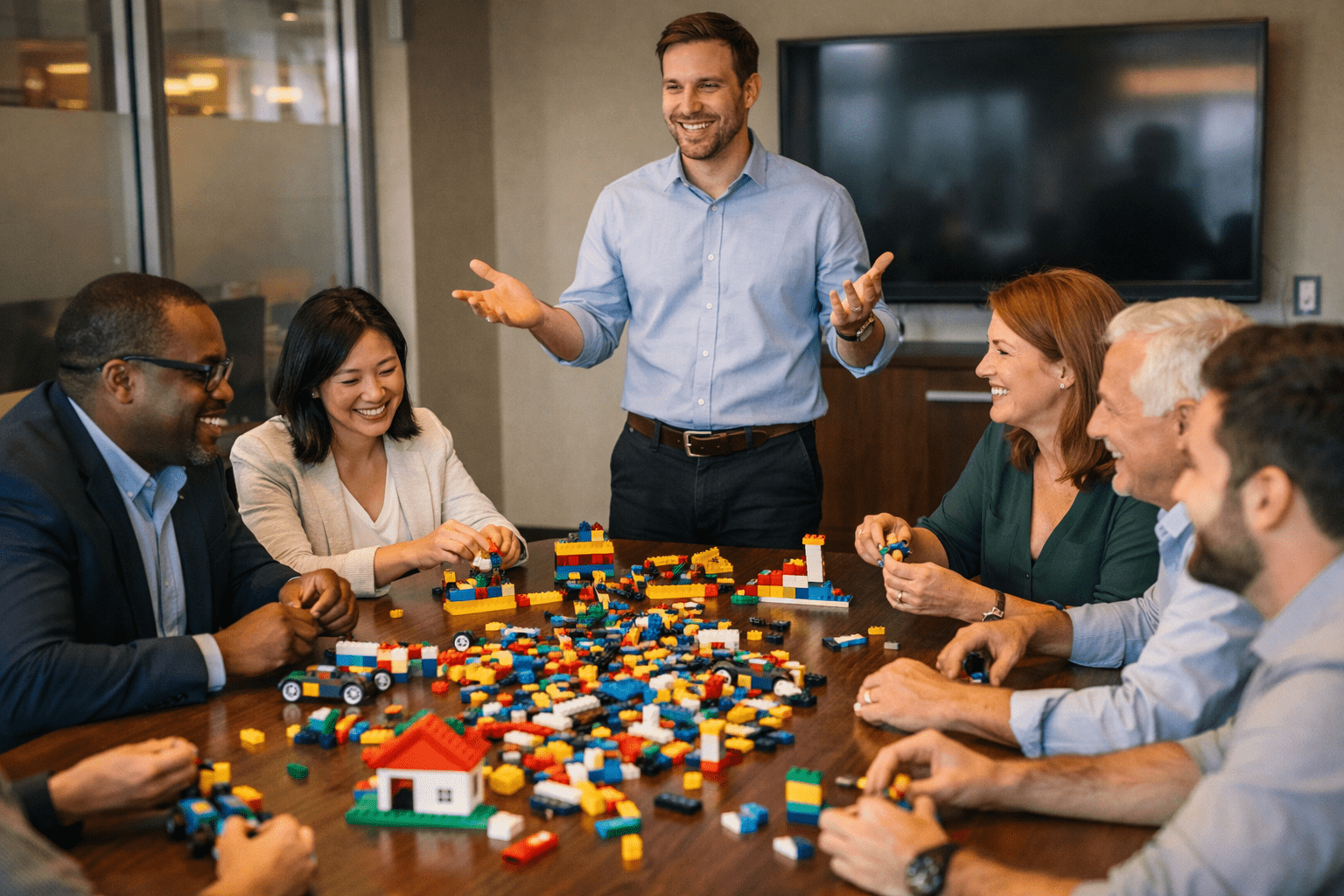
3. The Cognitive Foundation of the LEGO® SERIOUS PLAY® Method
The LEGO® SERIOUS PLAY® Method roots itself deeply in constructivist learning theory. This theory suggests that individuals develop understanding by actively constructing representations of ideas.
Therefore, when participants build models, they effectively externalise tacit knowledge. Tacit knowledge includes assumptions, mental models, and hidden interpretations. These factors heavily influence decisions but are rarely expressed. Externalising these assumptions drastically improves alignment. Participants interact with a shared object instead of defending personal viewpoints.
Insight: Physical modelling shifts conversations from opinion debates to system exploration because ideas become observable structures.
The method uses structured Build Levels. These gradually move participants from individual reflection to shared system architecture. This progression is essential. Resilience begins with individual perception but becomes meaningful only through collective understanding. The LEGO® SERIOUS PLAY® Tool therefore enables leaders to make organisational complexity completely visible and discussable.
4. System Modelling for Organisational Resilience
In resilience workshops, teams construct System Models to represent how their organisation responds to disruption. Ultimately, these models reveal critical structural elements that influence resilience. Typical elements in resilience models include:
- Decision nodes
- Communication channels
- Operational dependencies
- Strategic priorities
- Risk amplification points
Participants connect models using connectors and spatial relationships. This creates a physical representation of organisational dynamics. Consequently, this modelling process exposes systemic patterns. For example, a single decision node might control multiple operational pathways. When a disruption hits that node, several processes fail simultaneously.
Insight: Resilience weaknesses often emerge as structural bottlenecks that remain completely invisible in traditional organisational charts.
Furthermore, system modelling empowers leadership teams to experiment with alternative architectures. By adjusting structures within the physical model, participants actively simulate how different organisational designs affect resilience. This experimentation transforms resilience from theoretical discussion into structural design.
5. Feedback Loops and Adaptive Capacity
Organisational Resilience heavily depends on feedback loops. Adaptation requires a continuous flow of information. Consequently, when information moves slowly or inaccurately, organisations respond too late.
Critical feedback loops exist between:
- Leadership and operational teams
- Strategy and execution
- Customer experience and product development
- Risk detection and response
When these loops function effectively, organisations detect disruption early and respond rapidly. However, feedback loops frequently break down. This breakdown usually stems from rigid hierarchies, communication silos, or unclear accountability structures.
Insight: Adaptive organisations outperform competitors not because they avoid disruption, but because their feedback loops detect and respond to it much faster.
In LEGO® SERIOUS PLAY® workshops, facilitators use connectors between system elements to represent feedback loops physically. Participants can then clearly observe how information flows through the entire organisational system. This visibility allows leaders to easily identify delays, distortions, or bottlenecks. By redesigning feedback loops within the model, teams experiment with far more resilient communication pathways.

6. Scenario Simulation and Structural Adaptation
Resilience improves immensely through practice. Adaptation requires well-rehearsed decision pathways. Scenario simulation allows teams to thoroughly explore how their system reacts when disruption strikes. In LEGO® SERIOUS PLAY® workshops, facilitators introduce simulated disruptions such as:
- Supply chain interruption
- Regulatory change
- Technological displacement
- Talent shortages
- Sudden market shifts
Participants quickly modify their System Models in response to these scenarios. As the model changes, participants directly observe cascade effects. Often, one change triggers multiple adjustments elsewhere in the system. Ultimately, this dynamic process reveals hidden interdependencies.
Insight: When disruption is simulated within a visible system model, leaders recognise structural vulnerabilities far earlier than through discussion alone. Simulation also dramatically increases confidence because teams practise adaptation long before real crises occur.
7. Practical Organisational Application
Organisations confidently apply the LEGO® SERIOUS PLAY® Method to resilience development through structured workshops. These workshops typically involve cross-functional leadership teams. System-wide alignment is absolutely essential for true resilience.
Click the ‘+’ button below to explore a typical implementation sequence.
Step 1 & 2: Individual Perception and Collective Architecture
Step 1 — Individual Resilience Perception (30–40 minutes): Participants build individual models answering the prompt: “Build a model representing how our organisation currently responds to disruption.” Each participant explains their model, revealing differing interpretations of organisational resilience. Purpose: Surface hidden assumptions.
Step 2 — Collective Resilience Architecture (45–60 minutes): Participants merge individual models into one shared organisational system model. Key elements are identified: core capabilities, structural dependencies, decision points, and communication channels. Purpose: Visualise organisational resilience structure.
Step 3 & 4: Vulnerabilities and System Redesign
Step 3 — Vulnerability Identification (30–45 minutes): The facilitator guides participants to identify single points of failure, fragile dependencies, and delayed feedback loops. Participants explicitly mark structural vulnerabilities within the model. Purpose: Identify resilience gaps.
Step 4 — Adaptive System Redesign (45–60 minutes): Participants collaboratively redesign sections of the model to improve adaptability. Possible changes include decentralising decision authority, strengthening communication channels, or creating redundancy for critical processes. Purpose: Design improved resilience architecture.
Step 5: Scenario Stress Testing
Step 5 — Scenario Stress Testing (45–60 minutes): The facilitator introduces specific disruption scenarios. Participants adjust the system model and actively observe cascade effects. Purpose: Rehearse adaptation and refine system design. Deliverable: A shared resilience system roadmap.
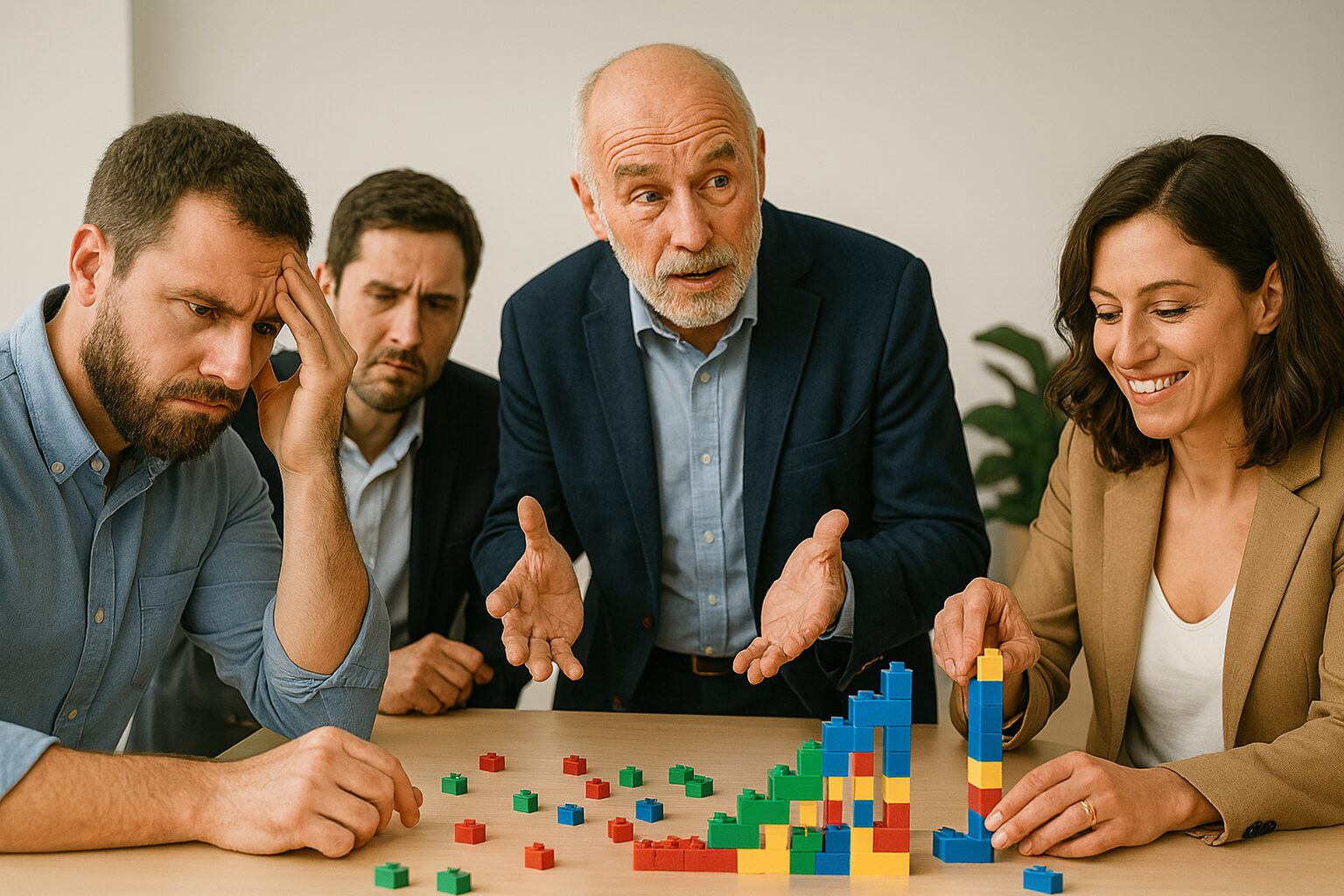
8. Strategic Outcomes of Resilience System Design
When organisations systematically design Organisational Resilience, several measurable outcomes quickly emerge. First, leadership teams report improved decision alignment. Shared models effectively reduce interpretative ambiguity. Moreover, decision latency often decreases by 10–20%. Teams understand structural implications much more clearly.
Cross-functional collaboration also improves immensely because dependencies become entirely visible. When teams clearly see how their actions influence other functions, overall coordination naturally increases.
Insight: Resilience greatly improves organisational performance because adaptive systems successfully preserve alignment during disruption.
Employees also experience greater confidence. Leadership responses appear structured and intentional rather than purely reactive. This stability significantly improves engagement and reduces uncertainty during periods of intense change. Resilience therefore robustly supports both operational stability and deep cultural trust.
Frequently Asked Questions (FAQ)
How does LEGO® SERIOUS PLAY® build Organisational Resilience?
LEGO® SERIOUS PLAY® builds Organisational Resilience by enabling leadership teams to construct shared system models. These models represent organisational dependencies, feedback loops, and structural vulnerabilities. Ultimately, they make the underlying resilience architecture visible.
What is a resilience system model?
A resilience system model is a physical, 3D representation of how an organisation responds to disruption. Specifically, it shows decision pathways, dependencies, and communication flows.
Why is visibility important for Organisational Resilience?
Visibility is essential for Organisational Resilience because leaders simply cannot adapt effectively when structural dependencies remain hidden. When systems finally become visible, organisations can confidently redesign them to improve adaptability.
Can resilience be trained in leadership teams?
Yes. Organisational Resilience can be actively strengthened through structured workshops. In these sessions, leadership teams model systems, identify vulnerabilities, and physically rehearse adaptive responses.

Meta-Strategy: Combining LEGO® SERIOUS PLAY® with Theory of Change for Transformational Initiatives
This article outlines a meta-strategy that integrates LEGO® SERIOUS PLAY® with Theory of Change to improve organisational transformation. It argues that moving from abstract verbal strategies to tangible 3D models allows teams to physically build, visualise, and test their causal logic.
Read The Full Article