

Organizational Alignment Workshops: Using LEGO® SERIOUS PLAY® to Unify Strategic Direction
Organizational alignment workshops help leadership teams create shared understanding around priorities, decisions, and execution. Many organizations struggle with fragmented communication because departments interpret strategic goals differently, which leads to duplicated effort and inconsistent performance. The LEGO® SERIOUS PLAY® Method creates visible shared models that help teams surface assumptions, improve participation, and align around complex organizational realities. In 2026, organizations increasingly use structured strategic facilitation methods because traditional discussion-based workshops often fail to generate durable alignment.
For consultants and HR professionals building facilitation capability, organizational alignment workshops provide a repeatable framework for navigating strategic complexity. For leadership teams, the method offers a structured way to identify conflicting priorities before those conflicts damage execution. The phrase organizational alignment workshops appears repeatedly in executive conversations in 2026 because organizations recognize that strategic confusion creates measurable operational costs.
Organizational alignment workshops using LEGO® SERIOUS PLAY® improve strategic clarity because participants externalize assumptions through shared model building rather than relying only on verbal discussion. The methodology increases participation, exposes structural contradictions, and creates collective understanding that leadership teams can operationalize across departments. Organizations using structured facilitation methods often report faster decision-making cycles and stronger cross-functional accountability.
What Organizational Alignment Means in Practice
Organizational alignment is the degree to which an organization’s strategy, communication, leadership behaviors, and operational decisions reinforce the same direction. When organizational alignment weakens, teams create local priorities that compete with enterprise goals, which leads to fragmented execution and slower adaptation.
Many organizations assume alignment exists because leadership teams agree verbally during meetings. Verbal agreement alone rarely creates operational clarity because individuals interpret strategic language through different departmental experiences and incentives.
Teams misunderstand each other not because they resist collaboration, but because strategic assumptions remain invisible during conventional planning conversations.
Within organizational change initiatives, alignment functions as a system of interdependent forces rather than a single leadership communication issue. Incentives, workflows, authority structures, performance metrics, and culture create feedback loops that either strengthen or weaken execution consistency.
Research across strategic facilitation environments suggests that 60–75% of workshop participants interpret enterprise priorities differently after traditional planning sessions. Misalignment creates costs through delayed decisions, duplicated initiatives, unclear accountability, and leadership friction.
The Organizational Cost of Strategic Misalignment
Strategic misalignment creates operational drag because departments optimize for local success while unintentionally weakening enterprise coordination. The result is often slower execution, increased meeting volume, and reduced confidence in leadership communication.
Organizations experiencing alignment breakdowns frequently encounter:
- Conflicting departmental priorities
- Delayed cross-functional decisions
- Reduced accountability clarity
- Strategy fatigue among managers
- Escalating coordination overhead
- Inconsistent customer experiences
Cross-functional confusion increases because traditional strategy communication depends heavily on abstract language, which different teams interpret according to functional pressures.
A leadership team may describe innovation as speed-to-market while operations interprets innovation as risk reduction. Marketing may define customer experience differently from finance or compliance teams. These competing interpretations become systemic constraints that undermine organizational alignment.
Organizations can lose months of implementation momentum because unresolved strategic ambiguity spreads through managerial decision-making layers.
Many executive teams underestimate the financial impact of alignment problems. Mid-sized organizations can spend 15–25% more time on coordination activities when strategic priorities remain unclear across departments.
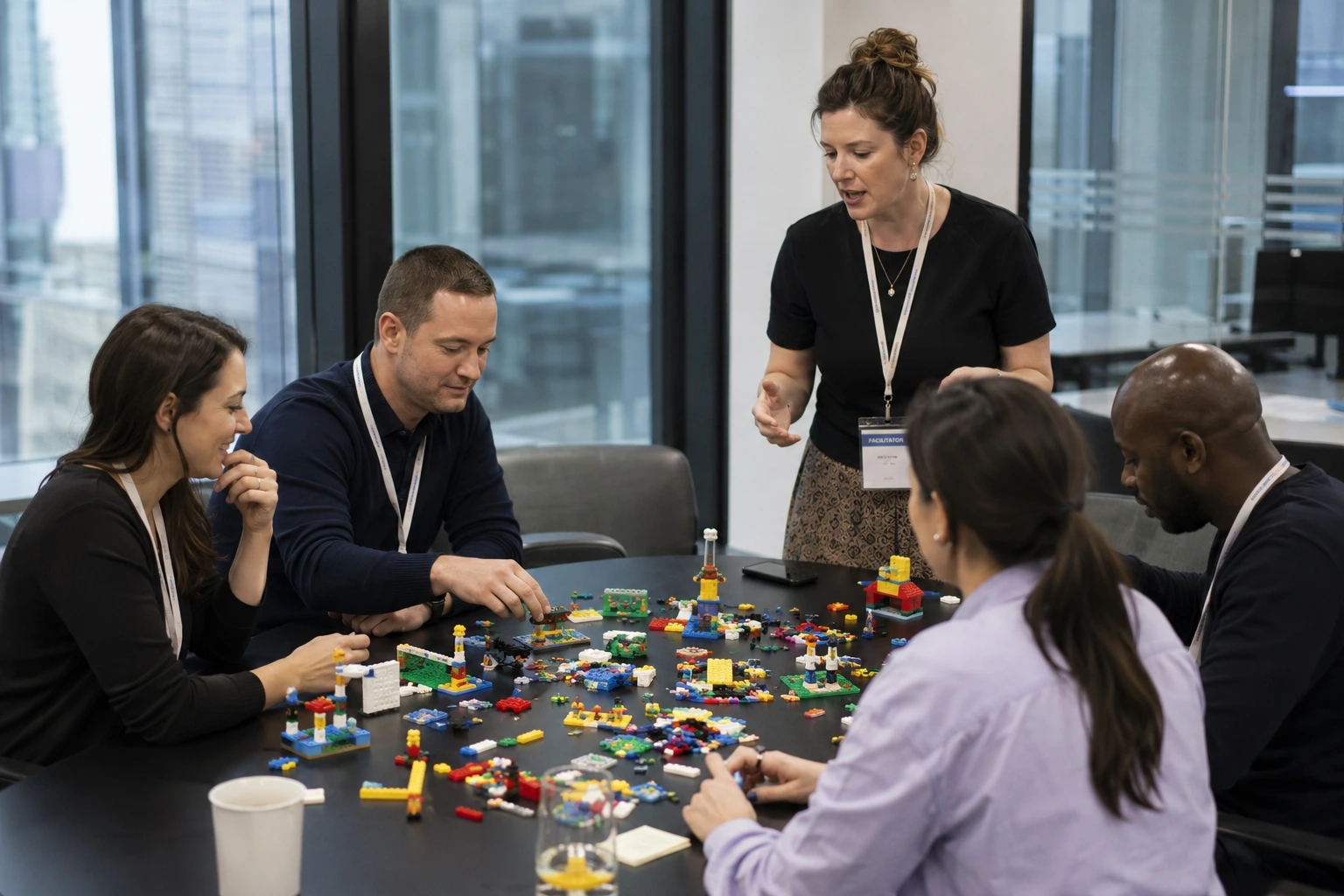
Why Traditional Alignment Workshops Often Fail
Traditional alignment workshops often fail because the format privileges verbal confidence over reflective thinking. Extroverted participants dominate discussion while quieter participants with critical insights contribute less frequently.
Participation drops in conventional workshops because the format rewards confidence and rank over depth of thought, which leads to decisions reflecting hierarchy instead of collective intelligence.
Conventional workshop structures also struggle with abstraction. Teams discuss concepts like trust, innovation, leadership, or accountability without creating a shared representation of meaning.
Without visible representations, strategic discussions remain vulnerable to interpretation drift. Participants leave meetings believing consensus exists even when underlying assumptions differ substantially.
Another limitation involves cognitive overload. Senior teams often attempt to resolve strategic complexity through presentations and discussion alone. Human cognition processes visual and tactile information differently from verbal information, which means conventional meetings frequently fail to engage deeper reflection.
Traditional strategic planning processes frequently produce documentation without generating shared understanding.
The LEGO® SERIOUS PLAY® Method addresses this limitation by helping participants think through the hands. To understand the full methodology foundation behind this process, review “The LEGO® Serious Play® Method explained” at Serious Play Business.
The Cognitive Foundation Behind LEGO® SERIOUS PLAY®
The LEGO® SERIOUS PLAY® Method is a structured strategic facilitation methodology that uses metaphorical model building to improve reflection, participation, and shared understanding. The methodology operates on the principle that constructing physical models activates different cognitive pathways than discussion alone.
Thinking through the hands improves strategic reflection because participants externalize abstract assumptions into visible forms that groups can collectively analyze.
The methodology emphasizes 100% participation, which changes group dynamics significantly compared with presentation-based workshops. Every participant builds, explains, reflects, and contributes.
In leadership development contexts, the method creates psychologically safer participation environments because the model becomes the object of discussion rather than the individual. This reduces defensive communication patterns and encourages deeper exploration.
The process typically follows a four-step sequence:
- The facilitator prompts the challenge
- Participants build models individually
- Participants share the meaning of their models
- The group reflects on emerging patterns and relationships
The methodology also supports systems thinking. Participants can create System Models showing relationships between culture, leadership behavior, customer expectations, decision flows, and operational barriers.
Serious Play Business frequently applies these approaches in enterprise alignment environments where leadership teams must navigate uncertainty, transformation, or structural complexity.
How LEGO® SERIOUS PLAY® Supports Organizational Alignment Workshops
Organizational alignment workshops using LEGO® SERIOUS PLAY® create clarity by making invisible assumptions visible. Rather than debating abstract strategic language, participants build representations of priorities, barriers, relationships, and organizational realities.
When teams build shared landscapes, contradictions become easier to identify because the organization’s competing forces appear visually and structurally.
The methodology improves organizational alignment in several ways:
Shared Understanding
Participants define strategic concepts collaboratively rather than assuming common interpretation.
Equalized Participation
Structured building cycles reduce hierarchy-driven discussion dominance.
Systems Visibility
Interdependent forces become visible through shared models and relationship mapping.
Decision Clarity
Teams identify conflicting assumptions before implementation begins.
Memory Retention
Participants retain insights more effectively because physical model interaction increases engagement.
Organizations using strategic facilitation approaches built around shared modeling frequently report stronger workshop retention and faster implementation momentum within 30–90 days.
As part of facilitator certification journeys, professionals learn how to guide Build Levels, reflection sequencing, and landscape construction without reducing the methodology to entertainment or icebreaker activity.
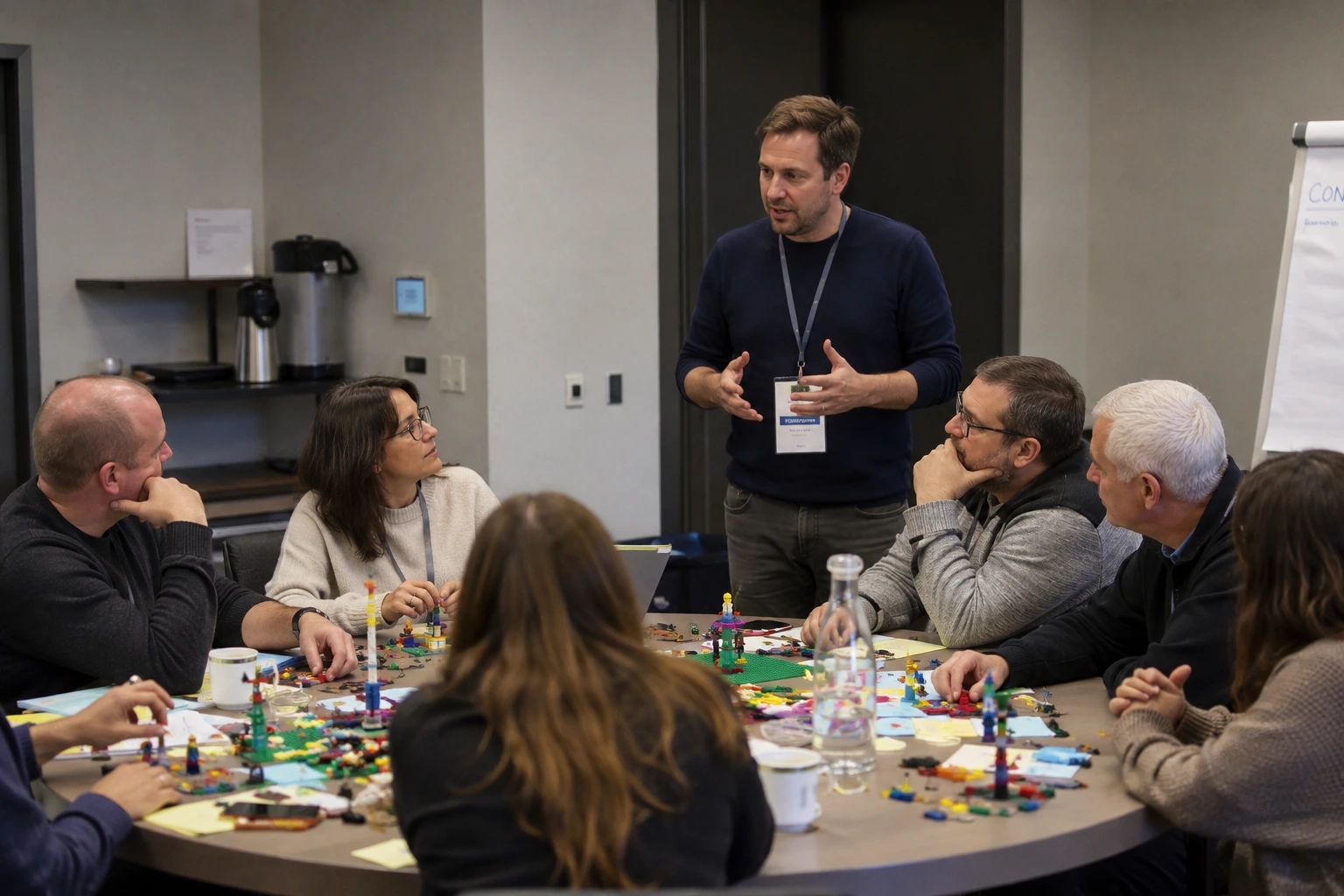
Workshop Example: Organizational Alignment Workshop Structure
Below is a reference structure commonly used in organizational alignment workshops.
Click the ‘+’ button below to explore the detailed workshop stages.
1. Strategic Challenge Framing & 2. Shared Meaning Exploration
Step 1 — Strategic Challenge Framing (20–30 minutes): The facilitator prompts participants to define the organization’s current strategic tension. Participants build silent individual models representing perceived organizational priorities. The facilitator prompts reflection using questions such as: What pressure shapes current decision-making? Where does strategic confusion appear most often? Which organizational assumptions remain unspoken?
Step 2 — Shared Meaning Exploration (30–45 minutes): Participants explain the meaning behind their models while the group listens without interruption. The facilitator identifies recurring themes, structural contradictions, and language inconsistencies. Participants often discover that departments attach different meanings to the same strategic terminology.
3. System Model Construction & 4. Future-State Alignment Mapping
Step 3 — System Model Construction (45–60 minutes): The group combines individual models into a shared landscape representing organizational interdependencies. Connections between teams, incentives, communication flows, and customer outcomes become visible. The facilitator prompts participants to identify: feedback loops, structural constraints, leadership bottlenecks, alignment enablers, and operational risks.
Step 4 — Future-State Alignment Mapping (30–45 minutes): Participants modify the shared model to represent an aligned future state. The facilitator guides discussion around what structural shifts must occur for alignment to strengthen. Future-state modeling improves implementation readiness because teams visualize operational consequences before launching initiatives.
5. Action Prioritization and Commitments
Step 5 — Action Prioritization and Commitments (20–30 minutes): Participants identify specific organizational actions, ownership structures, and communication priorities emerging from the workshop. The facilitator closes by connecting workshop insights to ongoing strategic facilitation and leadership accountability processes.
Comparing LEGO® SERIOUS PLAY® With Conventional Strategy Workshops
Traditional strategy workshops prioritize discussion, presentation, and verbal consensus. LEGO® SERIOUS PLAY® prioritizes reflection, model building, and shared meaning construction.
Conventional workshops often generate superficial agreement because participants avoid exposing uncertainty publicly.
LEGO® SERIOUS PLAY® workshops create stronger organizational alignment because shared models expose hidden assumptions that verbal conversations frequently leave unresolved.
Traditional formats frequently produce passive participation patterns:
- Senior voices dominate
- Reflective thinkers contribute less
- Ambiguity remains hidden
- Organizational tensions remain abstract
By contrast, structured strategic facilitation using shared modeling encourages equal contribution, deeper listening, and visible systems analysis.
Organizations looking to hire a facilitator increasingly seek methodologies capable of handling complexity rather than simply energizing participants temporarily.
Outcomes and Strategic Relevance
Organizational alignment workshops generate value when insights translate into operational behavior and decision consistency.
Effective workshops commonly produce:
Clearer Strategic Priorities
Teams develop stronger shared interpretation of enterprise direction.
Faster Cross-Functional Decisions
Visible assumptions reduce clarification cycles and repeated debate.
Improved Leadership Communication
Leadership teams gain shared language around organizational priorities.
Earlier Conflict Identification
Competing incentives become visible before implementation breakdowns occur.
Stronger Accountability Structures
Teams clarify ownership relationships and decision responsibilities.
Leadership teams strengthen organizational resilience when communication systems, incentives, and operational structures reinforce the same strategic direction.
Organizations frequently discover that alignment problems are systemic rather than interpersonal because structural ambiguity shapes behavior across the enterprise.
Serious Play Business supports organizations globally through strategic facilitation, facilitator certification, and leadership workshop design focused on measurable organizational outcomes.
Transform Your Strategy Conversations
To understand the full methodology behind every workshop described in this article, explore how LEGO® SERIOUS PLAY® transforms organizational alignment at Serious Play Business.
To understand the full methodology behind the workshop design described above, read understanding LEGO® Serious Play® in organizations.
Frequently Asked Questions
What are organizational alignment workshops?
Organizational alignment workshops are structured facilitation sessions designed to help leadership teams create shared understanding around priorities, communication, and strategic execution.
How do organizational alignment workshops use LEGO® SERIOUS PLAY®?
Organizational alignment workshops use LEGO® SERIOUS PLAY® by helping participants build metaphorical models representing organizational realities, strategic tensions, and operational relationships.
Why do traditional strategy workshops fail?
Traditional strategy workshops fail because discussion-based formats often leave assumptions invisible, which creates false consensus and weak implementation clarity.
What is the LEGO® SERIOUS PLAY® Method?
The LEGO® SERIOUS PLAY® Method is a structured facilitation methodology that uses model building, storytelling, reflection, and systems thinking to improve organizational communication and strategic insight.
How does facilitator certification improve workshop quality?
Facilitator certification improves workshop quality because trained facilitators learn how to sequence prompts, guide reflection, manage systems mapping, and maintain methodological integrity.