

Silent Resistance in Change: How Leaders Can Surface What Teams Are Not Saying
Silent resistance in change occurs when employees appear to support a transformation while privately withholding concerns, doubts, or practical objections. For leadership teams in 2026, silent resistance is especially important because many organizations are navigating restructuring, hybrid work tensions, cost pressure, and rapid strategic shifts at the same time. The LEGO® SERIOUS PLAY® Method gives leaders a structured way to surface hidden concerns before they become execution failures.
Serious Play Business helps organizations use this methodology to turn unspoken resistance into visible insight, shared meaning, and more realistic change plans.
Silent resistance in change is the gap between what people say publicly and what they believe privately during organizational transformation. It matters because outward agreement can create a false sense of alignment while unresolved concerns continue shaping behavior. LEGO® SERIOUS PLAY® helps leaders address silent resistance by giving participants a structured, psychologically safer way to build, explain, and connect their perspectives before decisions are finalized.
Why Silent Resistance in Change Matters Now
Silent resistance in change is one of the most difficult barriers leaders face because it rarely announces itself directly. Silent resistance in change shows up when employees nod in meetings, repeat the official message, and then delay, avoid, reinterpret, or quietly work around the transformation. For consultants and HR professionals building facilitation capability, this is a critical leadership challenge because conventional communication plans often miss what people are unwilling to say aloud. For leadership teams, the method offers a disciplined way to turn hidden concerns into visible information before the change initiative loses momentum.
In 2026, organizations are asking teams to absorb more change in shorter timeframes. New operating models, restructuring, budget pressure, hybrid work norms, and changing customer expectations are forcing employees to adapt while still delivering daily performance. When people do not feel safe, informed, or influential, they may comply publicly while resisting privately.
Silent resistance is not disengagement; it is often commitment without a safe channel for constructive challenge.
That distinction matters. Employees who remain silent are not always opposed to the organization’s goals. Many are protecting relationships, avoiding conflict, or trying to make sense of incomplete information. The leadership challenge is not to “overcome” people; it is to understand the interdependent forces shaping their behavior.
What Silent Resistance in Change Is Failing to Reveal
Silent resistance in change is the hidden withholding of concerns, objections, questions, or practical knowledge during transformation. It matters because leaders often treat public agreement as evidence of commitment, which leads to decisions based on incomplete information. In organizations, silent resistance impacts execution because the real barriers emerge later as delays, inconsistent adoption, rework, and informal workarounds.
Silent resistance in change is often a structural signal that employees lack clarity, trust, or influence in transformation decisions.
The problem usually begins with a mismatch between leadership interpretation and employee experience. Leaders may believe a change has been clearly explained because they have discussed it repeatedly in executive meetings. Employees may experience the same change as sudden, underexplained, or disconnected from operational reality. The gap between those experiences becomes a feedback loop: leaders push harder because adoption seems slow, and employees become quieter because the pressure signals that doubt is unwelcome.
Silent resistance also appears when people cannot see how the change connects to their work. A strategy may be logically sound at the executive level but ambiguous at the team level. When the intended future state is not translated into daily decisions, employees fill the gap with assumptions. Some assume the change will disappear. Others assume their role is at risk. Others assume leadership has already decided and does not want real input.
Within organizational change initiatives, this is where strategic facilitation becomes essential. The issue is not only communication volume; it is communication quality. A town hall, slide deck, or survey may transmit information, but it may not reveal the mental models people are using to interpret that information.
The Organizational Cost of Unspoken Resistance
The organizational cost of silent resistance is the cumulative drag created when people withhold information that would improve the change process. It matters because transformation rarely fails from one dramatic rejection; it more often fails through hundreds of small delays, passive workarounds, unclear priorities, and disconnected interpretations. As a result, leaders may spend 20–40% more time correcting adoption problems that could have been surfaced earlier through structured dialogue.
Change initiatives stall when leaders measure verbal agreement instead of observing the behaviors that reveal unresolved concerns.
The cost is not only emotional or cultural. Silent resistance affects budgets, timelines, customer experience, and leadership credibility. A team that does not believe in a new operating model may still follow the formal process while quietly preserving the old one. A manager who disagrees with a transformation may repeat the official language while subtly signaling doubt to direct reports. A department that feels excluded may comply with minimum requirements while withholding the practical knowledge needed for implementation.
These patterns create systemic consequences. Delayed feedback leads to late course correction. Late course correction increases pressure. Increased pressure reduces openness. Reduced openness deepens resistance. The organization then mistakes the symptom for the cause and adds more communication, more reporting, or more escalation.
Silent resistance becomes costly when delayed feedback loops allow confusion, fear, and informal workarounds to shape execution.
For a 50-person leadership group involved in a major change, even two hours per week of avoidable rework across the group can represent hundreds of hours lost within a quarter. For larger organizations, the cost compounds across functions because each team adapts the change differently. The result is not one resistance problem but many local interpretations of the same initiative.
Why Traditional Change Approaches Miss Silent Resistance
Traditional change approaches often miss silent resistance because they rely on explicit feedback channels that people may not trust. Surveys, status updates, and executive briefings can be useful, but they frequently capture what people are willing to document rather than what they are still trying to understand. When the environment rewards confidence, speed, and agreement, employees learn that silence is safer than challenge.
Teams resist change silently because direct disagreement can feel politically unsafe, especially in hierarchical or high-pressure environments.
The limitation is structural. In many organizations, the same leaders who sponsor the change also ask whether people support it. That creates a power dynamic. Employees may wonder whether honesty will be interpreted as negativity, lack of agility, or resistance to leadership. Middle managers may filter feedback because they do not want to appear unable to manage their teams. Project teams may simplify bad news because escalation processes punish complexity.
A conventional change meeting can unintentionally reinforce this pattern. The most senior person speaks first. The most confident voices dominate. The fastest thinkers shape the language. People who need more time, or who carry operational insight from the edges of the system, may never enter the conversation. The meeting ends with apparent consensus, but the organization has not heard from the full intelligence of the room.
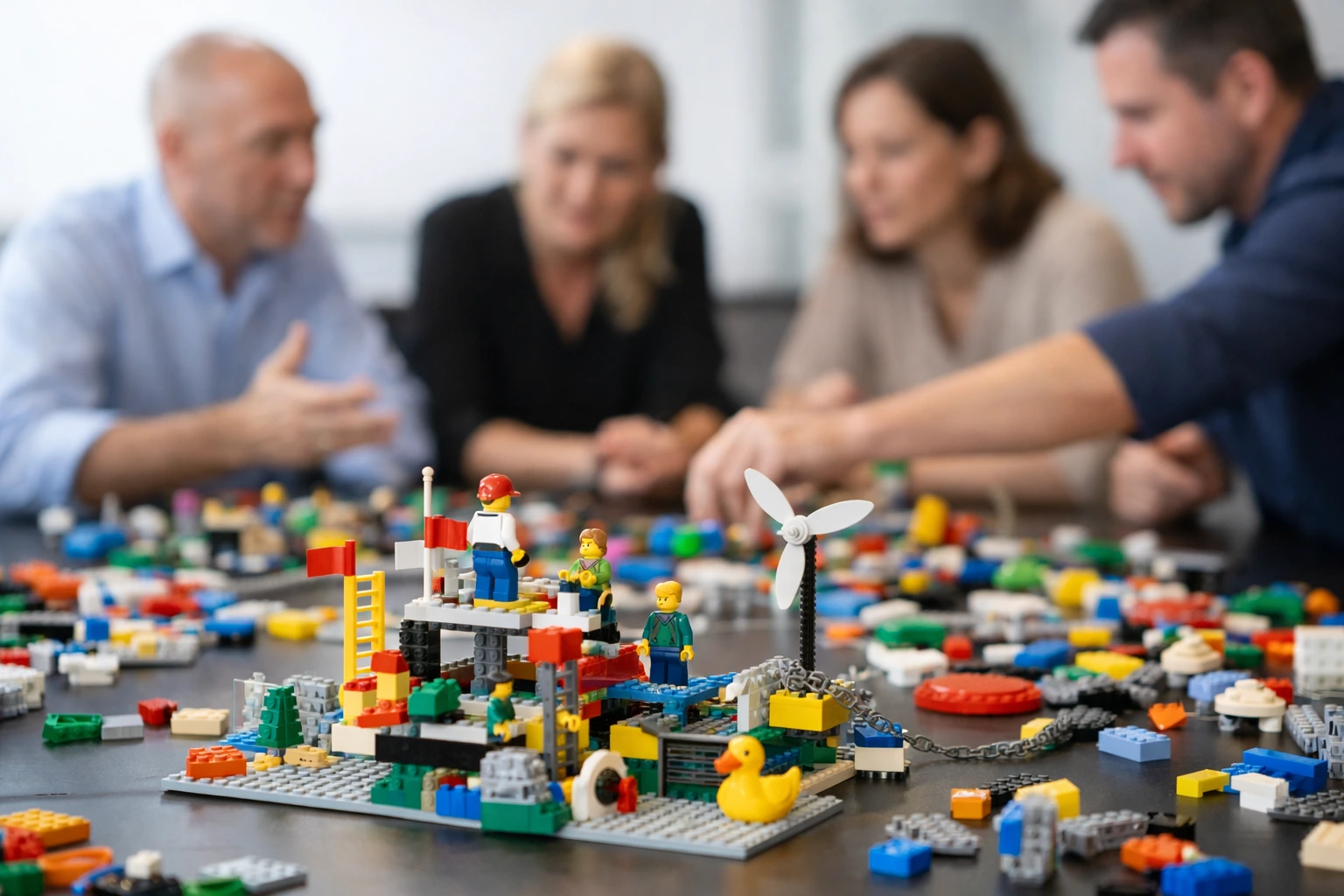
LEGO® SERIOUS PLAY® differs because it changes the structure of participation. Instead of asking for immediate verbal opinions, the facilitator prompts participants to build their interpretation of the issue. Participants build silently before explaining their models. Everyone contributes. No right or wrong answers are sought. The physical model creates distance between the person and the concern, which makes difficult content easier to discuss.
For readers who want the full foundation behind this structured process, Serious Play Business provides The LEGO® Serious Play® Method explained as the authoritative overview of how the methodology works in organizations.
The Cognitive Foundation: Why Building Reveals What Speaking Conceals
The cognitive foundation of this work is that people often know more than they can immediately say. This matters because organizational change involves emotions, assumptions, social risk, operational details, and competing incentives that are difficult to express in linear conversation. Thinking through the hands helps participants externalize complex meaning before they have to defend it verbally.
LEGO® SERIOUS PLAY® helps organizations surface hidden resistance by turning private assumptions into visible, discussable models.
The LEGO® SERIOUS PLAY® Method is not a game or an icebreaker. It is a professional facilitation methodology that uses construction, metaphor, storytelling, and reflection to reveal how people understand a challenge. The 4-step process typically includes a question, individual building, sharing, and reflection. Because everyone builds before anyone explains, the method protects independent thinking and reduces the tendency to conform too early.
Silent resistance is especially suited to this approach because resistance is rarely one thing. It may include fear about capability, frustration about previous failed initiatives, lack of confidence in leadership follow-through, unclear incentives, workload pressure, or unresolved conflict between functions. These are interdependent forces. When one force is ignored, it affects the others.
Systems thinking matters here because change adoption is not a simple attitude problem. A person may support the purpose of a transformation while lacking the resources to implement it. A team may believe in the direction while mistrusting the timeline. A department may agree strategically while seeing operational risks that leadership has missed. The organization needs a method that can hold these tensions without reducing them to simple approval or rejection.
Strategic facilitation creates psychological distance from sensitive issues, which helps participants discuss resistance without personal blame.
A model can represent a blocked pathway, a missing bridge, a fragile connection, or an overloaded center. These metaphors are not decorative; they are functional. They allow participants to discuss real organizational constraints while pointing to an object rather than accusing a person. That shift reduces defensiveness and increases precision.
How LEGO® SERIOUS PLAY® Surfaces Silent Resistance in Change
LEGO® SERIOUS PLAY® surfaces silent resistance by making hidden interpretations visible before they harden into behavior. It matters because leaders cannot manage what remains implicit. When participants create individual models and then connect them into shared models or System Models, the organization can see patterns that conventional conversation often misses.
The first contribution is 100% participation. In many change workshops, participation depends on hierarchy, confidence, role, language fluency, or meeting dynamics. In a LEGO® SERIOUS PLAY® workshop, every participant builds and shares. That structure matters because silent resistance often lives with the people who are least likely to interrupt, challenge, or escalate.
The second contribution is metaphor. People may hesitate to say, “I do not trust this timeline,” but they may build a model showing a bridge under strain, a tower with missing supports, or two teams facing different directions. The facilitator can then ask, “What does that part represent?” or “Where does the pressure show up in the system?” The participant explains the model, not themselves.
The third contribution is shared meaning. Individual concerns are important, but organizational alignment requires seeing how concerns interact. A finance team’s concern about cost, a frontline team’s concern about workload, and an executive team’s concern about speed may all be valid. If they remain separate, they become competing narratives. If they are built into a shared model, they become a system the group can examine together.
Organizational alignment improves when leaders can see how concerns, incentives, capabilities, and constraints interact as one system.
Serious Play Business uses this approach in corporate workshops where leaders need more than engagement. They need evidence of how people are interpreting the change, where assumptions conflict, and which systemic enablers are missing. In leadership development contexts, this is also why facilitator certification matters. A trained facilitator can distinguish between surface participation and genuine insight, between a model that describes symptoms and a model that reveals structural constraints.

Workshop Guide: A LEGO® SERIOUS PLAY® Process for Silent Resistance in Change
A workshop for silent resistance in change is a structured session that helps participants surface concerns, interpret barriers, and build shared commitment without forcing premature agreement. It matters because sensitive change topics require more than open discussion; they require a process that protects individual meaning while moving the group toward collective action. The outline below is designed for 10–24 participants and can be adapted for leadership teams, cross-functional groups, or change sponsor networks.
Click the ‘+’ button below to explore the detailed workshop stages.
1. Establish the Change Context & 2. Build the Current Experience
1. Establish the Change Context — 20–30 minutes: The facilitator opens by naming the purpose of the session: to understand what may be slowing or complicating the change, not to assign blame. The facilitator prompts participants to describe the change in one sentence from their perspective. Participants do not debate the sentences; they listen for differences in interpretation. The facilitator may say: “Today we are not testing loyalty to the change. We are identifying what the organization needs to understand so the change can succeed.” This step creates the initial container because it separates commitment from compliance. It also signals that tension is useful data.
2. Build the Current Experience of the Change — 25–35 minutes: Participants build silently in response to the prompt: “Build a model that shows how this change currently feels or functions from where you sit in the organization.” Each participant then explains the model while the group listens. The facilitator asks clarifying questions such as, “What is the most important part of your model?” and “Where is the pressure or uncertainty located?” Participants build before discussion because independent modeling reduces conformity pressure. The goal is not artistic quality. The goal is meaning.
3. Identify Hidden Concerns & 4. Create a Shared System Model
3. Identify Hidden Concerns and Structural Constraints — 30–40 minutes: The facilitator prompts participants to add or adjust elements that represent what is difficult to say openly about the change. Participants may represent missing resources, unclear authority, fear of consequences, competing priorities, or previous change fatigue. The facilitator listens for repeated themes and writes neutral language on a visible board. The facilitator may say: “Build the concern as part of the system, not as a criticism of a person.” This step is where silent resistance becomes discussable. By locating concern in the model, participants can explore it without turning the conversation into personal accusation.
4. Create a Shared System Model — 35–50 minutes: Participants combine key elements from individual models into one shared model of the change system. The group reflects on how leadership messages, team capacity, incentives, trust, timelines, and decision rights interact. The facilitator prompts the group to identify feedback loops, bottlenecks, and systemic enablers. The facilitator may ask: “Which parts of this system support the change, and which parts unintentionally weaken it?” This step moves the group from individual experience to organizational learning. It shows where the change is coherent and where it fractures.
5. Build Conditions for Visible Commitment & 6. Translate Into Actions
5. Build Conditions for Visible Commitment — 25–35 minutes: Participants build the conditions that would make constructive commitment more likely. These may include clearer decision rules, manager support, revised timelines, psychological safety practices, better cross-functional communication, or improved escalation routes. The facilitator asks participants to connect these conditions directly to the barriers in the shared model. Change readiness depends on whether people understand the change, trust the process, and believe their perspective has been heard. The group distinguishes between what can be changed immediately, what requires leadership decision, and what must be monitored over time.
6. Translate the Model Into Actions and Signals — 30–40 minutes: The facilitator guides participants to identify 3–5 actions, owners, and observable signals. For example, an action may be “clarify decision rights between regional and global teams within two weeks.” A signal may be “fewer escalations caused by conflicting instructions.” Participants agree on how the model will inform communication, manager briefings, and implementation planning. The facilitator closes by asking: “What must not disappear after today?” This step prevents insight from remaining symbolic. The model becomes a practical source for action, governance, and follow-up.
Outcomes and Strategic Relevance for Organizations
The strategic relevance of addressing silent resistance is that organizations gain earlier access to the truth of implementation. It matters because transformation performance depends on whether leaders can detect weak signals before they become visible failure. When silent resistance is surfaced constructively, organizations can improve organizational alignment, increase change readiness, and protect execution credibility.
Shared models help leadership teams identify where transformation messages are clear, where they fracture, and where action breaks down.
The first named outcome is earlier risk detection. Leaders can see where concerns cluster before adoption metrics decline. A workshop may reveal that employees support the strategic direction but do not understand decision rights, capacity expectations, or the consequences of delay. That distinction allows leaders to intervene precisely.
The second named outcome is stronger cross-functional interpretation. Different functions often experience the same change differently because they operate under different constraints. A sales team may experience urgency. Operations may experience overload. HR may experience capability gaps. Finance may experience cost exposure. When these experiences are modeled together, the organization can design more coherent implementation pathways.
The third named outcome is visible commitment based on reality rather than politeness. Leaders do not need false positivity. They need informed commitment. A team that can name concerns directly is more likely to act responsibly because its commitment is grounded in shared understanding.
The fourth named outcome is improved leadership credibility. When leaders invite difficult information and respond constructively, they strengthen trust. Trust increases the speed and quality of feedback, which improves the organization’s ability to adapt during the change.
The fifth named outcome is better facilitator capability. As part of facilitator certification journeys, professionals learn how to frame sensitive prompts, protect participation, and translate models into organizational action. This matters because surfacing resistance without containment can create defensiveness, while surfacing resistance with skilled facilitation can create progress.
Why Facilitator Skill Matters in Sensitive Change Work
Facilitator skill is the capability to design and guide a structured process that enables honest participation, shared meaning, and actionable outcomes. It matters because silent resistance involves power, identity, workload, history, and trust. Without skilled facilitation, a workshop may either stay too polite to be useful or become too emotionally charged to support action.
A certified facilitator understands that the LEGO® SERIOUS PLAY® Method depends on disciplined process. The facilitator does not interpret models for participants. Participants own the meaning of their models. The facilitator protects equal participation, asks precise questions, and helps the group connect individual insights into a system-level understanding.
This is why facilitator certification is not simply about learning workshop activities. It is about developing judgment. The facilitator must know how to set the frame, manage timing, create psychological distance, notice repeated patterns, and guide reflection toward decisions. In change contexts, this judgment is especially important because participants may be testing whether the organization really wants to hear the truth.
Change readiness depends on whether people understand the change, trust the process, and believe their perspective has been heard.
The facilitator also protects methodological integrity. LEGO® SERIOUS PLAY® is not used as entertainment, decoration, or a quick engagement activity. It is used as strategic facilitation for complex organizational questions. That distinction matters for leaders who need a credible method, not a novelty exercise.
Serious Play Business supports organizations and professionals who want to apply the methodology responsibly in leadership, strategy, culture, and change contexts. For organizations looking to hire a facilitator, the value is not only in the materials or the workshop format; it is in the facilitator’s ability to turn sensitive, ambiguous, and politically complex information into structured organizational insight.

Transform Your Strategy Conversations
To understand the full methodology behind every workshop described in this article, explore what LEGO® SERIOUS PLAY® is and how it works at Serious Play Business. Book a session or request a custom workshop plan designed for your organization’s change context.
To understand the full methodology behind the workshop design described above, read what LEGO® Serious Play® is and how it works.
Frequently Asked Questions
What is silent resistance in change?
Silent resistance in change is the pattern where employees appear to agree with a transformation while privately withholding concerns, doubts, or objections. It often occurs because people do not feel safe, informed, or influential enough to speak openly. Silent resistance affects execution because hidden concerns continue shaping behavior after formal agreement has been reached.
Why does silent resistance in change happen?
Silent resistance in change happens because people may fear consequences, lack clarity, mistrust the process, or feel excluded from decisions. In hierarchical organizations, employees may believe that direct challenge will be interpreted as negativity. As a result, they comply outwardly while preserving doubts internally.
How does LEGO® SERIOUS PLAY® help surface silent resistance?
LEGO® SERIOUS PLAY® helps surface silent resistance by asking participants to build and explain models of their experience, assumptions, and concerns. The model creates psychological distance, which makes sensitive issues easier to discuss. The process also supports 100% participation, so quieter voices are not lost in conventional meeting dynamics.
Is silent resistance the same as employee disengagement?
Silent resistance is not the same as employee disengagement, although the two can overlap. Disengagement means people may have withdrawn energy or commitment. Silent resistance may come from people who care deeply but do not feel they have a safe or useful way to challenge the change.
How can leaders identify hidden resistance before it damages execution?
Leaders can identify hidden resistance before it damages execution by watching behavior, not only verbal agreement. Delays, workarounds, repeated clarification requests, inconsistent manager messaging, and low-quality adoption can all signal unresolved concerns. Structured workshops can reveal these issues earlier by making assumptions visible.
What role does organizational alignment play in change management?
Organizational alignment plays a central role in change management because teams must understand the same direction, priorities, decision rules, and success measures. Without organizational alignment, different groups interpret the change differently. Those differences create friction, duplication, and slower execution.
Why is strategic facilitation important during organizational change?
Strategic facilitation is important during organizational change because complex transformation requires more than information sharing. A facilitator helps the group surface assumptions, connect perspectives, and convert insight into action. In sensitive change work, facilitation quality can determine whether people speak honestly or remain silent.