
LEGO® SERIOUS PLAY® Certification: What It Means, What It Does Not Mean, and Why It Matters in 2026
Organizations increasingly rely on facilitated dialogue to solve alignment, innovation, and leadership challenges. As demand grows, many professionals encounter LEGO® SERIOUS PLAY® certification but remain unclear about what it actually represents, what capabilities it develops, and how it differs from common misconceptions surrounding facilitator credentials.
This guide explains what LEGO® SERIOUS PLAY® certification is, what it teaches, what it explicitly does not mean, and why skilled facilitation has become a measurable driver of organizational alignment. The aim is clarity — separating credential marketing from the genuine facilitation capability that makes a workshop work.
LEGO® SERIOUS PLAY® certification develops the capability to design and facilitate structured workshops that surface assumptions, increase participation, and create shared understanding across organizations. It is a facilitation competency — not a product license, and not a guarantee of expertise on its own.
What Is LEGO® SERIOUS PLAY® Certification?
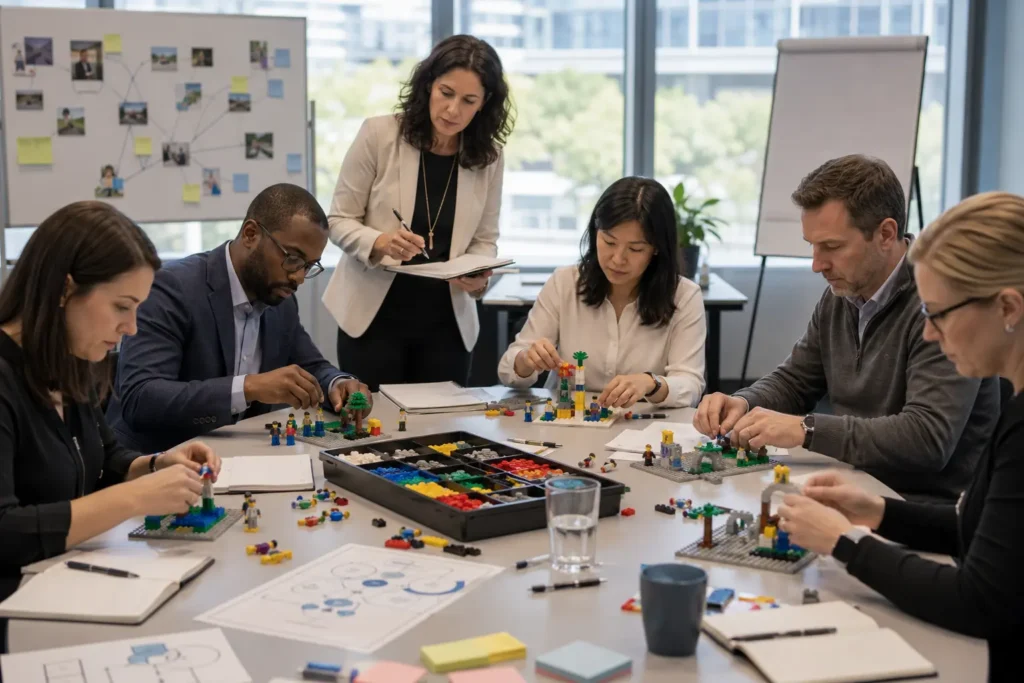
LEGO® SERIOUS PLAY® certification is recognition that a facilitator has been trained in the LEGO® SERIOUS PLAY® method and can apply it to lead structured, hands-on workshops. The point of the credential is not the building bricks and not a syllabus checklist — it is the ability to design and run sessions in which every participant builds, explains, and connects ideas through three-dimensional models rather than through open discussion alone.
A Capability, Not a Course Feature
Most certification pages describe what a course includes: the hours, the modules, the kit, the schedule. Those details matter, but they describe the container, not the result. The actual outcome of certification is a facilitation capability — the trained ability to structure a question, prompt individual builds, draw out meaning, and guide a group toward a shared model they all helped create.
What the Credential Represents
A LEGO® SERIOUS PLAY® certification signals that a facilitator understands the method’s underlying logic and can apply it with intent: framing the right challenge, sequencing the build, and managing the conversation so that quieter voices contribute as fully as dominant ones. It represents readiness to facilitate — a starting point for real practice, not a finishing line.
Why Organizations Need More Skilled Facilitators
The cost of poor facilitation is rarely visible on a balance sheet, but leaders feel it constantly: meetings that circle the same points, decisions that stall, and “alignment” that evaporates the moment people leave the room. The pattern is almost always the same — a few confident voices dominate, important assumptions stay unspoken, and the group commits to a plan that not everyone actually understands.
In many unstructured workshops it is common to see a small subset of participants capture the majority of the airtime — frequently in the range of 60–75% — while the rest stay quiet or defer. That participation imbalance has a downstream effect: decisions get delayed as unspoken disagreement surfaces later, sometimes adding weeks to a timeline that should have closed in a single session. Skilled facilitation exists precisely to close that gap.
When participation is uneven, the room does not reach consensus — it reaches the opinion of whoever spoke most. Structured facilitation replaces that with input from everyone.
What LEGO® SERIOUS PLAY® Certification Actually Teaches
Certification training develops a specific set of facilitation skills built around how people think when their hands are involved. These are the core capabilities a certified facilitator learns to apply.
Thinking Through the Hands
The method is built on the principle that people articulate ideas more honestly and completely when they build a model first and explain it second. Certification teaches facilitators how to pose challenges that turn abstract questions — about strategy, culture, or risk — into something a participant can construct and describe.
Shared Models and 100% Participation
A defining feature of the method is that everyone builds, and everyone speaks to what they built. Certification teaches the techniques that make full participation the default rather than the exception, and that guide individual models into a single shared model the whole group owns. This is where strategic facilitation and systems thinking come together — helping a group see not just individual views, but how those views connect into one picture of the organization.
The capability itself rests on the method’s underlying logic. For a full explanation of the principles behind the workshops described here, read The LEGO® Serious Play® Method Explained.
What LEGO® SERIOUS PLAY® Certification Does Not Mean
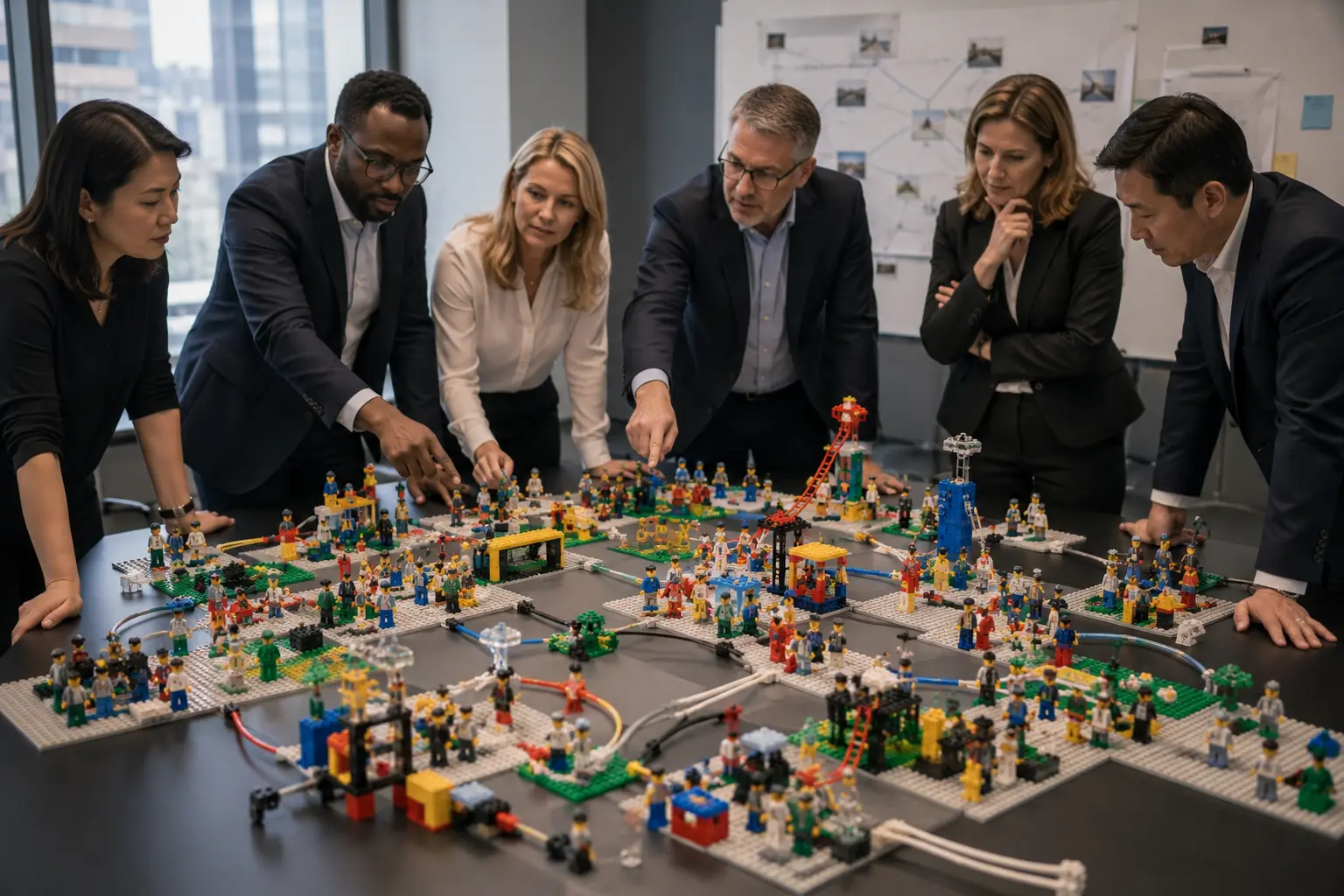
This is the part most certification pages skip, and it is the part that protects both facilitators and the organizations that hire them. Being clear about the limits of the credential is what makes the credential credible.
It Is Not LEGO Group Certification
Certification in the method does not mean a facilitator has been certified, employed, or endorsed by the LEGO Group. LEGO® SERIOUS PLAY® is a facilitation methodology; completing training in it does not create an official relationship with the toy manufacturer or imply its sponsorship of a facilitator’s work.
It Is Not a License or a Guarantee of Expertise
Certification is not a regulatory license, and it does not, by itself, make someone an expert. It confirms that a facilitator has been trained in the method. Real expertise comes from running sessions repeatedly — reading a room, recovering when a build stalls, and adapting the design to the challenge in front of them. A certificate is the beginning of that journey, not proof of its completion.
A credential confirms training. Competence is earned in the room — through repeated, reflective facilitation practice.
It Does Not Make Workshops Succeed Without Practice
No certification removes the need to prepare and practice. A strong workshop depends on a well-framed challenge, a sound sequence, and a facilitator who can hold the process steady when a group goes quiet or goes off-track. Certification gives a facilitator the tools; practice is what turns those tools into reliable outcomes.
Traditional Facilitation vs LEGO® SERIOUS PLAY® Facilitation
The clearest way to understand what certification develops is to compare a conventional workshop with a LEGO® SERIOUS PLAY® workshop. The difference is not the bricks — it is what the format does to participation, assumptions, and shared understanding.
| Traditional Workshop | LEGO® SERIOUS PLAY® Workshop |
|---|---|
| Verbal discussion | Model-based thinking |
| Partial participation | 100% participation |
| Hidden assumptions | Visible assumptions |
| Individual perspectives | Shared models |
How Facilitator Certification Improves Organizational Alignment
Alignment problems are rarely caused by a lack of intelligence or goodwill. They are caused by assumptions that stay invisible — people agreeing to words while quietly disagreeing about what those words mean. A certified facilitator’s core job is to make those assumptions visible so a team can resolve them deliberately rather than discover them mid-execution.
That capability connects directly to the work leaders care about. In leadership and culture, it surfaces the unspoken priorities that pull a team in different directions. In innovation and change, it gives every contributor a way to put an idea on the table, not just the most senior or vocal people. And in strategy, it turns a list of individual opinions into a single shared model the team can commit to and act on together.
When assumptions are built into a shared model, disagreement becomes visible and discussable — instead of staying hidden until execution fails.
A LEGO® SERIOUS PLAY® Workshop in Practice
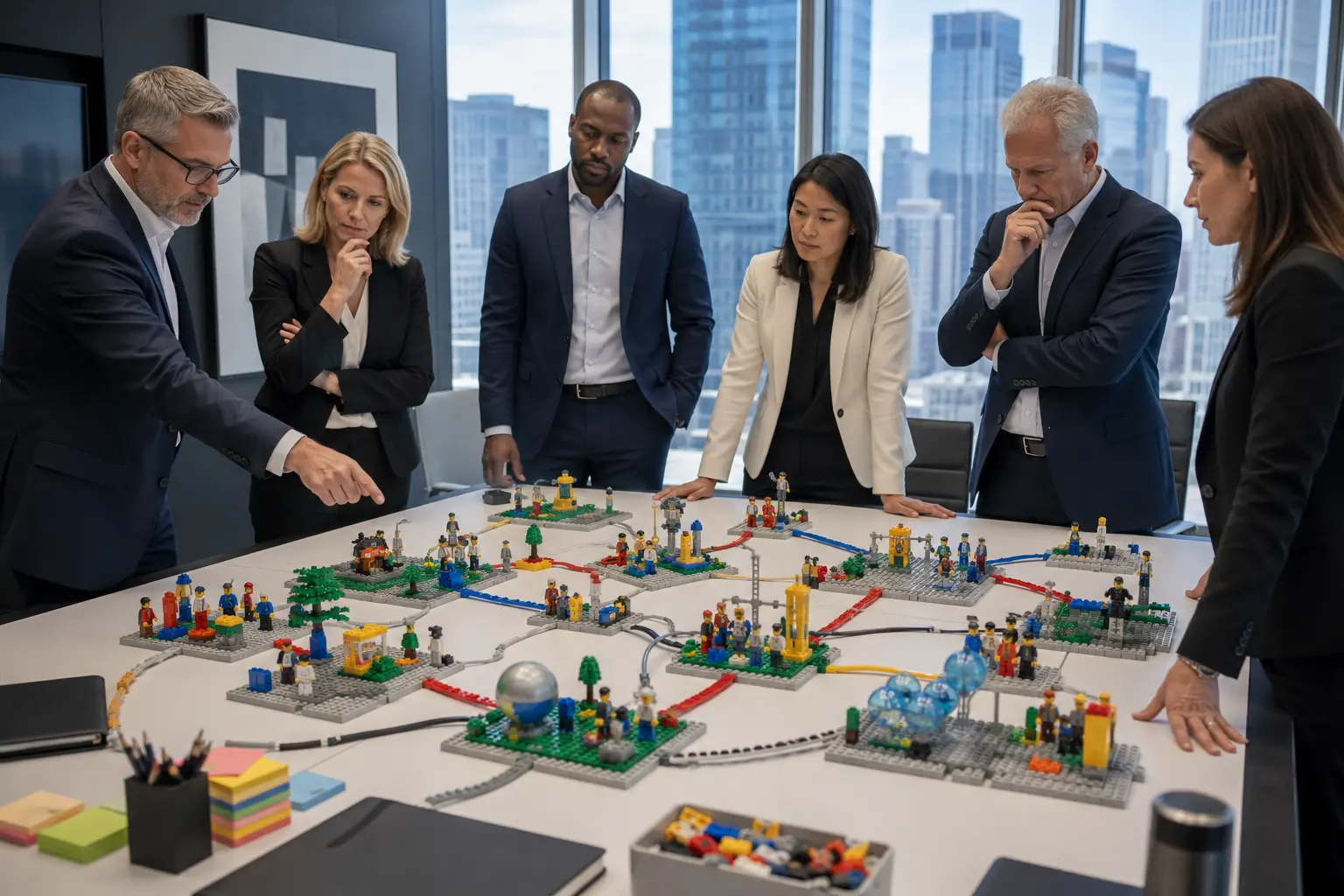
To see what certified facilitation looks like in action, it helps to walk through the structure of a typical strategy or alignment session. Each stage is led with deliberate facilitator language and a clear purpose.
Click the ‘+’ button below to explore the detailed workshop stages.
1. Individual Challenge Build & 2. Storytelling
Step 1 — Individual Challenge Build (15–20 min): The facilitator frames a specific challenge and asks every participant to build an individual model in response. Because everyone builds at once, the format guarantees that each person commits to a position before any discussion begins — removing the early dominance of the loudest voices.
Step 2 — Storytelling and Meaning Extraction (20–30 min): Each participant explains their model in turn. The facilitator draws out meaning with focused questions, ensuring the group hears the reasoning behind every build and that quieter contributors are heard in full.
3. Shared Model Construction & 4. Strategic Reflection
Step 3 — Shared Model Construction (30–45 min): The facilitator guides the group in combining individual models into one shared model. This is where connections, tensions, and dependencies become visible — and where the group begins to align around a single, co-created picture of the challenge.
Step 4 — Strategic Reflection and Action Planning (20–30 min): The facilitator leads reflection on the shared model and converts insight into commitments — naming priorities, surfacing execution barriers, and agreeing on next steps the whole group understands and owns.
Who Should Pursue LEGO® SERIOUS PLAY® Certification?
Certification is most valuable for professionals whose work depends on getting groups to think, decide, and align together. It fits naturally into a range of roles.
- HR professionals designing engagement, culture, and team-development sessions.
- L&D leaders building learning experiences that demand full participation.
- Consultants who need a repeatable method for surfacing client assumptions.
- Agile coaches running retrospectives, planning, and team-alignment workshops.
- Leadership facilitators guiding strategy and decision-making sessions.
- Transformation professionals leading change, where shared understanding determines whether a plan survives implementation.
Strategic Outcomes
The value of skilled facilitation should be measured in specific, observable changes — not in vague promises of “better communication.” When a certified facilitator runs a well-designed session, the outcomes are concrete.
- Conflicting assumptions become visible, so teams resolve disagreement instead of carrying it forward.
- Leadership teams align around shared priorities they have co-created and can defend.
- Workshop participation becomes more balanced, drawing input from everyone in the room rather than a vocal few.
- Execution barriers emerge before implementation begins, when they are still cheap to address.
Build Real Facilitation Capability
Whether you want to experience a session firsthand or design one around your team’s specific challenge, the next step is a structured conversation about what you need to align, decide, or build.
To understand the full methodology behind facilitator certification and workshop design, read The LEGO® Serious Play® Method Explained.
Frequently Asked Questions
What is LEGO® SERIOUS PLAY® certification?
It is recognition that a facilitator has been trained in the LEGO® SERIOUS PLAY® method and can apply it to design and lead structured, hands-on workshops. The credential reflects a facilitation capability — the ability to surface assumptions, drive full participation, and build shared understanding — rather than a course checklist or a guarantee of expertise.
Is LEGO® SERIOUS PLAY® certification official?
Certification confirms training in the method; it does not mean a facilitator has been certified, employed, or endorsed by the LEGO Group. LEGO® SERIOUS PLAY® is a facilitation methodology, and completing training in it does not create an official relationship with the toy manufacturer.
How long does LEGO® SERIOUS PLAY® certification take?
Training length varies by program, but the credential itself marks the beginning of a facilitator’s development rather than its completion. Real capability is built through repeated, reflective practice running actual sessions, well beyond the duration of any single course.
Who should pursue facilitator certification?
It suits professionals whose work depends on aligning groups: HR professionals, L&D leaders, consultants, Agile coaches, leadership facilitators, and transformation professionals. In each role, the ability to run sessions where everyone participates and assumptions become visible is a direct advantage.
How does LEGO® SERIOUS PLAY® certification improve organizational alignment?
It develops the facilitation skills that make hidden assumptions visible and convert individual perspectives into one shared model a team co-creates. That shared model lets leadership teams align around real priorities and surface execution barriers before implementation begins, rather than discovering disagreement mid-project.