
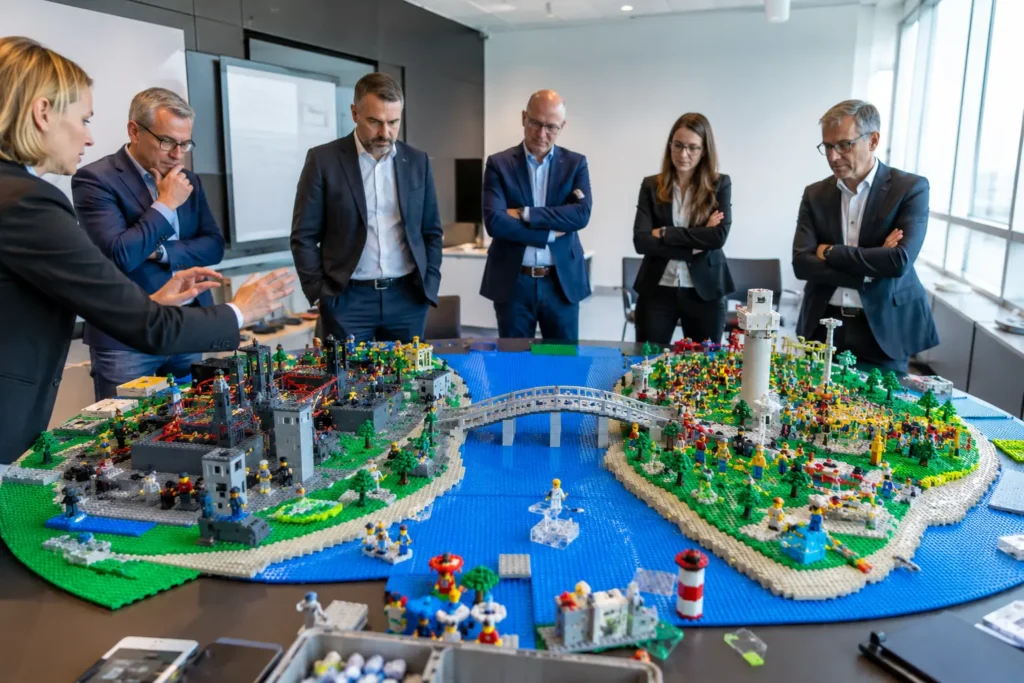
Change Management Workshops Using LEGO® SERIOUS PLAY®
Change management is the structured process organizations use to transition people, processes, and systems from a current state to a desired future state. Despite significant investment in transformation initiatives, many organizations struggle to achieve sustainable adoption because employees do not share a common understanding of why change is necessary, what success looks like, or how their role contributes to the transition.
LEGO® SERIOUS PLAY® workshops address this challenge by making assumptions, concerns, dependencies, and future possibilities visible through structured model-building and facilitated dialogue. Rather than relying solely on presentations, surveys, or top-down communication, participants create shared representations of organizational realities and future aspirations.
For leadership teams, change management workshops using LEGO® SERIOUS PLAY® can improve alignment, accelerate understanding, and reveal hidden obstacles before they become implementation risks. For consultants and HR professionals building facilitation capability in 2026, the methodology provides a practical framework for increasing engagement during periods of transformation.
Change management workshops using LEGO® SERIOUS PLAY® are structured facilitation sessions that help organizations visualize current realities, identify barriers to change, create shared understanding, and build collective commitment to future strategies. The methodology improves participation because every individual contributes equally through building, storytelling, reflection, and collaborative sense-making. Organizations use these workshops to support transformation initiatives, cultural change, strategic realignment, mergers, digital transformation, and leadership transitions.
Understanding Change Management Failure
Change management is the process of helping individuals and organizations transition from an existing state to a desired future state. Importantly, effective change management matters because organizations rarely fail due to strategy alone; instead, they fail because people interpret, prioritize, and implement change differently.
Many transformation efforts struggle because communication is treated as information transfer rather than meaning creation. Leaders announce a strategy, distribute documentation, and assume understanding will naturally emerge. As a result, employees often construct different interpretations of the same initiative.
Organizations frequently discover that departments support the same transformation for entirely different reasons. As a result, these differences create hidden friction, which in turn leads to conflicting priorities, slower execution, and reduced organizational alignment.
Teams rarely resist change itself; teams resist uncertainty, ambiguity, and loss of control.
Change initiatives also operate within interconnected organizational systems. Moreover, leadership behavior, communication patterns, incentive structures, culture, decision-making processes, and operational workflows function as interdependent forces. Consequently, when one element changes without consideration of the wider system, feedback loops emerge that undermine adoption.
The Organizational Cost of Poor Change Management
Poor change management creates measurable organizational costs because uncertainty spreads faster than clarity. Employees spend time interpreting intentions, managers spend time correcting misunderstandings, and leadership teams spend time addressing avoidable resistance.
Research across organizational transformation initiatives consistently suggests that significant portions of major change programs fail to achieve intended outcomes, with estimates frequently ranging between 60% and 75% depending on industry and methodology. The financial impact can extend into hundreds of thousands or millions of dollars for larger organizations.
In addition, the cost is not limited to financial investment.
Organizations experiencing poorly managed transformation often encounter:
- Reduced employee engagement
- Increased turnover risk
- Slower decision-making
- Conflicting departmental priorities
- Project delays
- Declining trust in leadership
- Communication breakdowns
Organizational resistance often emerges because assumptions remain invisible rather than because employees fundamentally oppose strategic objectives.
These challenges rarely exist in isolation. Resistance affects communication. Communication affects trust. Trust affects collaboration. Collaboration affects execution. Execution affects strategic outcomes.
Ultimately, this systems perspective is critical for understanding why conventional change management approaches frequently fall short.
Why Traditional Change Management Approaches Fail
Traditional change management approaches often rely heavily on presentations, communication plans, stakeholder updates, and training programs. While these tools remain valuable, they frequently assume that awareness automatically creates commitment.
Awareness does not create ownership.
Employees can understand a change initiative intellectually while remaining emotionally disconnected from its purpose. They may understand what leadership intends without understanding how their own concerns, experiences, or expertise fit within the transformation journey.
People commit more deeply to change when they help construct the narrative rather than simply receive it.
Conventional workshops frequently reward confidence, hierarchy, and verbal dominance. As a result, the loudest voices often shape discussions while quieter participants contribute less visible insights.
Consequently, this creates a structural constraint within organizational dialogue.
Critical perspectives remain hidden. Risks remain unidentified. Alternative possibilities remain unexplored.
As part of understanding how the LEGO® SERIOUS PLAY® Method works, organizations increasingly recognize that participation quality often matters more than presentation quality when navigating transformation.
The Cognitive Foundation Behind LEGO® SERIOUS PLAY®
LEGO® SERIOUS PLAY® is a structured facilitation methodology that uses model-building and storytelling to support thinking, communication, and problem-solving.
The methodology is based on the principle of thinking through the hands. Participants build physical representations of ideas, experiences, challenges, and aspirations. These models act as externalized thinking tools that make complex concepts visible and discussable.
The process matters because abstract concepts become easier to explore when represented physically.
Leadership alignment improves because assumptions become visible.
Strategic clarity improves because competing interpretations can be examined collectively.
Decision quality improves because more perspectives enter the conversation.
Shared models create collective understanding because participants can literally see how different perspectives connect and conflict.
Unlike traditional workshop formats, LEGO® SERIOUS PLAY® emphasizes 100% participation. Every participant builds. Each person then shares their model. Together, they contribute to the evolving understanding of the system.
This principle is particularly valuable within organizational change initiatives where hidden assumptions often determine success or failure.
Applying LEGO® SERIOUS PLAY® to Change Management
Change management workshops using LEGO® SERIOUS PLAY® focus on helping participants explore current realities, identify obstacles, envision future states, and understand systemic relationships.
Initially, a typical workshop begins by examining the present environment.
First, participants build models representing current organizational conditions. For example, these may include communication barriers, leadership challenges, cultural tensions, process constraints, or external pressures.
The facilitator prompts reflection through structured questioning.
Participants then construct future-state models that represent successful transformation outcomes.
In particular, the contrast between current-state and future-state models becomes a powerful diagnostic tool.
Transformation accelerates when organizations make invisible organizational dynamics visible and discussable.
Organizations working with Serious Play Business frequently use these workshops to support:
- Culture transformation
- Strategic planning
- AI adoption initiatives
- Leadership transitions
- Organizational redesign
- Cross-functional alignment
- Mergers and acquisitions
- Innovation programs
Within organizational change initiatives, the methodology helps reveal systemic enablers and structural constraints that traditional planning processes often overlook.
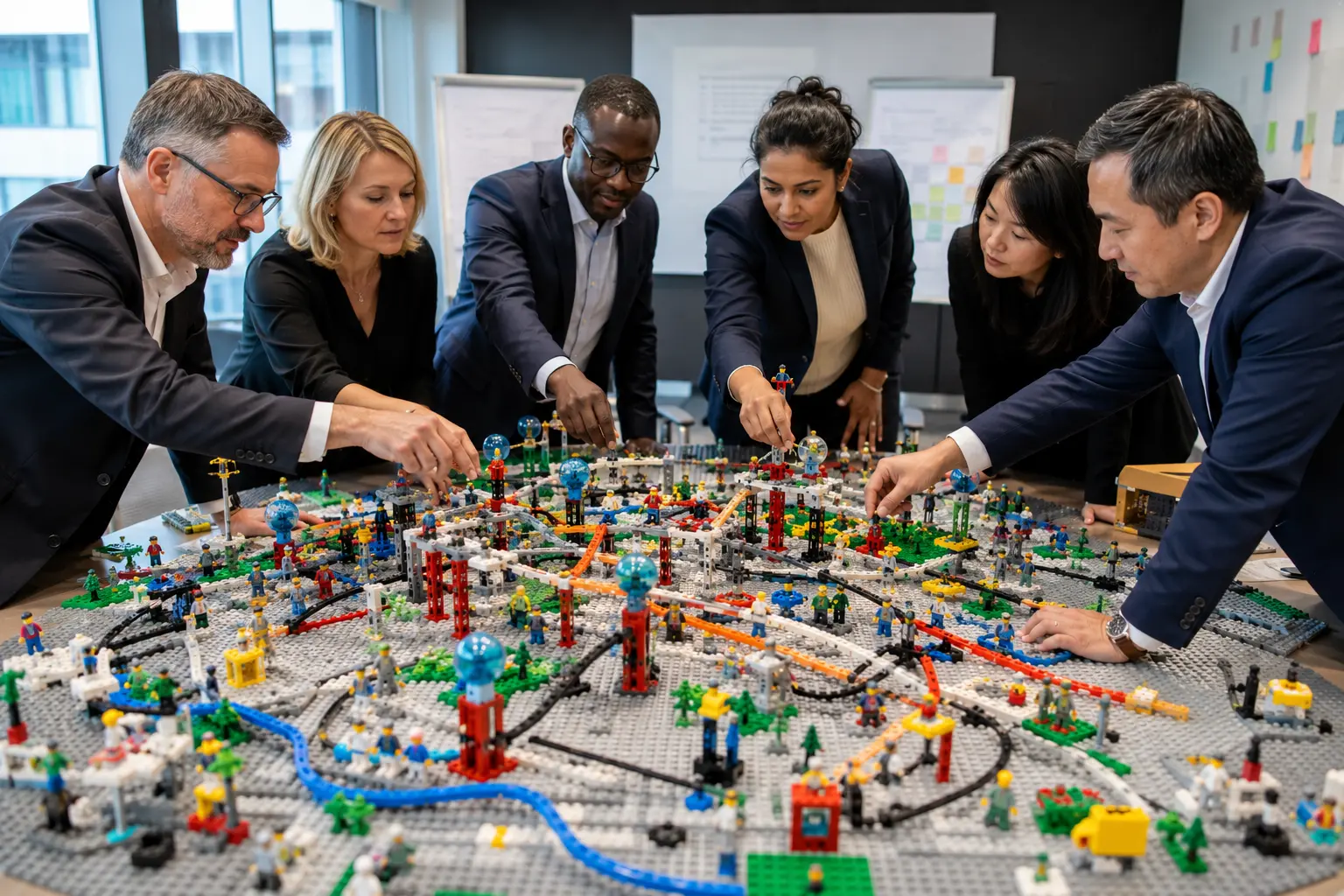
Workshop Implementation Guide
Click the ‘+’ button below to explore the detailed workshop stages.
Surfacing the Current Reality and Its Barriers
1. Build the Current Reality & 2. Identify Barriers and Dependencies
1. Build the Current Reality (20–30 Minutes): The facilitator prompts participants to build a model representing the organization’s current experience of change.
Participants build silently before sharing stories connected to their models.
The group reflects on recurring themes and patterns.
2. Identify Barriers and Dependencies (25–35 Minutes): Participants expand their models to include obstacles, dependencies, risks, and constraints.
The facilitator prompts exploration of relationships between organizational systems.
Participants identify feedback loops affecting transformation success.
Designing the Future State and the Road Map
3. Build the Desired Future State & 4. Create Shared System Models
3. Build the Desired Future State (30–40 Minutes): Participants create models representing successful change outcomes.
The facilitator prompts participants to define specific characteristics of success.
The group explores differences between current and future realities.
4. Create Shared System Models (30–45 Minutes): Individual models are combined into a shared organizational landscape.
Participants identify critical interdependencies.
The facilitator guides discussion around alignment opportunities and implementation priorities.
5. Develop Strategic Road Maps
5. Develop Strategic Road Maps (20–30 Minutes): Participants identify practical actions required to bridge current and future states.
The group prioritizes initiatives, responsibilities, and success indicators.
Clear next steps are documented.
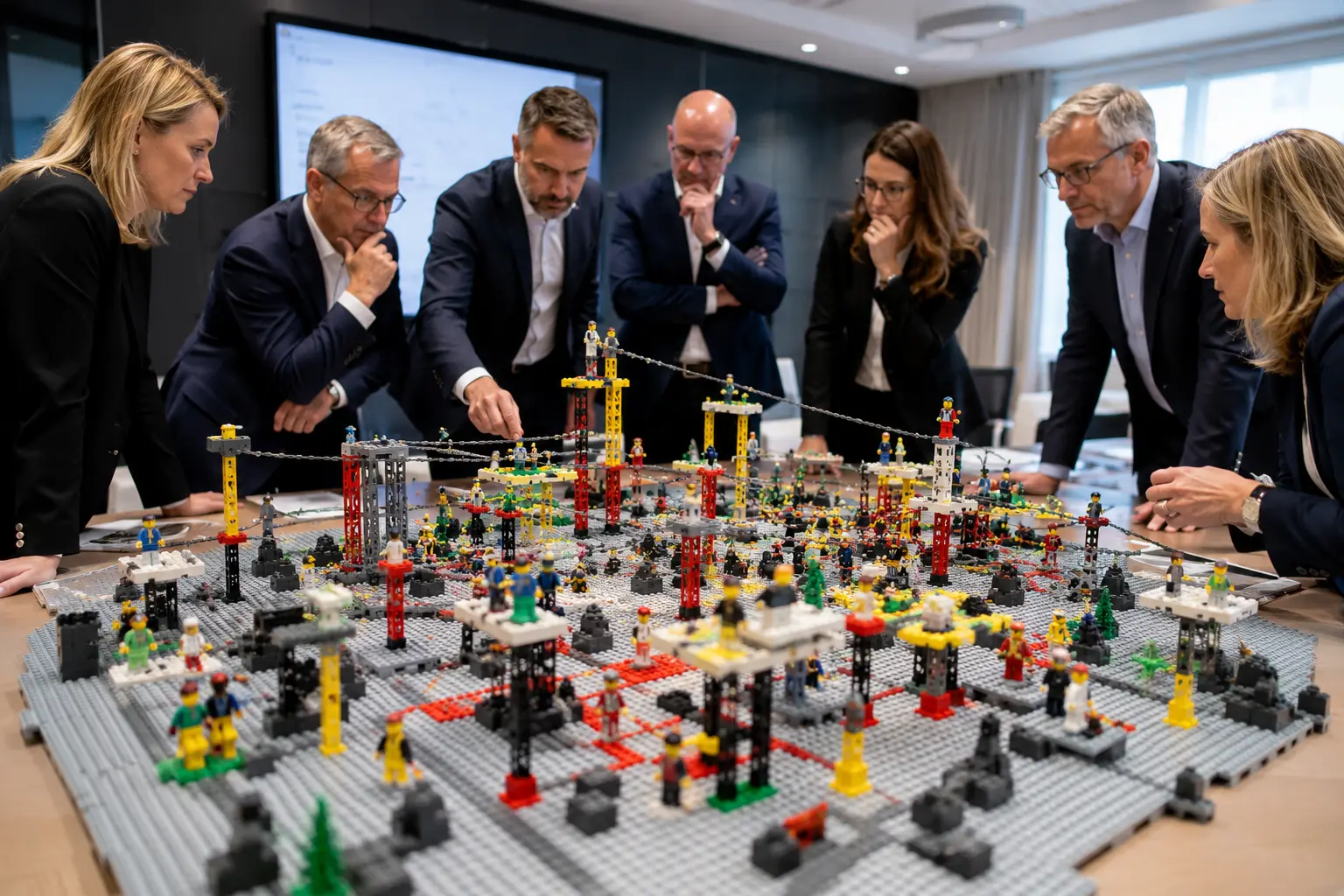
Outcomes and Strategic Relevance
Organizations that effectively integrate LEGO® SERIOUS PLAY® into change management efforts often achieve three significant outcomes.
First, teams identify conflicting assumptions before strategic planning begins.
Second, leaders gain visibility into systemic barriers affecting adoption.
Third, employees develop stronger ownership of transformation initiatives because they helped shape the understanding of the challenge itself.
Sustainable change emerges when organizational understanding, participation, and action reinforce each other through continuous feedback loops.
Together, these outcomes support stronger organizational alignment, improved communication, and more effective strategic execution.
Why Facilitator Capability Matters
Strategic facilitation is a critical capability during organizational transformation because change initiatives rarely fail from a lack of ideas. They fail because organizations struggle to create shared understanding across diverse stakeholder groups.
Facilitators trained in the LEGO® SERIOUS PLAY® Method help organizations navigate complexity by creating environments where multiple perspectives can be explored simultaneously. The facilitator does not provide answers; instead, the facilitator guides discovery.
As part of facilitator certification journeys, professionals learn how to design workshops, manage group dynamics, facilitate systems thinking exercises, and translate insights into practical organizational action.
Furthermore, this capability becomes increasingly valuable as organizations face more interconnected challenges involving technology, culture, leadership, communication, and workforce transformation.
Organizations accelerate change when facilitators help people see relationships between problems instead of treating symptoms as isolated issues.
Strategic Implications for 2026 and Beyond
Change management is becoming more complex because organizations are navigating multiple transformations simultaneously. AI adoption, hybrid work models, workforce expectations, economic uncertainty, and digital modernization are interacting as interconnected forces rather than separate initiatives.
However, leaders can no longer assume that communication alone will create alignment.
Therefore, organizations need mechanisms that help people make sense of complexity together.
The LEGO® SERIOUS PLAY® Method provides a structured way to surface assumptions, reveal systemic dependencies, and build shared understanding across organizational boundaries. As transformation becomes increasingly continuous rather than episodic, methodologies that support collective sense-making will become more strategically important.
The most successful transformation initiatives create clarity collectively rather than attempting to distribute clarity from the top down.
Ultimately, for organizations looking to hire a facilitator, change management workshops can provide an effective starting point for exploring organizational readiness, alignment challenges, and strategic opportunities.
Transform Your Strategy Conversations
Explore how a customized LEGO® SERIOUS PLAY® change management workshop can support your organization’s transformation goals. Discuss your specific change management challenges and receive a tailored workshop recommendation from Serious Play Business.
To understand the full methodology behind the workshop design described above, read The LEGO® Serious Play® Method Explained.
Frequently Asked Questions
What are change management workshops using LEGO® SERIOUS PLAY®?
Change management workshops using LEGO® SERIOUS PLAY® are structured facilitation sessions that help organizations visualize current realities, identify barriers to transformation, create shared understanding, and build commitment to future strategic directions. The methodology supports organizational alignment because participants actively construct and discuss their perspectives rather than simply receiving information.
Why is LEGO® SERIOUS PLAY® effective for change management?
LEGO® SERIOUS PLAY® is effective for change management because it makes assumptions, concerns, risks, and opportunities visible. Participants build physical representations of organizational challenges, which leads to deeper reflection, broader participation, and more productive conversations about transformation.
How does LEGO® SERIOUS PLAY® reduce resistance to change?
LEGO® SERIOUS PLAY® reduces resistance to change by creating psychological ownership of the transformation process. Employees contribute directly to defining current challenges and future possibilities, which helps individuals see themselves as active participants rather than passive recipients of change.
When should organizations use change management workshops?
Organizations should use change management workshops during strategic transformation initiatives, mergers, acquisitions, leadership transitions, digital transformation projects, AI adoption programs, cultural change efforts, and organizational restructuring. The methodology is particularly valuable when alignment and stakeholder engagement are critical success factors.
Can LEGO® SERIOUS PLAY® support large-scale organizational transformation?
LEGO® SERIOUS PLAY® can support large-scale organizational transformation by helping leaders and teams understand complex systems, identify interdependencies, and create shared strategic understanding. The methodology is frequently used to explore organizational alignment, communication challenges, cultural barriers, and strategic priorities.
How does change management workshops using LEGO® SERIOUS PLAY® differ from traditional workshops?
Change management workshops using LEGO® SERIOUS PLAY® differ from traditional workshops because participants build and share models rather than relying primarily on presentations and discussion. This structured process promotes 100% participation and often reveals insights that remain hidden in conventional meeting formats.
Trademark note: LEGO® SERIOUS PLAY® is a methodology name used here in a professional facilitation context.