
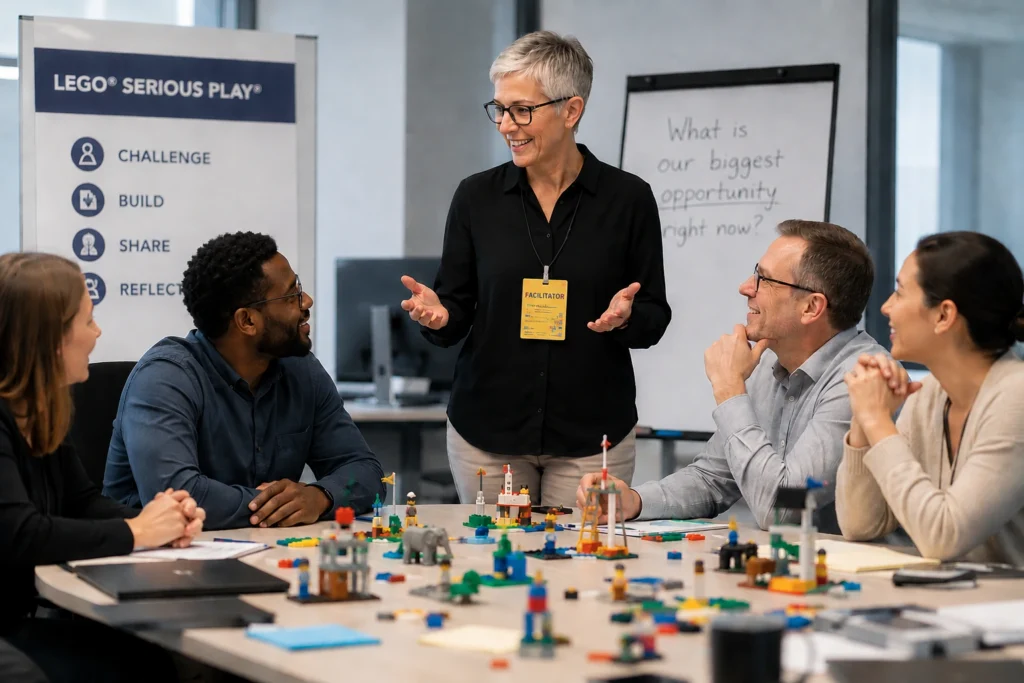
LEGO® SERIOUS PLAY® Participation: How 100% Contribution Changes Organizational Conversations
LEGO® SERIOUS PLAY® Participation is the structured involvement of every participant in a facilitated organizational conversation. In 2026, organizations cannot afford workshops where only 20–30% of the room shapes the outcome.
For consultants and HR professionals building facilitation capability, participation is not a soft benefit; it is a design requirement for better thinking. For leadership teams, the method offers a disciplined way to surface assumptions, test meaning, and build shared understanding before decisions are made.
LEGO® SERIOUS PLAY® Participation matters because every participant builds, shares, and reflects before the group converges on conclusions. The method reduces dominance bias, protects quieter contributors, and turns invisible thinking into visible models. When participation becomes structured rather than voluntary, organizations gain more accurate insight from the people closest to the work.
What LEGO® SERIOUS PLAY® Participation Means
LEGO® SERIOUS PLAY® Participation is the method-designed condition in which every person contributes meaningfully to the conversation through building, storytelling, listening, and reflection. It matters because most organizational discussions are shaped by hierarchy, speed, confidence, and habitual meeting behavior, which leads to incomplete decisions and hidden resistance.
In many leadership workshops, the visible discussion does not represent the full intelligence of the group. A senior executive speaks first, a confident participant elaborates, and others quietly adjust their comments to fit the dominant interpretation. As a result, the team may leave with agreement that is more performative than real.
LEGO® SERIOUS PLAY® Participation changes that pattern because the method gives every participant a model, a story, and protected airtime. Participants build silently before explaining their models, which reduces the pressure to respond instantly and gives individuals time to think independently.
Participation improves decision quality when every person contributes meaning before the group negotiates conclusions.
Serious Play Business positions this as a core feature of the LEGO® SERIOUS PLAY® Method, not as an optional facilitation style. To understand the broader methodology behind this participation structure, read The LEGO® Serious Play® Method explained.
The Organizational Cost of Partial Participation
Partial participation is the organizational pattern in which only a subset of people actively shapes discussion, interpretation, and decision-making. It matters because the people who speak most are not always the people with the most relevant insight, which leads to blind spots in strategy, culture, change, and execution.
In a typical 10-person meeting, two or three voices can easily occupy 60–75% of the airtime. The cost is not merely unequal communication. The deeper cost is that weak signals remain hidden, operational realities are underreported, and disagreement is delayed until implementation.
Silent participants often carry operational knowledge that leaders need before strategy becomes execution.
When participation is uneven, organizational alignment becomes fragile because people may comply in the room while withholding concerns that surface later as resistance. Leaders then misread silence as agreement, which leads to slower execution and repeated clarification meetings.
The organizational cost grows in complex systems. Culture, leadership, communication, and strategy are interdependent forces. When one part of the system suppresses contribution, feedback loops weaken across the whole organization. A team may think it has solved a problem when it has only heard from the people most comfortable speaking.
For a mid-sized leadership team, one poorly designed alignment workshop can create weeks of rework if the decision fails to account for practical constraints. The time cost may range from 10–30 hours of follow-up discussion, especially when unresolved assumptions appear after commitments have already been made.
Why Traditional Workshops Fail to Create 100% Participation
Traditional workshops fail to create 100% participation because they often depend on verbal speed, confidence, seniority, and open discussion formats. These formats matter because they reward people who are already comfortable speaking, which leads to predictable patterns of dominance and silence.
A conventional workshop may invite everyone to contribute, but invitation is not the same as structure. Open questions such as “What do people think?” usually produce uneven responses because participants make rapid social calculations before speaking. They consider rank, risk, relevance, timing, and whether their view will be seen as disruptive.
Traditional brainstorming also separates idea generation from deeper meaning. People may produce many suggestions, yet the group may not understand the assumptions, tensions, or personal interpretations behind those ideas. As a result, the output can look energetic without becoming strategically useful.
Open discussion rewards speed and confidence, while structured building protects depth, reflection, and equal contribution.
LEGO® SERIOUS PLAY® Participation differs from conventional facilitation because every participant responds to the same prompt by building first. The model becomes a thinking artifact, not a decorative object. No one needs to compete for the first word because the process creates a sequence: prompt, build, share, reflect.
This comparison is important for strategic facilitation. Traditional workshops often ask people to align verbally before they have clarified what they mean. LEGO® SERIOUS PLAY® gives the group a way to externalize thinking first, which leads to more grounded interpretation.
The Cognitive Foundation: Thinking Through the Hands
Thinking through the hands is the principle that physical building can help people access, organize, and express knowledge that may be difficult to explain directly. It matters because organizational knowledge is often tacit, emotional, relational, and context-dependent, which means it does not always emerge through standard discussion.
In LEGO® SERIOUS PLAY® workshops, participants do not begin by debating concepts. They build models that represent their understanding of a challenge, system, relationship, or future state. The act of building slows the conversation down and gives the brain a different route into meaning.
This matters in leadership and culture work because many organizational issues are abstract. Trust, accountability, strategic uncertainty, customer value, and change readiness are difficult to define in a single sentence. When participants build a model, they create a visible anchor for describing those abstract realities.
Physical models help teams discuss complex issues because the object carries meaning before debate begins.
The method also reduces the pressure to produce polished language immediately. A participant can point to part of a model and explain, “This represents the bottleneck,” or “This shows the part of the system we keep ignoring.” The model supports explanation, which leads to clearer contribution from people who may not dominate verbal discussion.
This is why LEGO® SERIOUS PLAY® Participation is not about entertainment. It is about disciplined cognitive access, structured expression, and shared interpretation in organizational settings.
How LEGO® SERIOUS PLAY® Participation Works in Practice
LEGO® SERIOUS PLAY® Participation works by combining individual model-building, storytelling, reflective questioning, and shared meaning-making. It matters because the process separates individual thinking from group convergence, which prevents early consensus from narrowing the conversation too soon.
The facilitator begins with a carefully designed question. Participants build silently, which protects independent thinking. Each person then explains the meaning of their own model. The group listens before interpreting, which creates a discipline of attention that is often missing in standard meetings.
The method’s 4-step process—question, build, share, and reflect—creates participation by design. No right or wrong answers are required, because each model represents the builder’s meaning. This prevents the group from evaluating contributions too early.
LEGO® SERIOUS PLAY® creates inclusion by designing contribution into the process rather than requesting it from participants.
In organizational alignment work, this structure is especially valuable. Leaders may discover that people use the same words but attach different meanings to them. A team may all say “customer focus,” yet build very different models of what customer focus requires in daily decision-making.
Serious Play Business uses this method in corporate contexts where participation must produce useful organizational outcomes. The goal is not simply to hear from everyone. The goal is to create a more accurate picture of the system before leaders commit to action.

Workshop Guide: Designing for 100% Participation
A LEGO® SERIOUS PLAY® participation workshop is a structured session that ensures every participant builds, explains, listens, and contributes to shared interpretation. It matters because the facilitator designs the conditions for equal contribution instead of hoping equal contribution happens naturally.
Click the ‘+’ button below to explore the detailed workshop stages.
1. Frame the Purpose & 2. Build Individual Models
1. Frame the Purpose and Participation Contract — 15–20 minutes: The facilitator prompts the group to understand the purpose of the session and the participation expectations. The facilitator explains that every participant will build, every participant will share, and every model owner controls the meaning of their model.
Participants are told that the session is not about artistic skill, quick answers, or performance. The facilitator reinforces that there are no right or wrong answers. This creates psychological permission without turning the workshop into an informal activity.
2. Build Individual Models of the Current Challenge — 25–35 minutes: The facilitator prompts participants to build a model representing the current organizational challenge, such as a leadership bottleneck, alignment issue, culture tension, or change barrier. Participants build silently so each person can form an independent interpretation before hearing others.
After building, each participant explains their model in turn. The facilitator protects airtime and prevents interruption. The group listens for meaning, patterns, and differences rather than immediately solving the issue.
3. Surface Assumptions & 4. Build a Shared Model
3. Surface Assumptions and Systemic Connections — 30–40 minutes: The facilitator prompts participants to identify what each model reveals about the wider system. The group reflects on interdependent forces, structural constraints, feedback loops, and systemic enablers.
Participants may notice that one issue affects several parts of the organization. For example, unclear decision rights may influence accountability, speed, trust, and customer responsiveness. The facilitator helps the group connect individual insights without collapsing them into one premature conclusion.
4. Build a Shared Model of the Participation Pattern — 35–45 minutes: The facilitator prompts the group to build a shared model representing how participation currently works in the organization. Participants negotiate meaning through the model rather than through abstract debate.
The group identifies where voices are amplified, where voices disappear, and where information fails to move across the system. This shared model helps the team see participation as an organizational design issue, not a personality issue.
5. Translate the Model Into Decisions & 6. Close With Commitments
5. Translate the Shared Model Into Decisions — 25–35 minutes: The facilitator prompts the group to identify practical implications. Participants name specific behaviors, meeting structures, decision points, or leadership habits that must change.
The facilitator asks, “What must be protected, changed, or clarified if this model is accurate?” This moves the session from insight to action while preserving the meaning generated by the group.
6. Close With Commitments and Reflection — 15–25 minutes: The facilitator prompts each participant to name one commitment connected to the shared model. The group reflects on what changed because every person contributed.
The facilitator captures named outcomes, unresolved tensions, and next steps. This final stage reinforces that participation is not complete until insight has been translated into organizational movement.
Outcomes of Better LEGO® SERIOUS PLAY® Participation
The outcome of LEGO® SERIOUS PLAY® Participation is not simply a more engaging workshop. The outcome is a more complete organizational picture that leaders can use to make better decisions, design stronger alignment, and reduce hidden resistance.
The first outcome is broader contribution. People who usually wait, defer, or self-edit have a defined role in the process. This changes the information available to the group.
The second outcome is clearer organizational alignment. Participants can see whether they are using the same words to mean different things. Misalignment becomes visible before it becomes expensive.
The third outcome is earlier detection of risk. Because participants build from their own perspective, weak signals and operational constraints can surface before leaders commit to a plan.
The fourth outcome is stronger commitment. People are more likely to support a decision when their thinking has been included in the meaning-making process.
Teams align faster when assumptions become visible before decisions are finalized.
The fifth outcome is improved leadership learning. Leaders can observe not only what people think, but how the group interprets complexity together. That creates valuable feedback about communication habits, trust, and decision quality.
Within organizational change initiatives, this matters because change fails when people comply publicly but disagree privately. LEGO® SERIOUS PLAY® Participation gives the organization a better way to detect the difference.

What Facilitators Must Know About Participation
Facilitator competence is the disciplined ability to design, hold, and guide a process that protects participation and produces meaningful organizational insight. It matters because the method depends on structure, timing, question design, and interpretation discipline.
A facilitator must know how to phrase prompts that invite depth without confusing the group. A facilitator must also protect silence during building, manage airtime during sharing, and prevent participants from interpreting someone else’s model before the builder has explained it.
As part of facilitator certification journeys, professionals learn that participation is not created by enthusiasm alone. It is created through method integrity, sequence, and restraint. The facilitator must resist the urge to over-explain, rescue, or lead the group toward a preferred answer.
Facilitators protect participation by managing sequence, airtime, silence, and meaning ownership throughout the workshop.
LEGO® SERIOUS PLAY® Tool use, Build Levels, and System Models may support the work when they are used as method artifacts by trained facilitators. These terms should never become product language. They only matter when they help facilitators deepen organizational thinking.
For organizations looking to hire a facilitator, the key question is not whether the session will be lively. The key question is whether the facilitator can create 100% participation that leads to useful business insight.

Why Participation Is a Strategic Capability
Participation is a strategic capability when an organization consistently captures relevant insight from the people who understand the work, the system, and the consequences of decisions. It matters because strategy depends on information quality, and information quality declines when contribution is uneven.
LEGO® SERIOUS PLAY® Participation strengthens strategy because it connects individual knowledge to collective interpretation. The method does not assume that the loudest view is the most accurate view. It creates a structured route for every participant to add meaning.
In leadership development contexts, this becomes a powerful capability. Leaders learn how their own behavior shapes contribution. They also learn that silence is not neutral; silence is data that the system failed to collect.
Strategic participation turns distributed knowledge into visible insight that leaders can interpret before acting.
For Serious Play Business, this is where participation connects to strategic facilitation, organizational alignment, and facilitator certification. The method is valuable because it helps groups think more completely before making consequential decisions.
Transform Your Strategy Conversations
Design strategy conversations where every voice shapes the outcome—and turn invisible thinking into shared, decision-ready insight.
To understand the full methodology behind the workshop design described above, read what LEGO® Serious Play® is and how it works.
Frequently Asked Questions
What is LEGO® SERIOUS PLAY® Participation?
LEGO® SERIOUS PLAY® Participation is the structured involvement of every participant in a facilitated organizational conversation. Each person builds, shares, listens, and reflects, which creates equal contribution before the group moves toward interpretation or decisions.
How does LEGO® SERIOUS PLAY® Participation create 100% contribution?
LEGO® SERIOUS PLAY® Participation creates 100% contribution by requiring every participant to build a model and explain its meaning. The process protects airtime, reduces dominance, and gives quieter contributors a clear role in the conversation.
Why is participation important in organizational alignment?
Participation is important in organizational alignment because alignment depends on shared meaning, not just verbal agreement. When all participants contribute, teams can identify conflicting assumptions before those assumptions affect execution.
What makes LEGO® SERIOUS PLAY® different from traditional workshops?
LEGO® SERIOUS PLAY® is different from traditional workshops because participants build before they debate. Traditional workshops often reward verbal confidence, while the LEGO® SERIOUS PLAY® Method protects independent thinking before group convergence.
Does facilitator certification matter for participation quality?
Facilitator certification matters for participation quality because trained facilitators learn how to design prompts, protect process sequence, manage airtime, and preserve meaning ownership. These skills help prevent the workshop from becoming an unstructured discussion.