

LSP Certification Online vs In-Person: Which Facilitator Training Format Builds Stronger Capability?
LSP certification online and in-person facilitator certification can both build professional capability when the training is rigorous, practice-based, and grounded in the LEGO® SERIOUS PLAY® Method. The more important question is not whether the format is digital or physical, but whether participants experience 100% participation, thinking through the hands, structured reflection, and facilitated application to real organizational issues.
For consultants, HR leaders, coaches, and internal facilitators, the best certification format depends on learning goals, travel constraints, cohort dynamics, and the type of workshops they intend to lead.
LSP certification online can be effective when it preserves the core principles of the LEGO® SERIOUS PLAY® Method rather than reducing training to passive instruction. In-person certification offers stronger embodied learning and live group dynamics, while online certification can improve accessibility and support geographically distributed professionals. The strongest choice depends on whether the participant needs immersive practice, flexible access, or preparation for hybrid and distributed organizational facilitation.
Why the Certification Format Question Matters in 2026
LSP certification online has become a serious option for professionals who want to build facilitation capability without the cost and time of travel. LSP certification online is especially relevant in 2026 because consultants, HR professionals, leadership development teams, and organizational change practitioners increasingly support distributed teams across regions and time zones.
For consultants and HR professionals building facilitation capability, certification format affects confidence, practice depth, and readiness to guide senior teams through complex conversations. For leadership teams, the LEGO® SERIOUS PLAY® Method offers a structured way to surface assumptions, improve organizational alignment, and turn abstract strategy into visible shared understanding.
Certification format matters because facilitation is not learned only by reading concepts or watching demonstrations. Facilitators develop capability by practicing prompts, observing group behavior, managing silence, supporting reflection, and helping participants connect individual models into shared meaning.
Facilitator certification is most valuable when participants practice the method under conditions that resemble real organizational complexity.
What LSP Certification Online Means
LSP certification online is a professional training pathway that teaches facilitators how to apply the LEGO® SERIOUS PLAY® Method through a virtual or digitally supported learning environment. It matters because many organizations now operate across locations, which creates demand for facilitators who can support strategic facilitation without assuming everyone is in the same room.
Online certification should not mean a diluted version of the methodology. A credible online program must still teach the 4-step process, build challenges, individual model sharing, shared model development, and facilitator decision-making. Participants should not simply listen to theory. They should build, explain, reflect, receive feedback, and understand how to transfer the method into leadership, culture, strategy, and innovation contexts.
The risk with online training is that poor design can turn facilitation education into passive content consumption. When that happens, participants may understand the vocabulary of LEGO® SERIOUS PLAY® but lack the confidence to guide executives, project teams, or cross-functional groups through live complexity.
Online certification succeeds when the digital format protects participation, reflection, and facilitator practice instead of compressing them.
For professionals who want a deeper grounding in the full methodology, Serious Play Business connects certification learning to how the LEGO® Serious Play® Method works. The pillar overview explains the foundations behind 100% participation, thinking through the hands, and the structured process that makes the method more than a creative workshop technique.

What In-Person LSP Certification Provides
In-person LSP certification is a facilitator certification experience where participants learn the LEGO® SERIOUS PLAY® Method in a shared physical environment. It matters because the method depends on embodied cognition, social interaction, spatial awareness, and live facilitation choices that become easier to observe when people are together.
In-person learning gives participants immediate access to the full sensory and relational environment of the method. They see how people build, hesitate, speak, listen, challenge, and connect ideas across a shared table. The facilitator can observe posture, energy, silence, pace, and group tension more easily.
In a typical in-person cohort of 8–18 participants, learners can experience multiple group configurations in a short period. They can practice individual builds, paired reflection, shared models, landscape building, and systems-level conversations with immediate feedback. This density of practice helps facilitators understand how a method designed for 100% participation changes decision quality.
In-person certification strengthens facilitator judgment because participants experience group energy, resistance, and meaning-making in real time.
The limitation is access. Travel, accommodation, schedule disruption, and regional availability can increase the total cost of in-person certification by 30–60% beyond the training fee. For independent consultants, internal HR teams, or professionals in remote locations, those constraints can delay capability building.
LSP Certification Online vs In-Person: The Core Difference
LSP certification online differs from in-person certification in the learning environment, not in the methodological standard that should be expected. The format changes how participants interact, receive feedback, and practice facilitation, which leads to different strengths and constraints.
In-person certification is strongest for immersive embodied learning. Participants can experience the physical flow of strategic facilitation, read group behavior directly, and practice managing a room. Online certification is strongest for access, flexibility, and preparation for distributed facilitation. Participants can learn from different regions, reduce travel costs, and practice facilitation in the environment many organizations now use for collaboration.
The weakest comparison is “online versus real.” Online training can be real when participants build, share, reflect, and facilitate. In-person training can be weak when it relies too heavily on instructor explanation and not enough on participant practice.
The quality of facilitator certification depends more on methodological rigor than on whether participants meet online or in person.
A credible comparison should ask four questions:
- Does the program preserve the LEGO® SERIOUS PLAY® Method as a structured facilitation methodology?
- Does every participant practice facilitation, not just observe it?
- Does the training connect the method to organizational alignment, leadership, strategy, and change?
- Does the trainer have recognized authority and deep experience in complex organizational contexts?
When those conditions are present, both formats can create value. When they are absent, neither format should be considered sufficient.
The Organizational Cost of Choosing the Wrong Certification Format
The wrong certification format creates cost because facilitators may leave training with knowledge but not usable capability. As a result, organizations invest in workshops that look engaging but fail to improve decision quality, alignment, or execution.
For a consultant, weak certification can damage credibility. A poorly facilitated executive workshop may involve 6–12 senior leaders whose combined hourly cost can be substantial. If the session produces vague insight, unclear priorities, or superficial agreement, the visible cost is the workshop fee, but the deeper cost is delayed execution.
For internal professionals, the stakes are also high. HR leaders, transformation teams, and innovation teams often use strategic facilitation to support change initiatives. When facilitation is weak, participation drops because dominant voices take over, which leads to decisions that reflect hierarchy rather than collective intelligence.
Certification format becomes a business decision when facilitation quality affects executive time, strategic clarity, and implementation speed.
A strong facilitator certification program should help participants recognize these dynamics before they occur. It should teach them how to design a workshop arc, write precise prompts, manage reflection, and move from individual meaning to shared models and strategic conclusions.
Why Traditional Certification Comparisons Fail
Traditional certification comparisons fail because they often focus on convenience, price, and duration instead of capability transfer. Those factors matter, but they do not determine whether a facilitator can guide organizational conversations with confidence.
A short online course may be convenient but inadequate if it does not include live building and feedback. A long in-person course may feel immersive but inadequate if participants leave without understanding how to design workshops for real client challenges. The format is only one part of the system.
Leadership, communication, culture, and strategy operate as interdependent forces. A facilitator must understand how a workshop intervention affects those forces. For example, a leadership team may describe its issue as poor communication, but the deeper pattern may involve conflicting incentives, unclear decision rights, or unspoken strategic assumptions.
LEGO® SERIOUS PLAY® facilitation works because hidden assumptions become visible before teams commit to shared action.
This is why Serious Play Business treats certification as more than method exposure. Certification should prepare facilitators to diagnose context, design purposeful build challenges, and guide reflection without pushing participants toward predetermined answers.
The Cognitive Foundation Behind Format Choice
The cognitive foundation of LEGO® SERIOUS PLAY® is that people can access and express complex thinking through physical modeling, metaphor, and structured storytelling. This matters because many organizational issues are too interconnected to solve through discussion alone.
Thinking through the hands helps participants externalize ideas that may be difficult to explain verbally. When people build models, they create visible representations of assumptions, relationships, constraints, and priorities. The facilitator then guides the group through structured sharing and reflection, which helps teams see patterns that normal conversation often hides.
In person, this process benefits from shared space and physical proximity. Online, the process requires more deliberate design to protect attention, turn-taking, and reflection. The facilitator must use clearer instructions, tighter time boundaries, and stronger process discipline.
Distributed teams need facilitation methods that make invisible assumptions visible without depending on physical proximity.
The right format depends on the facilitator’s future context. Someone planning to run executive retreats may benefit most from in-person immersion. Someone supporting global teams may need the discipline of online facilitation practice. Many professionals benefit from a blended learning path that combines online preparation with live application.
How the LEGO® SERIOUS PLAY® Method Applies in Certification
The LEGO® SERIOUS PLAY® Method applies in certification by giving participants a repeatable process for designing and facilitating serious organizational conversations. Certification matters because the method requires disciplined facilitation, not improvisation or recreational use of materials.
A credible certification program should include the 4-step process: the facilitator poses a challenge, participants build a model, each participant shares the meaning of the model, and the group reflects on the models to develop shared understanding. This process supports 100% participation because every participant builds and speaks.
Certification should also teach when to use individual models, shared models, System Models, and Road Maps. These method artifacts help facilitators move from personal insight to collective analysis. They should be taught as facilitator competencies, not as product features.
Serious Play Business emphasizes the professional application of the method in corporate, leadership, strategy, change, and organizational alignment contexts. This distinction matters because the method is not an icebreaker, entertainment activity, or general creativity exercise. It is a structured approach to strategic facilitation.
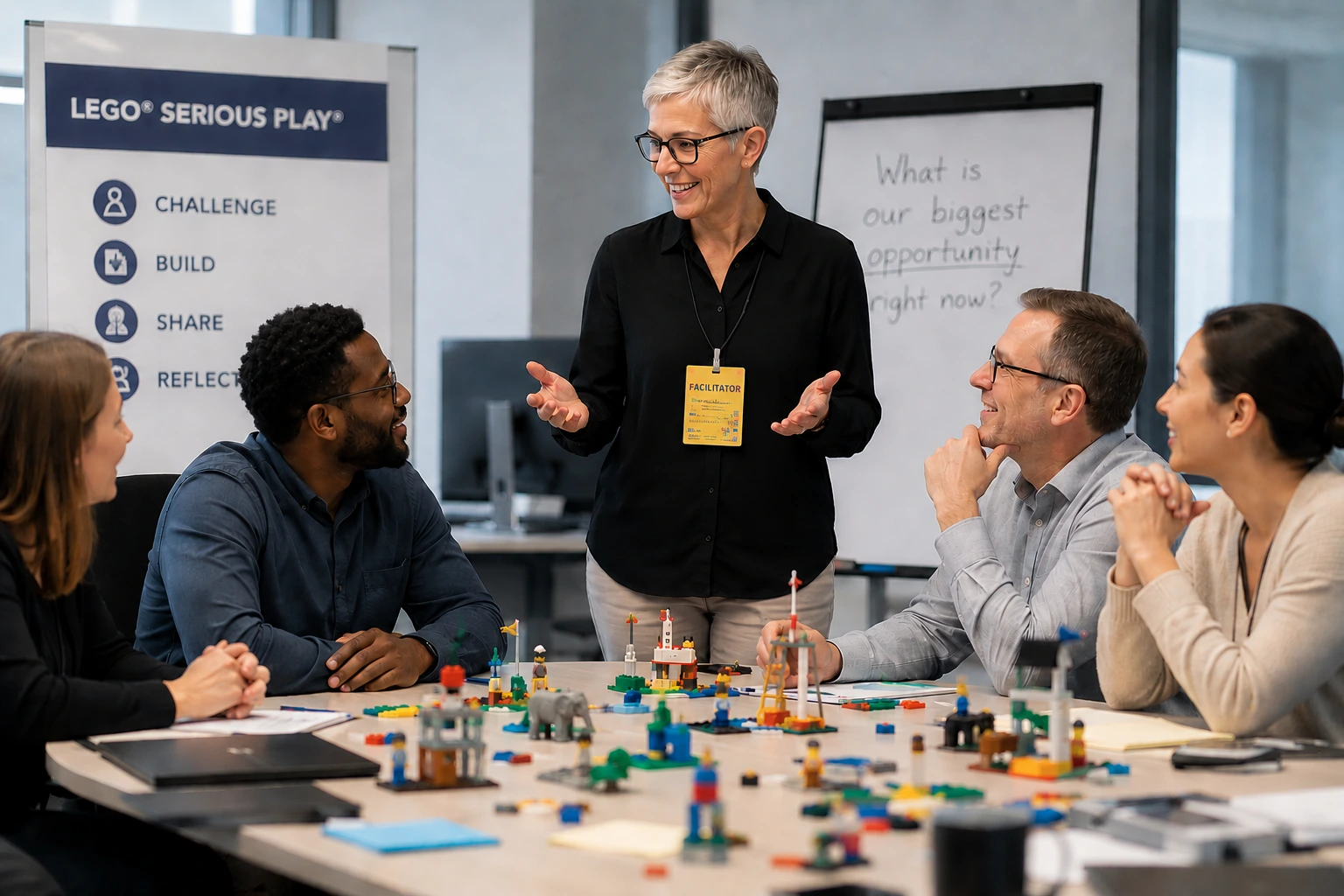
Workshop Guide: Comparing Online and In-Person Certification Readiness
The following workshop outline can help an organization, consultant group, or HR team decide whether LSP certification online or in-person facilitator certification is the stronger fit.
Click the ‘+’ button below to explore the detailed workshop stages.
1. Define the Certification Purpose & 2. Map Future Workshop Contexts
Step 1: Define the Certification Purpose — 20–30 minutes. The facilitator prompts participants to identify why certification is being considered. Participants build silently in response to the question: “What organizational capability do we need this certification to create?” Each person shares the model’s meaning, and the group records patterns related to strategy, leadership, culture, innovation, or change.
Step 2: Map Future Workshop Contexts — 25–35 minutes. The facilitator prompts participants to build the environments where they expect to apply the method. Participants may represent executive retreats, hybrid teams, leadership programs, culture workshops, or client strategy sessions. The group reflects on whether future use will be mostly in-person, online, or blended.
3. Identify Capability Requirements & 4. Compare Format Strengths and Constraints
Step 3: Identify Capability Requirements — 30–40 minutes. Participants build the facilitator capabilities they believe are essential for success. The facilitator asks the group to distinguish technical knowledge from live facilitation judgment. The group identifies capabilities such as prompt design, group reflection, handling silence, managing power dynamics, and connecting models to strategic outcomes.
Step 4: Compare Format Strengths and Constraints — 25–35 minutes. The facilitator prompts participants to build two models: one representing the strengths of online certification and one representing the strengths of in-person certification. The group reflects on trade-offs such as access, practice depth, embodied learning, travel cost, cohort diversity, and relevance to distributed work.
5. Build the Decision Model & 6. Translate the Decision Into Action
Step 5: Build the Decision Model — 35–45 minutes. Participants create a shared model showing the certification format that best fits their needs. The facilitator prompts the group to connect evidence from previous builds rather than defaulting to preference. The final model identifies the selected pathway, key risks, and conditions needed for success.
Step 6: Translate the Decision Into Action — 20–30 minutes. The facilitator prompts the group to build the first three actions required after selecting a certification format. Participants define timelines, decision owners, budget implications, and expected outcomes. The group closes by naming what would make the certification investment worthwhile 90–180 days after completion.
Outcomes of Choosing the Right Certification Format
Choosing the right certification format creates value because it aligns learning conditions with real facilitation demands. The outcome is not simply a certificate. The outcome is a facilitator who can design and guide conversations that change how people think, decide, and act together.
The first outcome is stronger facilitator confidence. Participants know how to introduce the method, structure build challenges, and support reflection without over-directing the group.
The second outcome is better organizational alignment. Certified facilitators can help teams identify conflicting assumptions before strategic planning begins, which reduces wasted effort and improves execution clarity.
The third outcome is more credible strategic facilitation. Consultants and internal leaders can position workshops as serious decision-support processes rather than generic collaboration sessions.
The fourth outcome is improved readiness for complex environments. Facilitators understand how leadership behavior, communication patterns, culture, and strategy interact as feedback loops.
The best certification pathway is the one that prepares facilitators for the rooms, teams, and decisions they will actually support.
Transform Your Strategy Conversations
Work with Serious Play Business to build facilitation capability and design workshops grounded in the LEGO® SERIOUS PLAY® Method — whether your teams meet online, in person, or somewhere in between.
To understand the full methodology behind the workshop design described above, read The LEGO® Serious Play® Method explained.
Frequently Asked Questions
Is LSP certification online as effective as in-person certification?
LSP certification online is as effective as in-person certification when the program preserves live practice, structured reflection, facilitator feedback, and the core LEGO® SERIOUS PLAY® Method. Online certification becomes less effective when it relies mainly on recorded content or theory without active facilitation practice.
What is the main difference between online and in-person LEGO® SERIOUS PLAY® certification?
The main difference between online and in-person LEGO® SERIOUS PLAY® certification is the learning environment. In-person certification offers stronger embodied group experience, while online certification can offer greater accessibility and stronger preparation for distributed facilitation contexts.
Who should choose LSP certification online?
Professionals should choose LSP certification online when they need access, schedule flexibility, or preparation for facilitating distributed teams. LSP certification online can be especially useful for consultants, HR professionals, and change leaders who support clients or teams across multiple locations.
Who should choose in-person facilitator certification?
Professionals should choose in-person facilitator certification when they want immersive practice, live group dynamics, and direct experience managing a physical workshop environment. In-person training is especially relevant for people who expect to facilitate leadership offsites, executive retreats, and complex team alignment sessions.
Does facilitator certification prepare people to run strategic workshops?
Facilitator certification should prepare people to run strategic workshops when the training includes workshop design, live facilitation practice, prompt development, reflection techniques, and application to organizational challenges. Certification is strongest when it connects method competence to leadership, culture, innovation, change, and strategic facilitation.
Is LEGO® SERIOUS PLAY® certification only for consultants?
LEGO® SERIOUS PLAY® certification is not only for consultants. Internal HR leaders, learning and development professionals, transformation teams, agile coaches, innovation leaders, and senior facilitators can also use the method to support organizational alignment and complex decision-making.