

How to Choose a LEGO® SERIOUS PLAY® Certification Provider in 2026
There is no official LEGO® SERIOUS PLAY® certification. On June 1, 2010, the LEGO® Group released the method's basic principles and philosophy under a Creative Commons Attribution-ShareAlike 3.0 license and stopped maintaining a licensed partner network. Since that date the LEGO® Group has not offered, accredited, or approved any facilitator certification program. Every certificate on the market is issued by a private training provider, on that provider's own authority.
That makes provider selection the entire decision. Two courses can carry near-identical titles and differ by a factor of five in contact hours, feedback, and post-course support. This guide gives you seven questions to ask before you pay, a side-by-side comparison framework, role-specific guidance for HR and L&D leaders, independent consultants, and academics, and the red flags that indicate a thin program.
To choose a LEGO® SERIOUS PLAY® certification provider, evaluate seven things: years spent training facilitators, the lead trainer's real facilitation record, total contact hours, whether you receive individual feedback on your own session plan, what support continues after the course, what the certificate actually represents, and the true total cost including travel. No provider can offer LEGO®-approved certification, because no such thing exists. The differentiator is the depth of training behind the certificate, not the certificate itself.
Why There Is No "Official" LEGO® SERIOUS PLAY® Certification
This is the single most misunderstood fact in the market, and it changes how you should read every provider's sales page.
What the LEGO® Group released in 2010
Before 2010, the LEGO® Group maintained a network of licensed partners and facilitators. On June 1, 2010, it moved the method to a community-based model and published the basic principles and philosophy under a Creative Commons Attribution-ShareAlike 3.0 license.
Two of the method's three original resource layers were opened: the principles and philosophy, and the specially selected brick sets. Detailed workshop applications were not included in that release. The LEGO® Group's own background page states plainly that since June 2010 it no longer maintains a licensed partner network and no longer offers LEGO® SERIOUS PLAY® certification training.
What that means for you as a buyer
Anyone may lawfully train facilitators in the method, provided they respect the license terms and the LEGO® Group's trademark guidelines. There is no regulator, no accreditation board, and no examining body with authority over the method.
Several communities have formed since the open-source release, including the Association of Master Trainers, Serious Play Pro, LSPConnect, and the Global Federation of LSP Master Trainers. These are communities and networks. None of them is a governing body, and membership of one is a signal about a provider's network, not proof of teaching quality.
Since June 2010, the LEGO® Group has not certified LEGO® SERIOUS PLAY® facilitators. Every certificate available today is issued by a private provider on its own authority, which makes the provider — not the certificate — the thing you are actually buying.
The 7 Questions to Ask Before You Pay
Ask these of every provider on your shortlist, and ask them in writing. A provider confident in its program will answer all seven with specifics. Vagueness on any of them is information.
1. How long has the provider been training facilitators?
Longevity signals refinement. A provider that has run the same program for a decade has watched hundreds of facilitators succeed and fail, and has rebuilt the curriculum around what actually breaks in the room.
Ask for the year they started training facilitators, not the year the company was founded. These are often different, and the gap tells you whether facilitator training is the core business or a recent add-on.
2. Who teaches the course, and what is their facilitation record?
Training facilitators and facilitating workshops are different skills, and you want someone who does both. A trainer who has not run a live session with a difficult executive group in three years cannot teach you how to handle one.
Ask specifically:
- Who designed the curriculum, and who delivers the live components?
- What organizations has that person facilitated for, and at what group sizes?
- Where did they receive their own training in the method?
- Are they contactable during the course, or is delivery handled entirely by junior staff?
3. How many hours of content do you actually receive?
This is the number that varies most and gets disclosed least. Programs in this market range from a single two-day intensive to 40+ hours of structured content spread across modules.
Neither format is automatically better, but the hours should be stated. If a provider will not tell you the total contact hours before you pay, treat that as a pricing decision rather than an oversight.
4. Do you get individual feedback on your own session plan?
This is the sharpest quality divider in the market. Recorded video teaches you what the method is. Feedback on a plan you wrote, for a group you actually work with, teaches you to facilitate.
Ask whether feedback is included, who provides it, how many rounds you get, and whether it is written or live. "Access to a community forum" is not feedback.
The clearest quality signal in LEGO® SERIOUS PLAY® training is not the syllabus — it is whether a named expert reviews your own session plan and tells you what is wrong with it before you stand in front of a real group.
5. What support continues after the course ends?
Most facilitators do not run their first real session the week they finish training. They run it three months later, when a stakeholder finally says yes, and that is when the questions arrive.
Ask how long you keep access to materials, whether templates and session plans are downloadable, and whether you can still ask questions after certification.
6. What does the certificate actually represent?
Ask what you must complete to earn it. A certificate awarded for attendance means something different from one awarded after assessed assignments.
Also ask what the certificate does not claim. Any provider suggesting their credential is LEGO®-approved, LEGO®-endorsed, or officially recognized by the LEGO® Group is describing something that has not existed since 2010.
7. What is the true total cost?
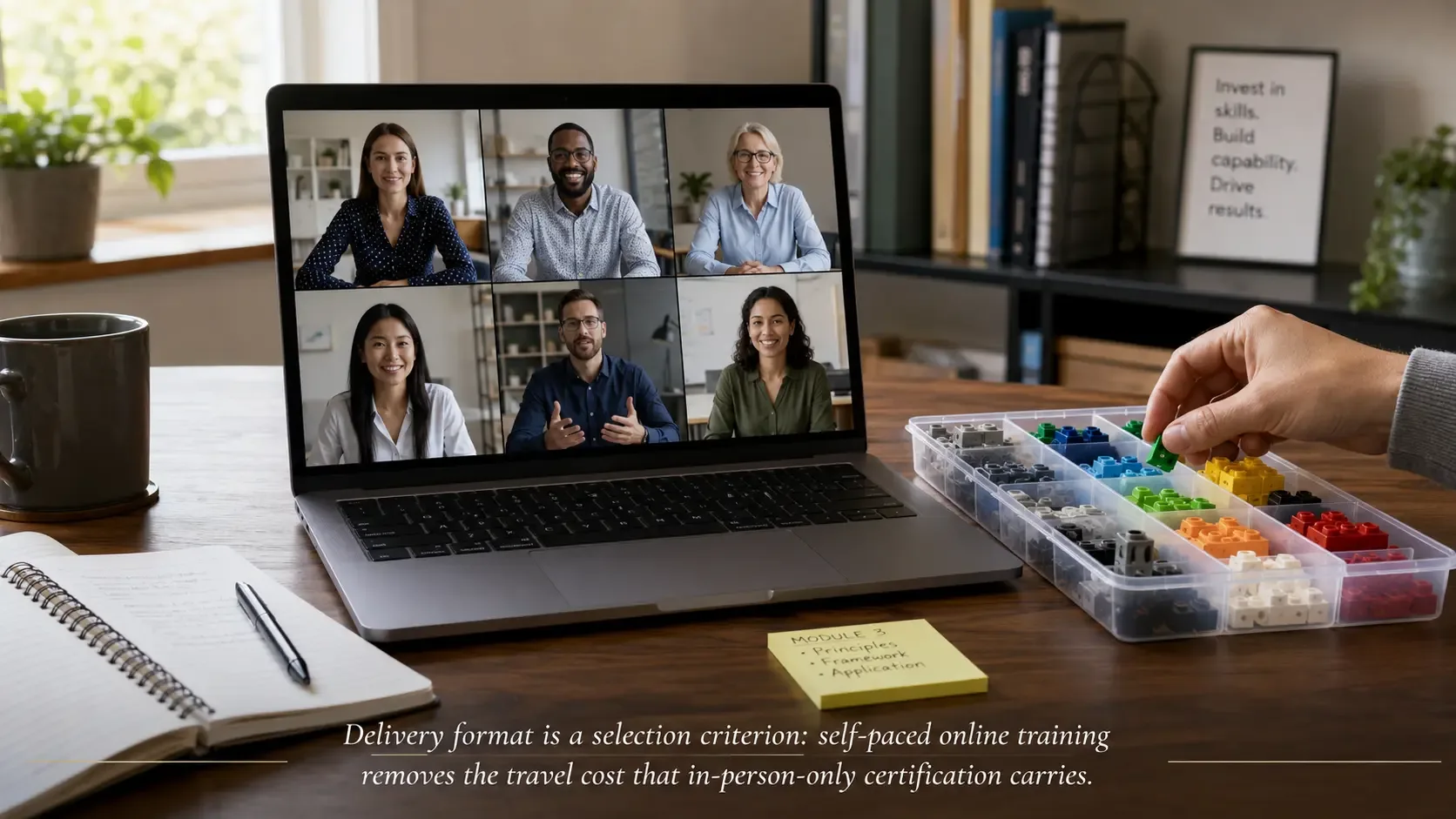
Compare landed cost, not sticker price. In-person programs commonly require several days off work plus flights and accommodation, which can exceed the course fee itself.
Build the comparison from these components:
- Course fee, including any tax
- Travel, accommodation, and meals for in-person delivery
- Working days lost to attendance
- Brick sets, if not included
- Recurring membership or renewal fees, if any
- Cost of upgrading later, if you start with an entry tier
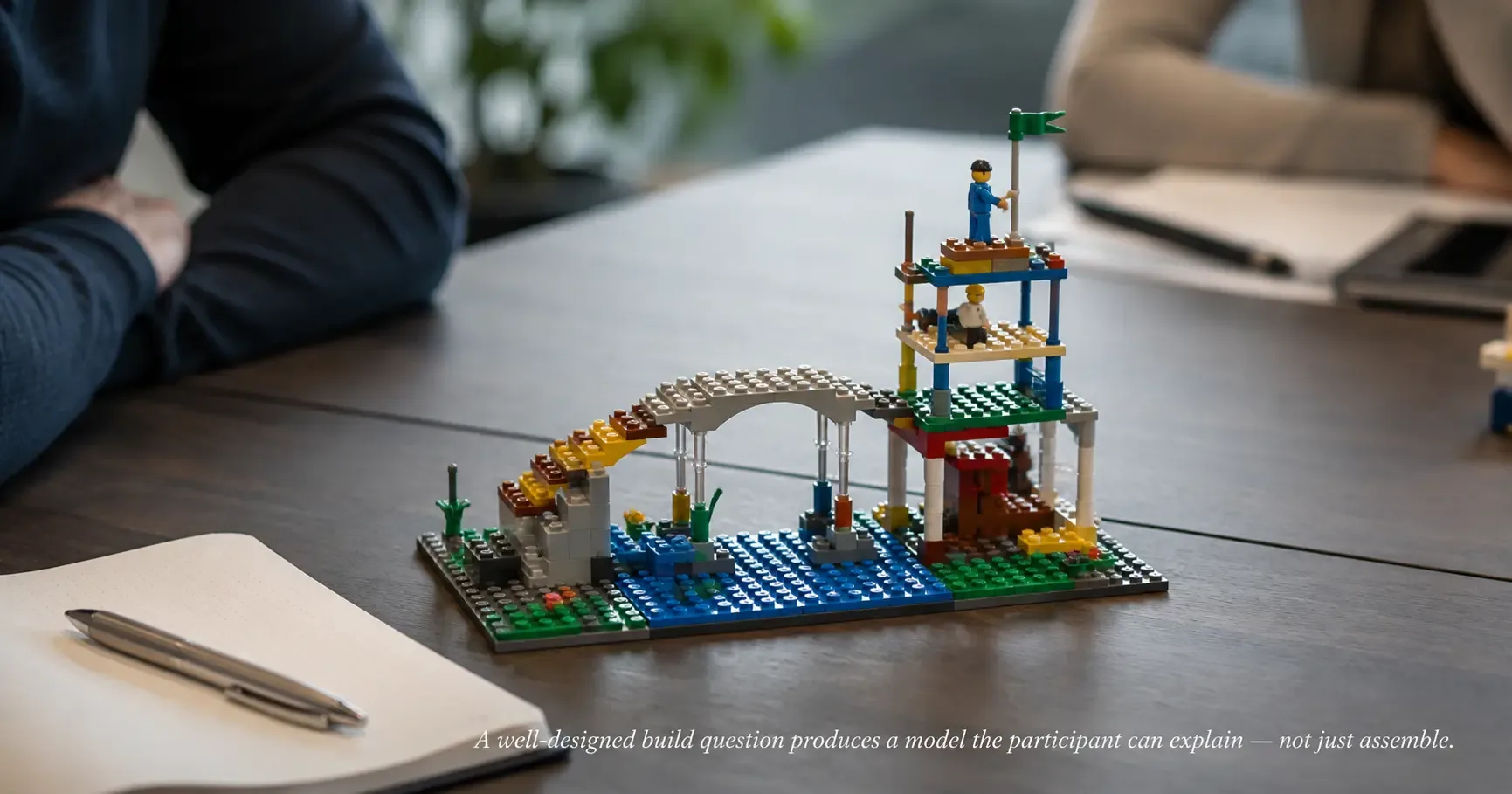
Provider Comparison Framework
Score each shortlisted provider against the same criteria. Weight the rows that matter to your situation rather than treating them equally.
| Criterion | Strong signal | Weak signal |
|---|---|---|
| Years training facilitators | A decade or more, stated openly | Unstated, or company age used as a proxy |
| Lead trainer | Named, with a verifiable facilitation record | Unnamed "expert team" |
| Contact hours | Total stated before purchase | Described only as "comprehensive" |
| Individual feedback | Named reviewer, on your own session plan | Forum access described as support |
| Assessment | Submitted assignments, assessed | Certificate on attendance |
| Post-course access | Defined period, downloadable materials | Access ends with the final session |
| Claims about LEGO® | States clearly that no official certification exists | Implies LEGO® approval or endorsement |
How to Choose Based on Your Role
The right provider depends on what you will do with the method the week after you finish. Three buyer profiles dominate this market, and their priorities differ.
HR and L&D leaders
You will most likely run onboarding, culture, and team-building sessions internally, often with groups who did not choose to be there.
- Prioritize ready-to-use session plans you can adapt to internal briefs quickly
- Check for guidance on shorter formats — full workshops rarely fit a corporate calendar
- Confirm materials are downloadable, since internal programs get repeated
- Ask about group pricing if you intend to certify more than one person
Independent consultants and coaches
You are adding a billable method to a practice, so credibility with clients and confidence in unfamiliar rooms both matter.
- Prioritize individual feedback and live practice over recorded content volume
- Ask whether the program covers commercial positioning and how to sell the method
- Value access to a peer network for referrals and co-facilitation
- Check whether you can observe or participate in a full session from the participant's seat
Academics and educators
You need the research grounding as much as the technique, and you are usually working within a fixed teaching schedule.
- Ask which peer-reviewed work the curriculum draws on
- Prioritize self-paced delivery that fits around a semester
- Look for material on adapting the method to classroom-length sessions
- Check whether the provider has trained others in academic settings
Red Flags to Watch For
None of these is proof of a bad program on its own. Two or more together should slow you down.
Claims that cannot be true
- Any suggestion of LEGO®-approved, LEGO®-authorized, or officially recognized certification
- Language implying the provider is the only legitimate source of training
- Claims that using the method requires a license fee to the LEGO® Group — it has not since 2010
Disclosure gaps
- Total hours, trainer identity, or full price not published before checkout
- Testimonials without names, roles, or countries
- No clear statement of what the certificate requires you to complete
Structural weaknesses
- No feedback on your own work at any point in the program
- Access to materials ending the day the course ends
- Recurring fees required to keep describing yourself as certified
Running Your Provider Evaluation in Five Steps
A structured evaluation takes about a week of low-effort work and reliably separates the shortlist. The stages below group the five steps into three phases.
Click the '+' button below to explore the detailed workshop stages.
1. Define your use case & 2. Build the shortlist
1. Define your use case (30 minutes): Write down the first three sessions you actually intend to run — the group, the size, the question, and the time available. Nearly every later comparison resolves against this document. A provider strong for two-hour internal team sessions is not necessarily strong for full-day executive strategy work.
2. Build the shortlist (1–2 hours): Identify three to five providers. Include at least one online, self-paced option and one in-person option so you can compare landed cost honestly. Record each one's published hours, price, trainer name, and delivery format in a single sheet before you contact anyone.
3. Send the seven questions & 4. Score the responses
3. Send the seven questions (30 minutes): Email the same seven questions to every shortlisted provider. Using identical wording matters — it makes the responses genuinely comparable and reveals who answers directly. Note response time as a proxy for the support you will receive later.
4. Score the responses (1 hour): Fill in the comparison framework above. Weight the criteria according to your use case document rather than scoring every row equally. If a provider left a question unanswered, record it as unanswered rather than assuming a middling score.
5. Verify before you commit
5. Verify independently (1–2 hours): Check the lead trainer's professional profile and published work. Look for named graduates and contact one or two directly — most will answer a short, specific question about whether the training prepared them for real sessions. Confirm the total cost in writing, including anything not covered by the course fee, before you pay.
How Serious Play Business Answers These Questions
Applying the same seven questions to our own program, with the specifics stated openly.
Experience and reach
Serious Play Business is part of The Focus Learning Group Pty Ltd, founded in Sydney, Australia in 2008 and rebranded from Play4Business in 2024. We have spent 19+ years refining how the method is taught, and have trained more than 1,800 facilitators, consultants, and academics across 38 countries.
Our founder, Dr Denise Meyerson, was appointed by the LEGO® Group as one of the original four Master Trainers of the method, and has been a Master Trainer since 2010. She is also a Master Trainer with the Association of Master Trainers. Organizations we have worked with include Virginia Commonwealth University, Miami University, Capgemini, Kaiser Permanente, Syngenta USA, the US Air Force, the US FCC, and the Metropolitan Council of Minnesota.
What is included
The Foundational Certification provides 40+ hours of curated content and recorded live sessions, an individualized Q&A session with tutor feedback, three ready-to-use session plans, bonus modules covering marketing and academic applications plus the "What the Duck®" short-format methodology, and 12 months of access to all resources and downloadable templates.
The certificate is awarded on completion of 10+ modules and two submitted assignments — not on attendance. The Advanced Certification adds two 2-hour live sessions on advanced techniques, access to a global facilitator network, and the experience of a full session from the participant's perspective. You can read more about the underlying approach on our methodology page.
Serious Play Business has trained more than 1,800 facilitators across 38 countries over 19+ years, with certification awarded on assessed assignments rather than attendance.
Pricing and delivery
The Foundational Certification is US$750 and the Advanced Certification is US$1,300, both delivered fully online and self-paced. Because there is no travel or time away from work, the list price is close to the landed cost — which is the comparison that matters when weighing an in-person alternative.
Our pricing reflects a deliberate position: the method should be accessible to more than the few who can absorb very high price points. You can compare both tiers on our certifications page, or see the organizations our facilitators work with on our clients page.
On the certificate question, our position is the same one we recommend you apply to every provider: no certification in this market is approved by the LEGO® Group, ours included. What we offer is depth of training, assessed work, expert feedback, and 19+ years of doing only this.
Ready to Choose With Confidence?
Bring your seven questions to us. We will answer all of them in writing, tell you plainly whether our program fits the sessions you intend to run, and say so if it does not.
To understand the full methodology behind the workshop design described above, read The LEGO® SERIOUS PLAY® Method Explained.
Frequently Asked Questions
What should I look for when choosing a LEGO® SERIOUS PLAY® certification provider?
Look at seven things: how long the provider has been training facilitators, who teaches the course and what they have facilitated, total contact hours, whether you receive individual feedback on your own session plan, what support continues after the course, what the certificate requires you to complete, and the true total cost including travel and time away from work. Ask all seven in writing and compare the answers side by side.
Is any LEGO® SERIOUS PLAY® certification official or approved by the LEGO® Group?
No. On June 1, 2010, the LEGO® Group moved the method to a community-based model under a Creative Commons Attribution-ShareAlike 3.0 license and stopped maintaining a licensed partner network. Since then it has not offered or accredited facilitator certification. Every certificate available today is issued by a private provider on its own authority, so any claim of official LEGO® approval is inaccurate.
How many years of experience should a facilitator trainer have?
There is no minimum, but ask for the year they began training facilitators rather than the year the company was founded. Providers with a decade or more of facilitator training have usually rebuilt their curriculum several times around what fails in real rooms. Pair the years figure with the number of facilitators trained and the countries covered, since a long history with few graduates tells a different story.
What is a Master Trainer of LEGO® SERIOUS PLAY®?
Master Trainer describes someone qualified to train facilitators rather than only to facilitate sessions. Four Master Trainers were appointed by the LEGO® Group around the time the method moved to open source, and the term is now also used by community organizations such as the Association of Master Trainers, which certifies its own trainers. Because no single body governs the method, ask any provider where their Master Trainer status comes from and what it required.
Why do LEGO® SERIOUS PLAY® certification prices vary so much between providers?
Price differences mostly reflect delivery format, contact hours, and how much individual expert time is included. In-person programs carry venue and trainer travel costs, and require you to fund flights, accommodation, and days away from work. Self-paced online programs remove those costs, which is why the sticker price is a poor comparison — build the landed cost for each option before deciding.
Do I need prior facilitation experience to get certified?
Not for most foundational programs, including ours. What matters more is being clear about the sessions you intend to run, because that determines which provider suits you. If you have no facilitation background, weight individual feedback and assessed assignments heavily in your comparison — those are what convert knowledge of the method into the ability to run a room.