

The hand-mind connection serves as the core cognitive principle behind the LEGO® SERIOUS PLAY® Method. Consequently, it makes this tool highly effective in professional business settings. In 2026, understanding this connection matters immensely.
Organisations constantly ask their people to think clearly under intense pressure. Furthermore, they expect teams to communicate across massive complexity and make rapid decisions. For professionals working in leadership, HR, and organisational development, this principle dictates strategic success. Ultimately, the quality of group thinking directly determines the quality of execution.
Crucially, teams do not fail merely from a lack of effort. Instead, they fail when deep assumptions remain completely invisible. As a result, invisible assumptions lead to weak alignment, repeated misunderstandings, and painfully slow decision-making.
Insight 1: The hand-mind connection matters because people often understand vastly more than they can immediately explain. Specifically, building physical models gives that hidden understanding a clear, visible structure.
What the Hand-Mind Connection Actually Means
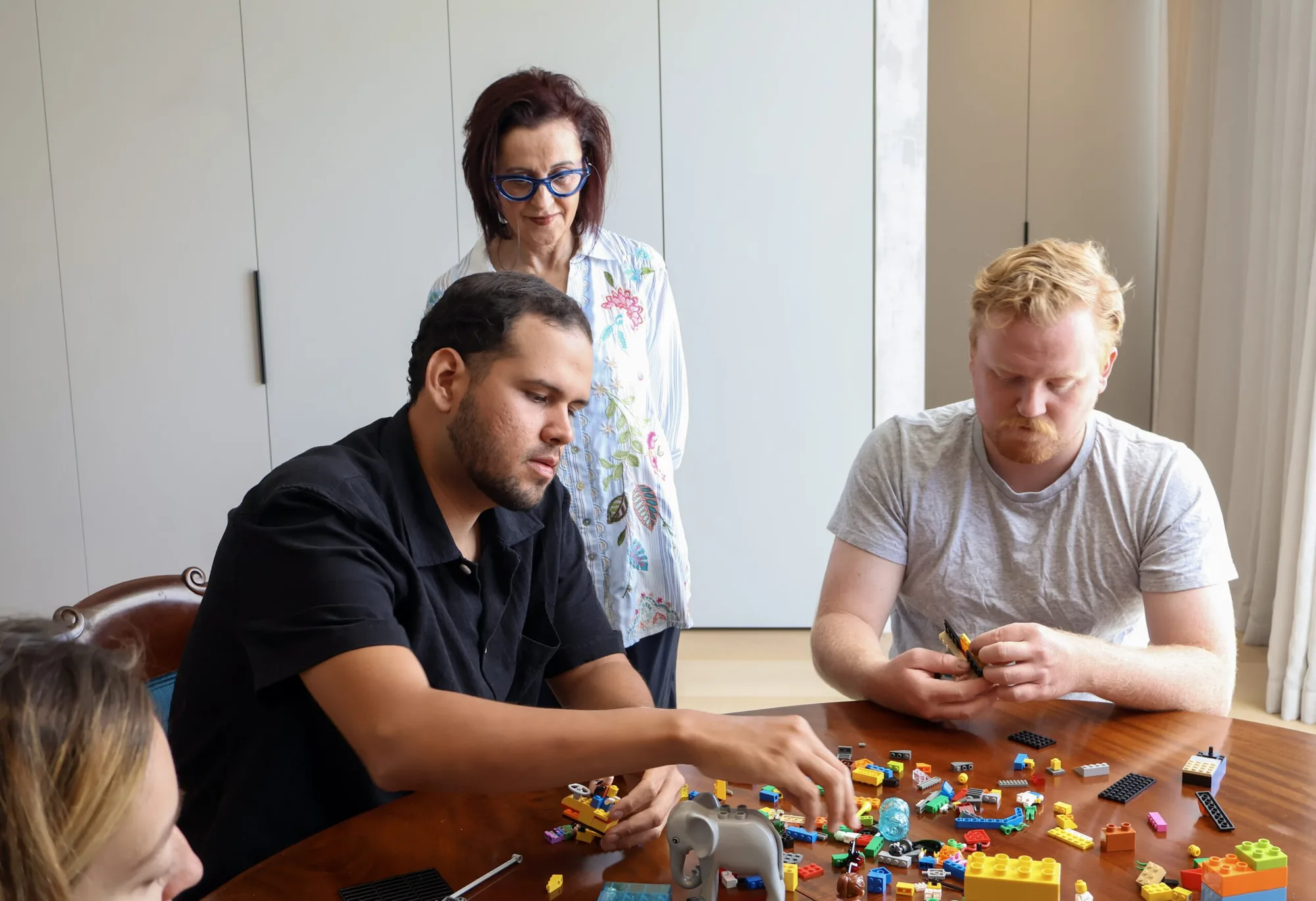
Essentially, the hand-mind connection defines the powerful relationship between physical manipulation and deep cognitive processing. In highly practical terms, using our hands actively supports how we access, structure, and communicate complex ideas.
This matters deeply in modern organisations. Many business problems simply remain too complex, overly political, or incredibly ambiguous to solve through casual conversation alone. In professional workshops, the hand-mind connection actively helps participants quickly convert internal thoughts into a highly visible form.
Why does this visibility matter? People almost always know more than they can comfortably say. Specifically, they carry incomplete impressions, subtle emotional signals, and fragmented data patterns. Unfortunately, these insights rarely emerge easily during a conventional discussion. Therefore, building models gives those loose fragments a rigid structure. Consequently, this structure leads directly to far deeper reflection and significantly clearer language.
Why This Matters for Organisations, Not Just Individuals
Unlocking Collective Intelligence
Experts often explain the hand-mind connection as a purely individual cognitive benefit. However, its greatest true value remains deeply organisational. Businesses desperately need better shared thinking across teams, distinct functions, and all levels of authority. They do not just need smarter individuals.
In many large organisations, a lack of raw intelligence rarely causes problems. Instead, the real problem occurs when brilliant insight remains trapped inside isolated, individual perspectives. People hold highly valid observations about critical risks or culture. Yet, those observations stubbornly stay partial and totally disconnected. Standard meetings rarely solve this dilemma. Specifically, traditional meetings heavily privilege fast speech, highly polished opinions, and rigid role-based influence.
Changing the Emotional Tone
The LEGO® SERIOUS PLAY® Method fundamentally changes this broken dynamic. It actively makes the hidden thinking of each participant highly visible. Once that visibility occurs, the workshop smoothly moves from scattered, loud opinions to calm, shared inspection.
Furthermore, a highly visible model instantly changes the emotional tone of the entire room. Instead of aggressively arguing over who is right, participants safely explore exactly what the neutral model reveals. Consequently, this simple shift drastically reduces personal defensiveness. The intense discussion shifts rapidly from personal assertion to objective, collective interpretation. Ultimately, the organisation quickly gains much better information without increasing any interpersonal threat.
Insight 2: Organisations perform significantly better when vital knowledge becomes physically inspectable. Visible thinking allows teams to collaboratively work on the exact same system, rather than aggressively defend separate opinions.
Why Traditional Verbal Discussion Leaves Too Much Hidden
Traditional discussion inevitably leaves far too much hidden. This happens because spoken language remains inherently selective. People usually only say what feels completely safe or what comfortably fits the strict norms of the room. This self-censorship matters tremendously. The most important organisational information is very often incomplete, highly emotional, or deeply politically sensitive.
Moreover, a conventional strategy meeting strongly rewards both speed and extreme confidence. Leaders fully expect participants to present firm conclusions, not cautiously explore emerging thoughts. While this process certainly sounds efficient, it actually creates a massive structural blind spot. The group clearly hears the finished, polished statement. However, they completely miss the underlying mental model that built it. As a result, diagnosing real disagreement becomes incredibly hard.
Fortunately, the hand-mind connection effectively solves that specific problem. Building actively slows human thinking down just enough. Consequently, this slight pause allows hidden, complex structures to finally emerge.
Insight 3: Verbal meetings constantly hide critically important information. People present safe conclusions first. Conversely, model building safely reveals the raw assumptions that actually produced those conclusions.
The Cognitive and Methodological Foundation
The hand-mind connection plays a massively strong methodological role in the LEGO® SERIOUS PLAY® Method. Specifically, the method relies entirely on deep constructionist logic. Constructionism firmly holds that people understand complex concepts vastly more effectively when they actively create external, physical artefacts.
In high-stakes business workshops, this concept matters for three crucial reasons:
- Reduces Cognitive Overload: Complex business issues involve far too many variables to hold safely in working memory. Building models moves that heavy complexity directly into a visible structure.
- Improves Recall and Engagement: A physically constructed model remains vastly more memorable than a static slide. Building actively creates intense, lasting involvement.
- Enables Powerful Metaphor: Organisational life overflows with highly abstract concepts like trust, fear, and deep politics. A built model expresses these vague concepts far more clearly through distinct physical forms.
How LEGO® SERIOUS PLAY® Uses the Hand-Mind Connection
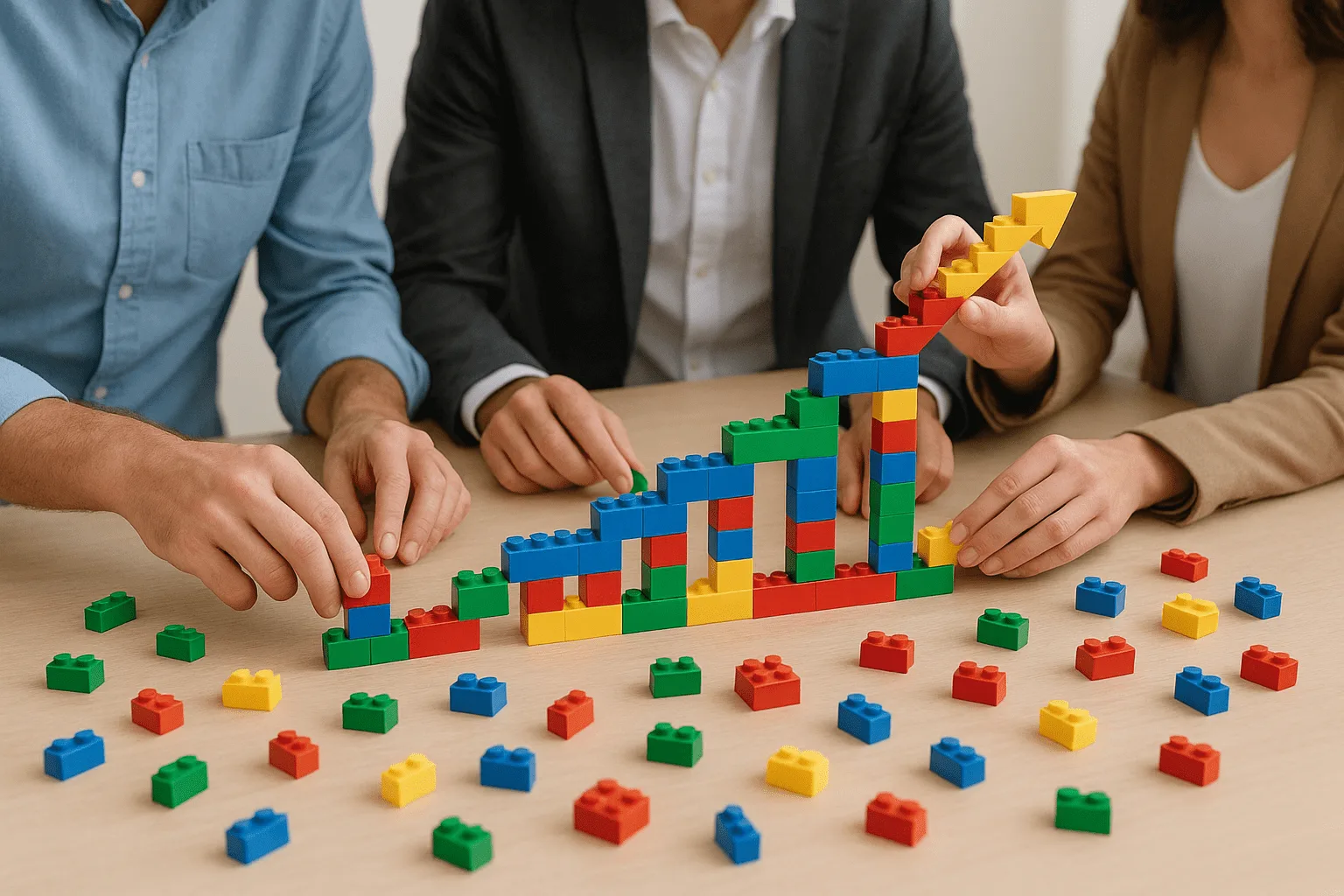
The LEGO® SERIOUS PLAY® Method deliberately uses the hand-mind connection through a highly structured, rigid sequence. Each step matters immensely. The true cognitive value of the method depends entirely on strict sequence, not wild spontaneity.
Click the '+' button below to explore the core 4-step process.
The 4-Step Core Process
- Question: The facilitator poses a highly focused question. Unclear prompts always create vague models, which inevitably leads to weak organisational insight.
- Build: Participants quickly build a response using LEGO bricks. This physical process strongly activates the hand-mind connection. Raw thought instantly becomes physical, and powerful metaphors begin to organise meaning.
- Share: Each participant thoroughly explains their model. This crucial step smoothly converts private, hidden meaning into highly accessible, shared language.
- Reflect: Finally, the group actively identifies deep patterns, hidden tensions, and critical dependencies. Insight only becomes truly strategic when the team interprets the entire system collectively.
Why the Hand-Mind Connection Improves Participation Quality
Participation quality matters significantly more than raw participation volume. Indeed, many corporate meetings contain plenty of loud talking. However, they severely lack thoughtful, even contribution distributed fairly across the entire group.
The hand-mind connection dramatically improves participation quality. Specifically, it completely changes what actually counts as a valid contribution. In a normal meeting, contributing often simply means speaking quickly or possessing high positional authority. Conversely, in a LEGO® SERIOUS PLAY® session, contribution always begins with building.
This shift matters deeply. People who naturally reflect more, or those who feel less comfortable with aggressive verbal competition, can finally contribute with total, equal legitimacy. Consequently, this actively supports the crucial 100/100 principle: 100 percent robust participation from 100 percent of the attendees.
Insight 4: Participation improves massively when building comes first. Contribution no longer depends heavily on verbal dominance, quick speed, or strict positional authority.
A Practical Workshop Example
Below is a highly practical, reference-grade workshop outline. It clearly demonstrates exactly how a skilled facilitator effectively uses the hand-mind connection in a serious professional setting.
Click the '+' button below to view the detailed workshop steps.
Workshop: Surfacing Hidden Team Assumptions
Audience: Leadership team or cross-functional managers (2.5 to 4 hours).
- Frame the objective (10-15 mins): Explain that the workshop will deeply explore how the team currently understands its critical obstacles and priorities.
- Skill-building warm-ups (15-25 mins): Participants complete very short, simple builds to safely learn metaphor and storytelling basics first.
- Build “how work feels right now” (20-30 mins): Create a model representing the current team system. Emotional and structural information will emerge together seamlessly.
- Share and clarify meaning (25-35 mins): Every participant explains their model. The facilitator asks highly clarifying questions regarding specific barriers and fragilities.
- Identify recurring patterns (15-20 mins): The group thoughtfully reflects on shared themes such as blocked communication or leadership bottlenecks.
- Build a shared model of the desired state (25-35 mins): Participants co-create a detailed model of exactly what vastly better collaboration would genuinely look like.
- Build bridges from current to future state (20-30 mins): The team explicitly identifies key interventions and ownership points, turning raw insight into highly practical steps.
- Close with commitments (10-15 mins): Participants firmly name one specific change they will actively make or strictly monitor moving forward.
Strategic Relevance in 2026
In 2026, the hand-mind connection has become significantly more strategically relevant. Organisations now operate under extreme conditions of high volatility, relentless speed, and immense cognitive strain. Leaders expect teams to constantly process massive ambiguity and confidently make rapid decisions with far less certainty.
This intense environment drastically increases the urgent value of robust methods that genuinely help people think clearly together. Furthermore, as organisations rely increasingly heavily on abstract digital tools and complex AI-supported workflows, the immense value of highly tactile sense-making will only increase.
Frequently Asked Questions (FAQ)
What is the hand-mind connection in LEGO® SERIOUS PLAY®?
It is the powerful relationship between actively building physical models with your hands and thinking vastly more clearly about highly complex, abstract business issues.
Why does building actually improve thinking in workshops?
Building strongly improves thinking because it effectively slows the brain down. It helps participants externalise deep tacit knowledge and turn confusing, abstract ideas into highly visible, manageable models.
Is the hand-mind connection only about generating creativity?
No, absolutely not. It is fundamentally about improving cognition, deep reflection, accurate memory, clear communication, and robust systems thinking.
Why does facilitator certification truly matter?
Certification matters deeply because the hand-mind connection only creates real business value when a trained expert designs and guides the workshop properly. Certification actively ensures facilitators know exactly how to ask strong questions and accurately interpret complex models.
LEGO® SERIOUS PLAY® for Organisations: Why Strategic Thinking Works Better in 3D
Discover how LEGO® SERIOUS PLAY® for organisations helps teams improve strategic thinking, alignment, leadership dialogue, and decision-making through structured, hands-on facilitation.
Learn More