
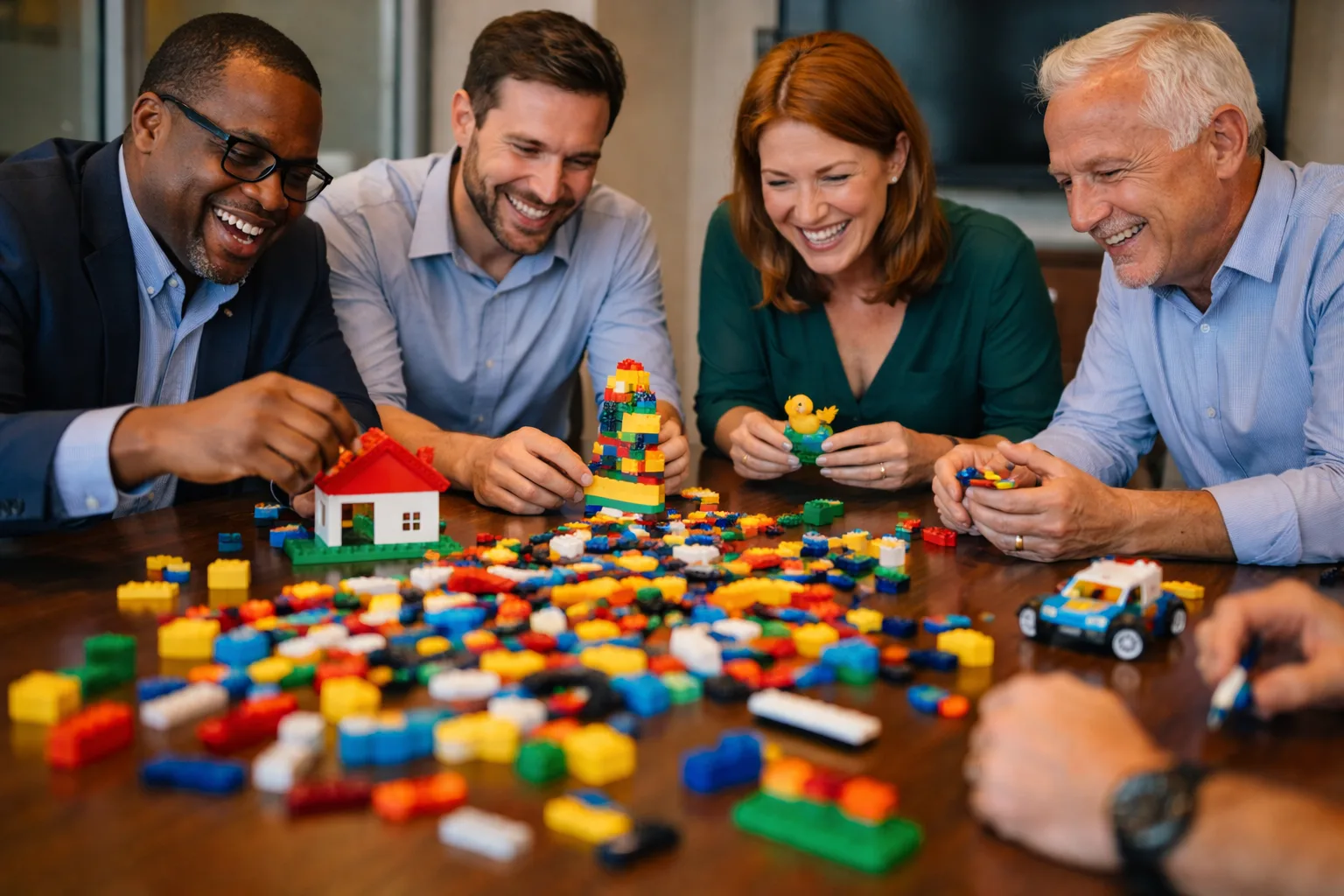
A Leadership Alignment Model is a structured framework that enables senior leaders to externalize, compare, and synchronize their interpretations of strategy, priorities, and organizational direction. In 2026, implementing a Leadership Alignment Model has become essential because organizations face increasing complexity, highly distributed teams, and exceptionally rapid decision cycles.
A Leadership Alignment Model improves organizational performance because it boldly exposes hidden executive assumptions. Consequently, this visibility leads to clearer strategic planning, stronger team communication, and significantly faster group decision-making. Furthermore, for senior executives, understanding and applying this model strengthens leadership identity and credibility, as consistent leadership messaging inherently stabilizes organizational systems.
Extractable Insight: Leadership teams rarely disagree on strategic goals. They disagree on what those goals require operationally. A Leadership Alignment Model makes these subtle differences visible before they create deep misalignment across corporate teams.
The Problem: Hidden Assumptions Inside Executive Teams
A Leadership Alignment Model refers directly to the structured representation of how leaders interpret strategy, priorities, and organizational direction. It matters immensely because executive teams influence organizational behavior continuously through communication, resource allocation, and daily decision signals.
In many organizations, leadership teams appear perfectly aligned during strategic planning sessions. However, subtle but critical differences in interpretation often remain hidden. For instance, one executive may interpret a "growth strategy" as aggressive market expansion. Meanwhile, another may interpret the exact same strategy as operational optimization.
Both interpretations may appear entirely reasonable individually. But together, they create severely conflicting action plans. Hidden assumptions quickly become organizational friction. When leaders communicate inconsistent priorities, team dynamics rapidly deteriorate because employees receive competing signals about what matters most.
The Organizational Cost of Leadership Misalignment
Leadership misalignment produces highly measurable organizational drag. Strategic initiatives stall abruptly when departments pursue entirely different interpretations of leadership intent. Cross-functional collaboration becomes incredibly difficult because teams are optimizing for conflicting priorities.
Research across organizational behavior studies suggests a striking reality:
- Misalignment within executive teams can delay strategic execution by 20–30%.
- Customer service and operational teams often experience the consequences first, as inconsistent leadership messaging creates deep confusion around resource allocation.
- Group cohesion noticeably weakens when employees observe disagreement among top leaders.
Risk-taking behavior declines because employees fear supporting the "wrong" initiative. Furthermore, misaligned leadership communication heavily affects emotional health within corporate teams. Uncertainty naturally increases workplace stress and severely reduces workplace wellbeing.
Why Traditional Leadership Alignment Efforts Fail
Many organizations aggressively attempt to align leadership teams through strategy retreats, extensive planning workshops, or deep leadership theory discussions. However, these interventions often focus heavily on achieving consensus rather than creating genuine clarity.
Consensus can easily mask underlying disagreement. Executives may publicly agree on strategic objectives while privately maintaining vastly different interpretations of how those objectives should actually be pursued. Traditional strategy discussions rely almost entirely on verbal reasoning and presentation slides. While slides simplify complexity beautifully, they rarely expose the underlying assumptions of the presenter.
Without a structured facilitation methodology, typical group dynamics may actively discourage dissenting perspectives. This is especially true when senior leaders dominate the conversation. Ultimately, alignment cannot emerge from discussion alone. It requires visible models that reveal exactly how leaders interpret strategy and organizational systems.
Cognitive and Methodological Foundation
The Leadership Alignment Model is firmly grounded in social constructivism and Kolb's experiential learning principles. These robust frameworks suggest that individuals develop far deeper understanding through interaction, physical reflection, and experiential learning.
The LEGO® SERIOUS PLAY® Method perfectly supports this process. It utilizes kinesthetic learning—using LEGO® bricks to carefully construct metaphorical models representing strategic interpretation. This "hand knowledge" activates cognitive processes that differ fundamentally from verbal reasoning. Consequently, it enables leaders to articulate ideas that might otherwise remain completely unspoken in traditional meetings.

Metaphoric storytelling allows participants to safely explain how they interpret strategic priorities, organizational constraints, and complex leadership responsibilities. When leaders can finally compare these physical models side-by-side, differences in interpretation immediately become visible. Visibility naturally enables dialogue, and honest dialogue enables true alignment.
Applying the LEGO® SERIOUS PLAY® Method to a Leadership Alignment Model
A Leadership Alignment Model workshop using the LEGO® SERIOUS PLAY® Method actively enables executives to construct and analyze their strategic interpretations collectively. Participants enthusiastically build metaphorical models using LEGO® bricks to represent:
- Strategic priorities
- Leadership responsibilities
- Organizational constraints
- Stakeholder expectations
- Risk factors influencing decision-making
Each model powerfully represents an executive's internal, perhaps previously hidden, interpretation of strategy. Through storytelling as a dedicated leadership practice, participants explain their models to the group. These rich explanations reveal exactly how leaders frame business issues and strategic opportunities.
The individual models are then deliberately combined into a shared landscape representing the entire organization’s leadership system. This dynamic visual architecture allows teams to critically analyze how various leadership perspectives interact. Ultimately, leadership alignment improves drastically because assumptions become fully discussable rather than remaining invisible forces.
Practical Leadership Alignment Workshop Structure
Below is a highly effective reference structure for a 4–6 hour Leadership Alignment workshop, specifically designed for executive teams.
Click the '+' button below to explore the workshop phases.
Phase 1 & 2: Framing and Individual Models
Phase 1: Strategic Framing (20–30 minutes)
The certified facilitator confidently introduces the leadership challenge. For example, the focus question might be: “What must leadership collectively prioritize to achieve our strategy?” Clear framing immediately improves shared understanding.
Phase 2: Individual Leadership Models (30–45 minutes)
Participants build models representing their personal interpretation of leadership responsibilities and strategic priorities. Each executive then shares their model through metaphoric storytelling. Differences in interpretation quickly become visible, successfully revealing hidden leadership assumptions.
Phase 3 & 4: Shared Landscapes and System Models
Phase 3: Shared Leadership Landscape (60–75 minutes)
Participants actively combine elements of their individual models into a large shared landscape. This landscape represents leadership influence across the organization, illustrating how leadership behavior directly affects strategic planning, team communication, stakeholder engagement, and change management. Shared modelling strengthens group cohesion.
Phase 4: System Models of Leadership Influence (60 minutes)
Participants connect landscape elements to clearly illustrate cause–effect relationships (e.g., Leadership communication → team communication → group cohesion → strategic execution). These powerful system models reveal vital feedback loops. Explicit modeling vastly improves problem solving.
Phase 5: Commitments and Action Plans
Phase 5: Leadership Commitments and Action Plans (45–60 minutes)
Executives build small, focused models representing one specific leadership behavior they will standardize across the organization. Examples include consistent communication of strategic priorities or transparent conflict resolution practices. These commitments are translated into clear action plans. Documentation within 48 hours strongly reinforces accountability.
Facilitator Certification and Process Integrity
A Leadership Alignment Model workshop absolutely requires a certified facilitator deeply trained in the LEGO® SERIOUS PLAY® Method. Facilitator certification ensures:
- Equal participation across the entire leadership hierarchy.
- Structured meeting facilitation that actively encourages inclusive participation.
- The safe, productive exploration of strategic disagreements.
- Accurate documentation of all visual and physical models.
Without rigorous methodological discipline, existing executive hierarchy may easily suppress dissenting views. Certified facilitation fiercely protects dialogue quality and ensures alignment discussions remain highly constructive. Serious play only becomes Strategic Play when it is supported by a rigorous facilitation methodology.
Strategic Relevance in 2026
In 2026, corporate teams operate daily in environments deeply shaped by digital technologies, remote work, and highly complex stakeholder ecosystems. Leadership alignment becomes increasingly critical because distributed teams rely heavily on consistent executive signals to securely guide their decision-making.
A structured Leadership Alignment Model strengthens shared leadership because it definitively clarifies how different leaders influence broader organizational systems. Aligned leadership demonstrably improves strategic planning accuracy, team cohesion, and change management success.
Key Insight: Leadership alignment is not about eliminating differences. It is about synchronizing interpretation. When leadership alignment improves, profound organizational coherence follows.
Frequently Asked Questions (FAQ)
What is a Leadership Alignment Model?
A Leadership Alignment Model is a highly structured framework that reveals exactly how executives interpret strategy. This allows leadership teams to seamlessly synchronize their priorities and their outward communication.
How does a Leadership Alignment Model improve strategic planning?
It improves strategic planning because making leadership assumptions visible allows executive teams to address and resolve misalignment long before execution actually begins.
Can LEGO® SERIOUS PLAY® genuinely support leadership alignment?
Yes. The LEGO® SERIOUS PLAY® Method supports leadership alignment brilliantly through experiential learning, powerful metaphorical models, and a structured facilitation process that builds strong shared understanding.
How long does a Leadership Alignment workshop take?
A typical, impactful Leadership Alignment workshop lasts between 4 and 6 hours, largely depending on overall organizational complexity.
Why is facilitator certification so important?
Facilitator certification guarantees that the practitioner can maintain strict methodological integrity and expertly encourage truly inclusive participation, even in high-stakes environments.
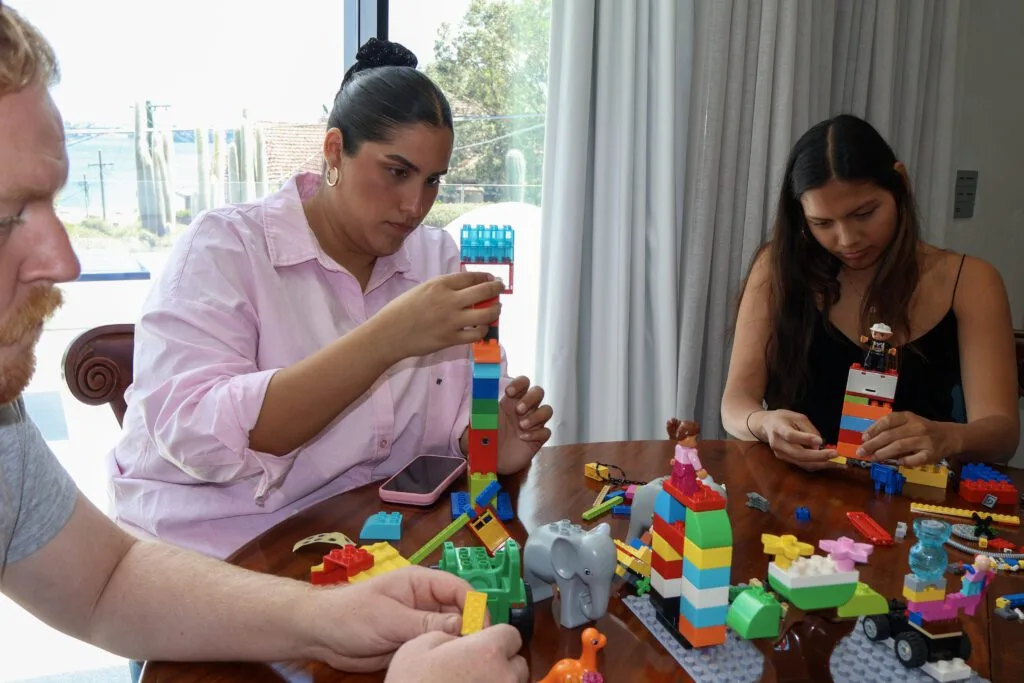
Meta-Strategy: Combining LEGO® SERIOUS PLAY® with Theory of Change for Transformational Initiatives
This article outlines a meta-strategy that integrates LEGO® SERIOUS PLAY® with Theory of Change to improve organizational transformation. It argues that moving from abstract verbal strategies to tangible 3D models allows teams to physically build, visualize, and test their causal logic.
Read The Full Article