
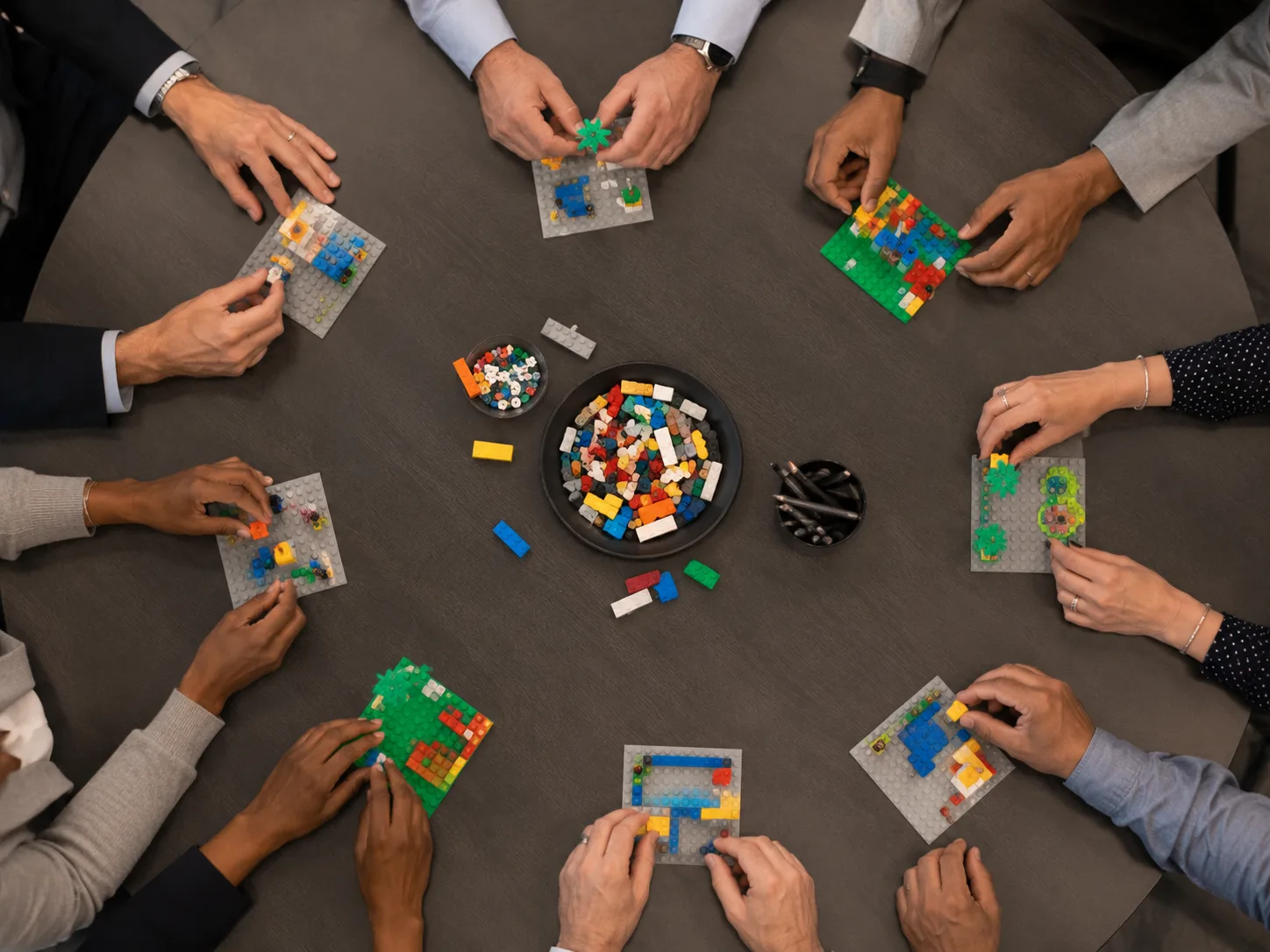
Metaphor in LEGO® SERIOUS PLAY®: Why Everyone Builds the Same Question Differently
Metaphor is the mechanism that makes LEGO® SERIOUS PLAY® work. A brick has no meaning until a participant assigns one to it, which means a single question put to eight people produces eight different models — and eight different pieces of information the group did not have five minutes earlier.
This article explains what metaphor actually does in a facilitated session, why the story matters more than the model, three metaphors that turn up in almost every workshop, and how to run a short metaphor warm-up with a group that has never touched the method.
In LEGO® SERIOUS PLAY®, metaphor is the act of a participant declaring what their model means. The bricks carry no fixed meaning of their own — a red 2x4 is a warning light to one person and a fire door to another — and it is the builder, not the facilitator, who decides. This is why the method surfaces thinking that stays hidden in ordinary discussion: people will say through an object what they will not say in a sentence.
What metaphor actually means in a LEGO® SERIOUS PLAY® session
Ask a leadership team "what is slowing us down?" in a meeting and you will get careful answers. Ask them to build it, and someone puts a small figure at the bottom of a very tall wall.
The short definition
A metaphor here is simply a physical stand-in for something abstract. The participant builds an object, then tells you what it represents.
Nothing about the brick suggests the meaning. The meaning arrives entirely in the telling, which is why two people can build near-identical shapes and describe completely different situations.
Why bricks make metaphor easier than words
Most people find it hard to describe an organizational problem out loud without either softening it or overstating it. Handing them a pile of bricks removes that pressure.
Three things change when the answer becomes an object:
- The object absorbs the risk. Criticizing a model on the table is easier than criticizing a colleague across it.
- Everyone answers at once. Nobody waits for a turn, so the confident voice in the room loses its head start.
- The thinking happens in the hands. Participants routinely discover what they meant only once they have built it.
The method's academic roots sit here too. Johan Roos and Bart Victor set out the original "serious play" concept at IMD in the late 1990s, publishing Towards a New Model of Strategy-making as Serious Play in the European Management Journal in 1999.
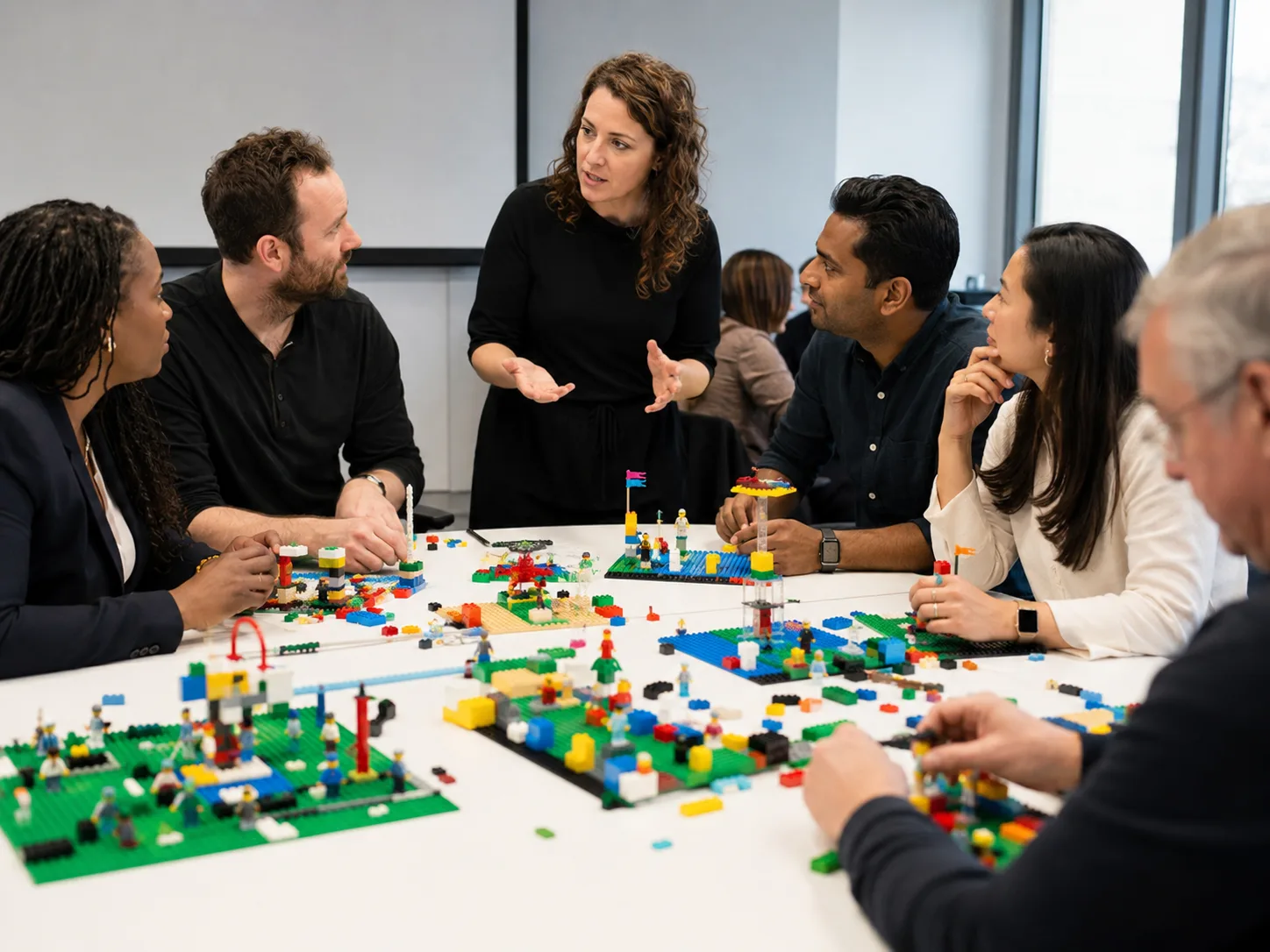
Why ten people build ten different models from one question
This is the part that surprises first-time participants. The instruction is identical for everyone, and the results are never close.
The bricks have no fixed meaning
There is no dictionary. A ladder is progression to one builder and an escape route to the next, and both readings are correct because both builders said so.
Facilitators who quietly develop their own key — green means growth, a wheel means momentum — start getting worse information, because they begin hearing what they expect instead of what was said.
The story is the data, not the model
The model is a prompt. The sentence the builder says while pointing at it is the actual output of the exercise.
A crooked tower built in forty seconds can carry more insight than an elaborate structure built in ten minutes, depending entirely on what its owner says about it.
The model is never the deliverable. The deliverable is the sentence the builder says while pointing at it — which is why a facilitator who interprets models for participants destroys the very thing the method was designed to produce.
What facilitators listen for
Experienced facilitators are not admiring the builds. They are listening for a small set of signals:
- Distance. What has the builder placed far away from everything else, and why?
- Barriers. Walls, lids, and gaps almost always mean something the group has not discussed.
- Where the builder puts themselves. Inside the system, outside it, or nowhere at all.
- Hesitation. The pause before someone explains one particular piece is usually the most useful moment in the round.
Three metaphors you will see in almost every workshop
Run enough sessions and patterns emerge. These three appear across industries, countries, and seniority levels — though what they mean varies every time.
The bridge
Something is on one side and something else is on the other. Usually it turns out to be strategy and delivery, or leadership and frontline staff.
The useful question is never "what is the bridge?" It is "who built it, and is anyone actually walking across?"
The wall
Walls are the most common structure in workshops about change. Participants build them quickly and describe them slowly.
The detail that matters is whether the wall has a door, who holds the key, and which side the builder placed themselves on.
When a participant builds a wall and then places their own figure on the far side of it, they have just told the room something they would not have said in a meeting — and they have done it in under two minutes.
The single figure standing apart
One small figure, set deliberately away from the rest of the model. It appears in team sessions more often than anyone expects.
It is not always negative. Depending on the story, it can mean any of the following:
- Feeling excluded from a decision that has already been made
- Holding a deliberately independent view the group needs
- Being new, and not yet sure where they fit
- Carrying responsibility that nobody else has noticed
Four plausible readings, one model. The only way to know which applies is to ask the builder — which is the whole point.
How to run a short metaphor warm-up
You do not need a full workshop to see this working. The sequence below takes roughly twenty minutes and works with groups of four to eight people per table, in person or online.
Click the '+' button below to explore the detailed workshop stages.
1. Skills build & 2. First metaphor
1. Skills build (5 minutes): Give everyone the same small handful of bricks and ask them to build anything at all. No meaning required yet. This exists purely to get hands moving and to prove that nobody is being judged on construction quality.
2. First metaphor (5 minutes): Ask them to build something that represents how their week is going. Keep the build window short — around ninety seconds — because time pressure prevents overthinking and produces more honest models.
3. Story sharing & 4. The follow-up question
3. Story sharing (7 minutes): Each person points at their model and says what it means, in no more than thirty seconds. The rule that matters: no one else interprets, and no one comments until the round is finished.
4. The follow-up question (3 minutes): Pick two or three models and ask the builder one question about a specific piece — never about the model as a whole. "What is that piece on the edge?" reliably opens more than "tell us more."
5. Reflection
5. Reflection (5 minutes): Ask the group what surprised them about someone else's model. This is where the warm-up earns its place, because the answer is almost always about a colleague they thought they already understood.
Common mistakes facilitators make with metaphor
Most metaphor problems are facilitator problems, and they are easy to fix once named.
Interpreting the model for the builder
The most damaging habit in the method. The moment a facilitator says "so that represents pressure," the builder either agrees to be polite or quietly disengages.
Both outcomes destroy the data. Ask instead, and wait through the silence.
Rushing the story
Facilitators under time pressure cut the sharing round first, which is precisely backwards — the sharing round is the output.
If the session is running long, cut a build, not a story. Four models fully explained beat eight models glanced at.
A short checklist worth running before any session involving metaphor:
- Have I written the build question so it cannot be answered yes or no?
- Am I prepared to hear an answer I do not like?
- Have I protected enough time for every person to speak?
- Do I have a follow-up question ready that points at a piece, not the whole?
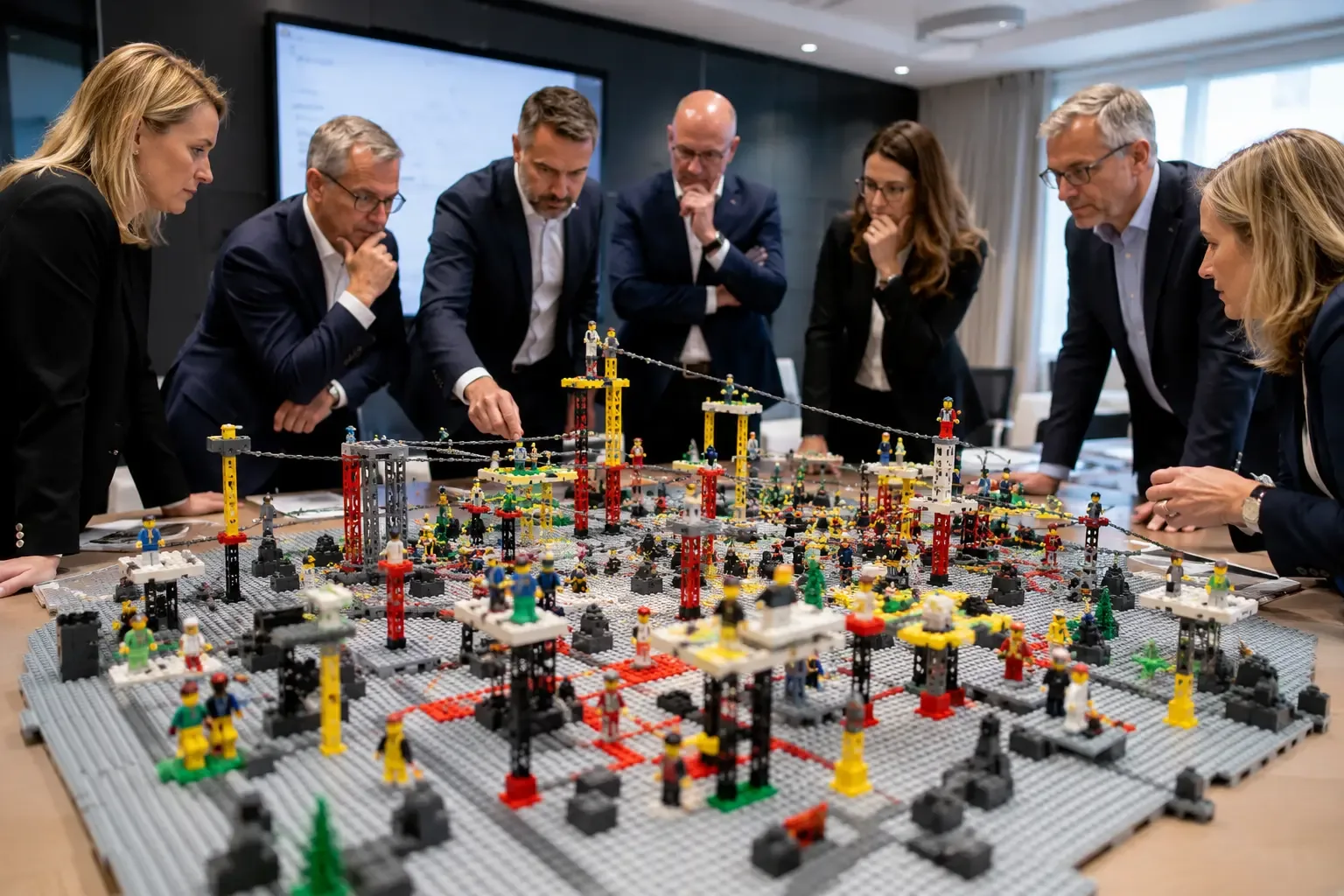
What to ask when choosing a facilitator or training provider
Metaphor is the part of the method that separates a trained facilitator from someone who has bought a kit. Handling it badly is not neutral — it produces confident, wrong conclusions about a team.
Questions worth asking any provider
If you are selecting a facilitator or a certification program, these questions surface real experience quickly:
- How long have you been training facilitators? Serious Play Business has been doing this for 19 years, with more than 1,800 facilitators trained across 38 countries.
- Who trained you? Dr. Denise Meyerson was selected as one of only four original Master Trainers of the method worldwide, and has been a Master Trainer since 2010 — the year the method moved to an open-source model.
- What is your real-world facilitation experience? Reading about the method is not the same as adapting it live for a room of forty people who did not want to be there.
- What is the certification actually based on? Look for assessed, results-focused certification rather than membership of an association.
Why experience shows up specifically in metaphor work
Anyone can read out the seven steps of the method. The skill is in what happens when a participant builds something the room was not ready for.
That is a judgment call made in real time — when to follow up, when to move on, and when to let a silence run. It comes from having done it in front of many different groups, not from a manual.
Transform Your Strategy Conversations
Bring a method into the room that gets every person contributing — not just the confident ones. Whether you want a session run for your team or want to facilitate it yourself, we can help you plan it.
To understand the full methodology behind the workshop design described above, read The LEGO® Serious Play® Method Explained.
Frequently Asked Questions
What is a metaphor in LEGO® SERIOUS PLAY®?
It is a physical stand-in for something abstract. A participant builds a model and then declares what it represents — a wall for a blocked process, a bridge for a gap between teams. The meaning comes entirely from the builder, never from the facilitator or the brick itself.
Do specific bricks or colors have fixed meanings?
No. There is no official key, and facilitators who invent one get worse results. A red brick is danger to one participant and energy to the next. The only reliable way to know what a piece means is to ask the person who placed it.
What if a participant says they are not creative?
This is common and it is not a problem. The method does not assess building skill — a crooked tower explained well produces better insight than a detailed model explained poorly. Starting with a short, meaning-free skills build usually settles this within a few minutes.
How long should a metaphor build take?
Shorter than most facilitators expect. Around ninety seconds works well for a warm-up build, because tight timing prevents overthinking and produces more honest models. The sharing that follows should get more time than the building did.
Can metaphor work in online sessions?
Yes, provided every participant has physical bricks in front of them. Kits are shipped in advance and the session runs over standard video conferencing, with participants holding models up to the camera during the sharing round.
Does it matter who trains me in LEGO® SERIOUS PLAY®?
It matters most for exactly this part of the method. Handling metaphor well is a live judgment skill — knowing when to follow up, when to move on, and when to leave a silence alone. That comes from a trainer with substantial real-world facilitation experience across many different group types, not from written material alone.