
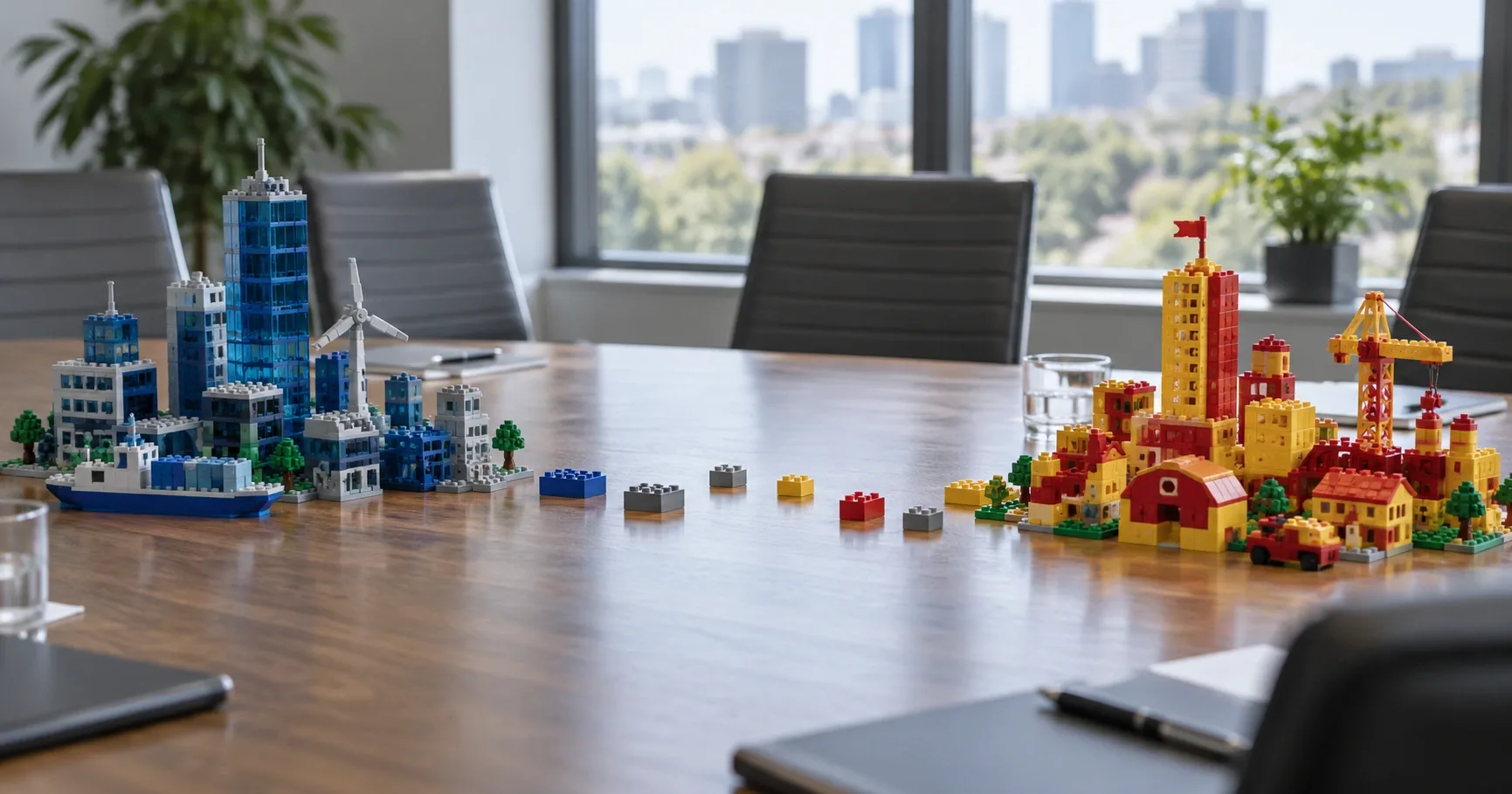
LEGO® SERIOUS PLAY® for Post-Merger Integration: How to Align Two Cultures After a Merger
Post-merger integration is the process of combining two organizations' people, systems, and ways of working after a deal closes. It is also where most deals lose their value. Harvard Business Review research puts the M&A failure rate at 70–90%, and integration leaders consistently name culture — not technology or regulation — as the biggest barrier to capturing the value a deal promised.
LEGO® SERIOUS PLAY® is a facilitated workshop method in which every participant builds a three-dimensional model in response to a question, then explains it to the group. In a post-merger context, it surfaces the unwritten operating assumptions each side brought with them, gives quiet acquired-company staff the same airtime as the acquirer's leadership, and produces a shared model of the combined organization that people helped build rather than sat through. This article covers why integration fails on culture, how a half-day LEGO® SERIOUS PLAY® integration workshop is structured, how to choose a facilitator, and how to measure the result at 30, 60, and 90 days.
Direct answer: LEGO® SERIOUS PLAY® helps post-merger integration by forcing every person in the room to make their assumptions visible and physical before anyone debates them. Instead of a leadership team presenting the new culture on slides, both organizations build models of how work actually gets done on their side, then build one shared model of the combined company together. The output is a set of agreed operating principles that the people who have to live with them helped construct — which is why they survive contact with the first quarter after the deal.
Why Post-Merger Integration Fails on Culture, Not Strategy
Deals are usually modeled well and integrated badly. The financial case is stress-tested by people who do this for a living, while the human integration gets a town hall, a values deck, and a hope that everyone adjusts.
What does the failure data actually say?
The numbers have been stubbornly consistent for decades. They point at people, not spreadsheets.
- 70–90% of M&A deals fail to create the value the acquirer expected, a range documented across academic studies reviewed in Harvard Business Review.
- 67% of integration leaders ranked cultural misalignment as the single largest barrier to capturing a deal's value — ahead of IT integration, customer attrition, and regulatory friction — in a 2025 Mercer survey of 450 post-close integration leaders.
- Failure signals appear in the first 90–180 days, but are typically only recognized formally 18–36 months later, long after the window to fix them cheaply has closed.
Why does the standard integration workshop make it worse?
A typical integration session puts 20 people in a room where the acquirer's leaders speak first and speak longest. Acquired-company employees read the power dynamic in the first ten minutes and calibrate accordingly.
What follows looks like agreement. Everyone nods at the new operating model, then returns to their desks and keeps working the way they always have, because nobody actually said out loud what "the way we always have" is.
In post-merger integration, silence is not consent — it is risk that has not surfaced yet. The assumptions people never say out loud are the ones that break the synergy case eighteen months later.
What Is LEGO® SERIOUS PLAY® and Why Does It Work for Integration?
LEGO® SERIOUS PLAY® is a facilitated meeting and problem-solving method in which participants build models with LEGO® bricks to represent their thinking, then tell the story of what they built. It was developed at IMD business school and grounded in academic research on constructionism (Roos & Victor, 1999), with later work examining equality of voice in diverse groups (McCusker, 2020).
How does the method work?
- Pose the challenge. The facilitator asks a specific question, such as "What does a decision look like in your organization today?"
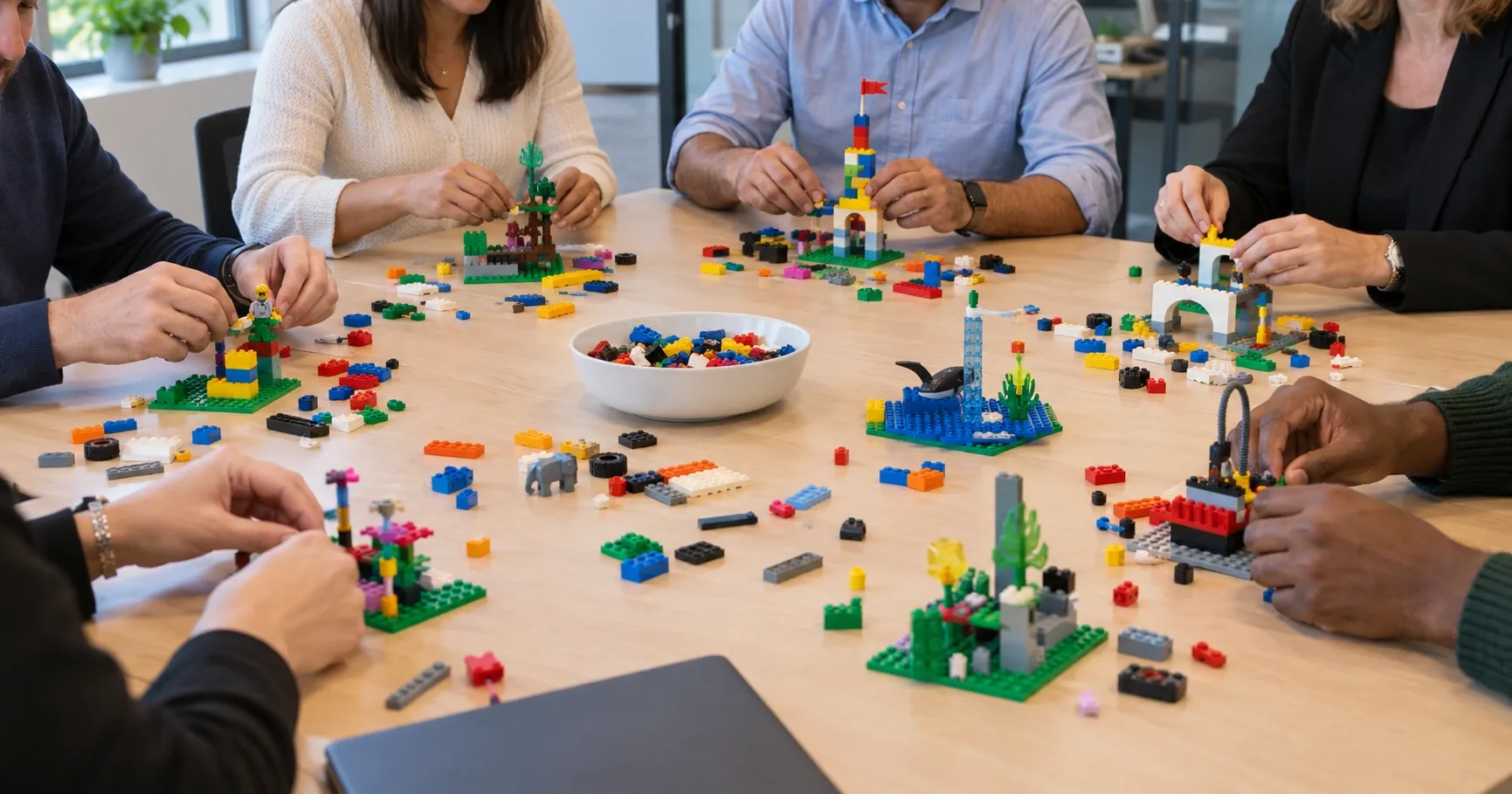
- Build. Every participant builds their own model. Nobody watches; everyone works.
- Share. Each person tells the story of their model. The group asks questions about the model, not about the person.
- Reflect. The facilitator draws out patterns, contradictions, and shared themes across the builds.
Why does building beat discussing in a post-merger room?
The mechanics of the method solve the specific failure modes of integration conversations.
- Everyone contributes. Because each participant has to build and then explain, the seniority gradient between acquirer and acquired flattens for the duration of the session.
- The model absorbs the conflict. Participants critique a plastic object on the table rather than a colleague's judgment, which lowers the defensiveness that makes integration disputes personal.
- Abstractions become concrete. "Our culture is more entrepreneurial" is unfalsifiable. A model showing three approval layers versus one is something you can point at.
- The output is durable. People remember what they built and what they said about it far longer than they remember a slide they were shown.
Four Integration Problems a LEGO® SERIOUS PLAY® Workshop Can Solve
The method is not a substitute for an integration plan. It is a way of getting accurate information into that plan while there is still time to act on it.
Surfacing unspoken assumptions about "how things work here"
Every organization has rules nobody documented: who really signs off, how much dissent is acceptable in a meeting, how fast a decision is expected to move. When both sides build these rules, the gaps become visible in an hour rather than a year.
Building a shared identity instead of announcing one
Announced cultures are complied with. Built cultures are owned. Asking both organizations to construct one shared model of the combined company produces something neither side can dismiss as the other side's imposition.
Making dependencies and handoffs visible
Integration breaks at the seams — the handoffs between a sales team that promised something and a delivery team that inherited it. Connecting individual models into a single system model exposes where those seams sit before customers find them.
Giving key talent a reason to stay
The people most likely to leave during integration are the ones with options and no voice. A session in which an acquired-company specialist explains their model to the acquirer's executive team is a concrete signal that their perspective still counts.
You cannot integrate two cultures you have never accurately described. LEGO® SERIOUS PLAY® produces that description in a single session — from everyone in the room, not from the three loudest people in it.
How to Run a Post-Merger Integration Workshop Using LEGO® SERIOUS PLAY®
The structure below is a half-day format (roughly 3.5 to 4 hours) for 8 to 20 participants drawn evenly from both organizations. It is designed to run in the first 90 days after close, while behavior is still forming.
Click the '+' button below to explore the detailed workshop stages.
1. Skills Build & 2. Individual Operating Realities
1. Skills build and readiness (20–30 minutes): Participants complete two or three short warm-up builds to learn the mechanics: build fast, build metaphorically, explain what you made. This stage exists to remove self-consciousness and to establish that nobody is being judged on construction quality. Skipping it is the most common reason first-time sessions underperform.
2. Individual builds — "how work actually happens on my side" (25–35 minutes): Each person builds a model of how decisions get made, how work gets approved, and what gets rewarded in their own organization. Everyone then explains their model to the room. The facilitator captures recurring themes on each side without commenting on which is better.
3. Shared System Model & 4. Naming the Tensions
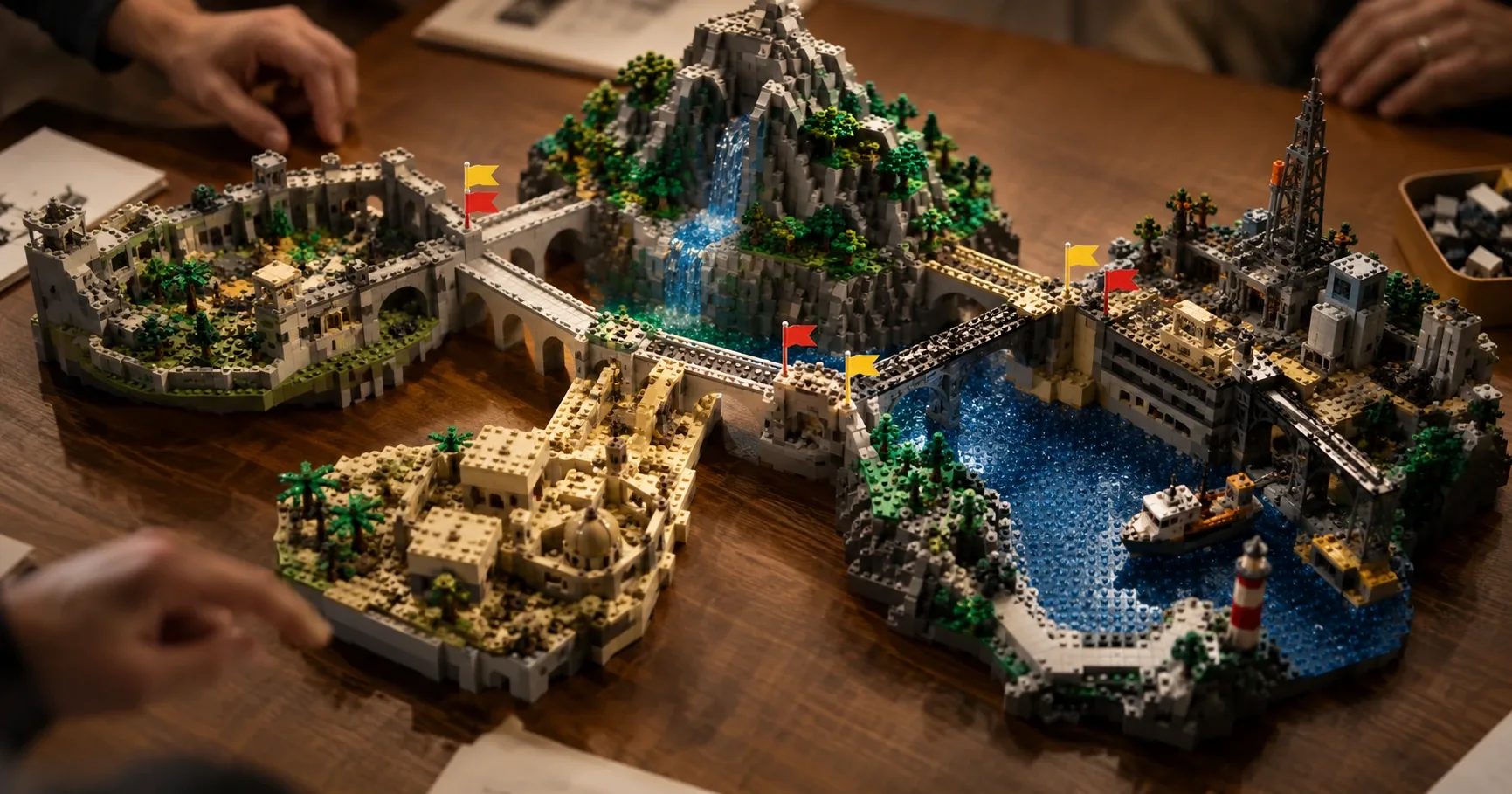
3. Shared model of the combined organization (45–60 minutes): Working as one group, participants build a single model representing the merged company — including the connections between the parts. Everyone must have an element of their individual build represented somewhere in the shared model, which prevents the exercise from becoming the acquirer's model with decoration.
4. Naming the tensions (25–35 minutes): The facilitator asks the group to identify the points in the shared model where the two operating realities genuinely conflict — speed versus governance, autonomy versus standardization, client intimacy versus scale. These are placed on the model physically. Naming a tension is not resolving it; the goal here is an accurate, shared list.
5. Guiding Principles & Commitments
5. Simple guiding principles and individual commitments (40–50 minutes): The group converts the named tensions into a short set of guiding principles for how the combined organization will operate — five or six at most, each phrased as something a person could actually follow on a Tuesday. Each participant then states one specific commitment they will make in the next 30 days. The models are photographed, the principles are written up, and both go to the integration steering group as workshop output rather than facilitator interpretation.
Traditional Integration Workshop vs. LEGO® SERIOUS PLAY® Integration Workshop
The comparison below sets out what changes when the format changes. Both approaches take similar amounts of calendar time; they produce very different information.
| Dimension | Traditional workshop | LEGO® SERIOUS PLAY® workshop |
|---|---|---|
| Who speaks | Typically 3–5 dominant voices | Every participant, structurally |
| Source of the culture description | Leadership or HR, presented | Both organizations, built |
| How disagreement surfaces | Rarely, and usually afterwards in private | In the room, directed at the model |
| Primary output | A values statement and a deck | Named tensions, guiding principles, individual commitments |
| Main risk | False consensus | Weak facilitation producing a fun session with no output |
How to Choose a Facilitator for Post-Merger Work
The main risk in the table above is worth dwelling on. A LEGO® SERIOUS PLAY® session run by an inexperienced facilitator is an enjoyable morning that changes nothing, and post-merger rooms are the least forgiving place to find that out.
What should you ask before you book?
These questions separate practitioners from people who attended a course once. Ask them of any provider, including this one.
- How many years have you been delivering this method, and how many facilitators or sessions is that? Longevity indicates a process that has been refined against real rooms rather than theory.
- Have you facilitated groups with an explicit power imbalance in the room? Post-merger sessions contain one by definition. Ask how they handle an executive who tries to summarize on everyone's behalf.
- How do you adapt when the group is 8 people versus 40? Group size changes the entire build-and-share arithmetic. A facilitator who has only run one size will run the wrong session.
- What happens to the output after the session? If there is no answer beyond "photographs," the workshop will not connect to the integration plan.
- What is your relationship to the method's origins? The method has been open source since 2010, so anyone may facilitate it. That makes provenance and depth of training a differentiator rather than a formality.
Why does experience level matter more here than usual?
Serious Play Business has spent 19 years focused on this single method, training more than 1,800 facilitators across 38 countries. Founder Dr. Denise Meyerson was selected as one of the original four Master Trainers of the LEGO® SERIOUS PLAY® method and has been a Master Trainer since 2010, working with organizations including Capgemini, Kaiser Permanente, Syngenta USA, the US Air Force, and Virginia Commonwealth University.
That background matters in an integration room for one practical reason: the facilitator has to decide, live, whether a tension the group has just surfaced should be pushed further or parked. Getting that judgment wrong either wastes the session or detonates it.
How to Measure Whether the Workshop Worked
Culture work gets cut when it cannot be evidenced. Attach measures to the session before it runs, not after.
What should you capture on the day?
- The full list of named tensions, in the group's own words.
- The agreed guiding principles — five or six, no more.
- One written 30-day commitment per participant, with a name against it.
- Photographs of the individual models and the shared system model.
What should you track at 30, 60, and 90 days?
- Day 30: Completion rate of individual commitments. This is the earliest honest signal of whether the session had authority or was theater.
- Day 60: Whether the named tensions have appeared in integration steering group decisions. If the list has gone unused, the workshop was disconnected from the plan.
- Day 90: Voluntary regretted attrition among session participants, compared against equivalent teams that did not attend. Given how early integration failure signals appear, this window is where the difference shows up.
Run the workshop inside the first 90 days after close. That is when behavior in the combined organization is still forming — and when a shared model can still change what forms.
Transform Your Strategy Conversations
If you are integrating two organizations and need the real operating assumptions on the table before the quarter closes, a facilitated LEGO® SERIOUS PLAY® session will get them there faster than another round of alignment meetings. Tell us the shape of your deal and we will design the session around it.
To understand the full methodology behind the workshop design described above, read the LEGO® SERIOUS PLAY® method explained.
Frequently Asked Questions
When in the integration timeline should we run a LEGO® SERIOUS PLAY® workshop?
Inside the first 90 days after close is the strongest window. Behavior in the combined organization is still forming at that point, and integration failure signals typically appear in the first 90 to 180 days. Running it later still helps, but you are then correcting habits rather than shaping them.
Will senior executives take a workshop with LEGO® bricks seriously?
In practice, resistance usually lasts through the first skills build and then disappears. The method has been used with leadership teams at organizations including Capgemini, Kaiser Permanente, and the US Air Force. The credibility comes from what the session produces — named tensions and specific commitments — rather than from the materials on the table.
How many people from each organization should attend?
Aim for a roughly even split between the two organizations, with 8 to 20 participants in a half-day session. An uneven split reproduces the power imbalance the workshop is meant to neutralize. For larger integrations, run several parallel sessions with the same structure rather than one oversized room.
Can this be run for remote or hybrid teams after a cross-border merger?
Yes. Kits are shipped to participants in advance and the build-and-share structure runs over video, with adjustments to timing and to how the shared model is assembled. Cross-border deals are often the ones that benefit most, since national and organizational culture differences compound each other.
Do we need to hire a facilitator, or can we certify someone internally?
Both are viable, and the choice usually turns on how often you expect to need the method. For a single integration, an external facilitator brings neutrality that an internal employee from either side cannot. If integration, change, and team alignment work is ongoing, certifying an internal facilitator is generally more economical — Serious Play Business offers a Foundational Certification at $750 USD and an Advanced Certification at $1,300 USD, both fully online and self-paced.
What is a Master Trainer of the LEGO® SERIOUS PLAY® method?
Master Trainers were the practitioners originally selected and trained to teach the method to other facilitators before it was released as open source in 2010. Only four were selected originally, one of whom was Dr. Denise Meyerson, founder of Serious Play Business. Since the method is now open source, anyone may facilitate it — which is precisely why depth of training and years of practice are worth checking when you select a provider.