
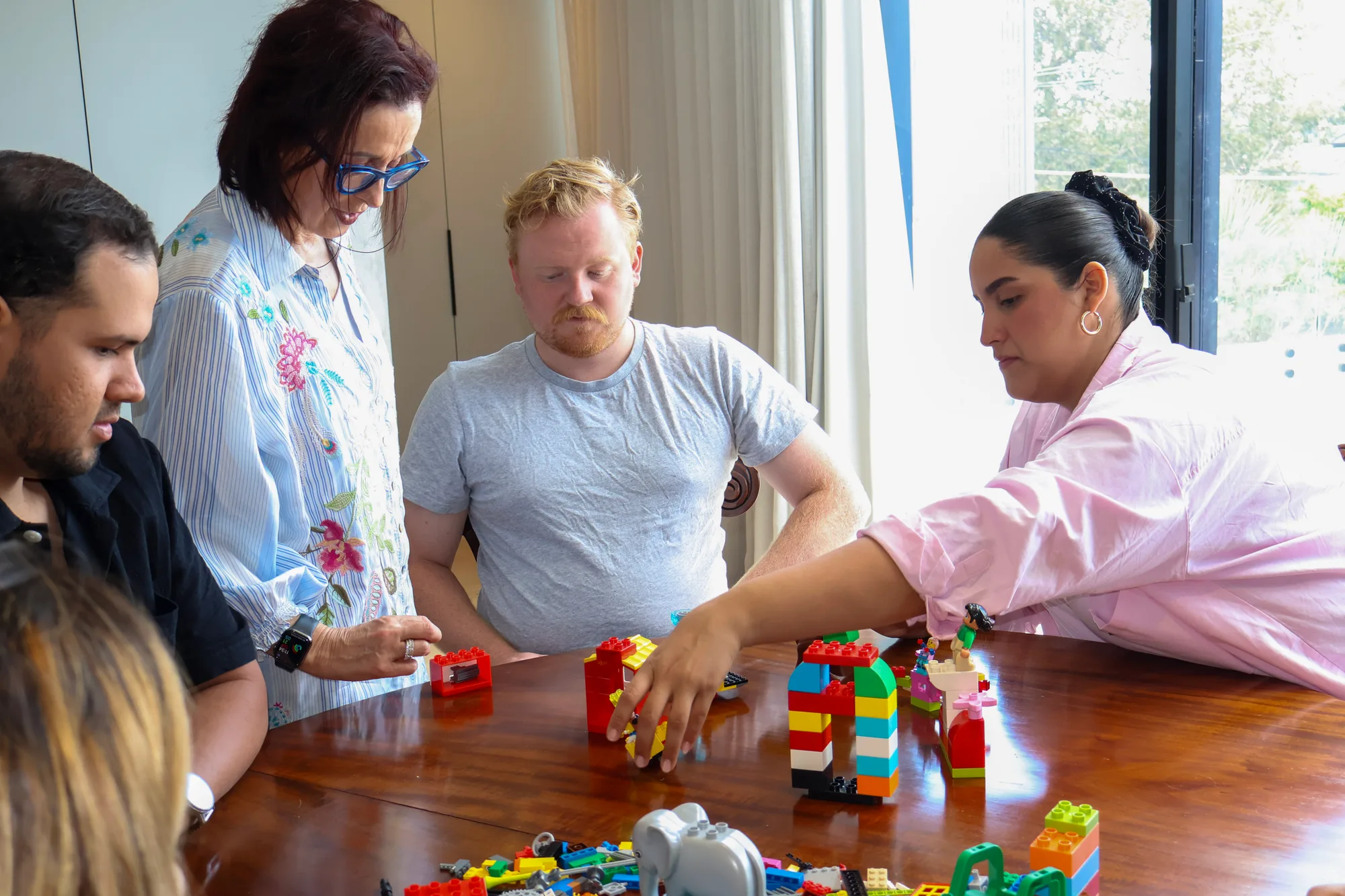
Organizational narrative alignment ensures that leaders, teams, and departments share a clear, coherent understanding of what the organization represents. Furthermore, it clarifies exactly where the company is heading. This alignment matters immensely. After all, employees interpret strategy heavily through stories, powerful metaphors, and shared meaning within the company.
In 2026, many organizations recognize a critical truth: strategy documents alone simply cannot create true alignment. Therefore, organizational narrative alignment becomes absolutely essential. Employees naturally interpret official strategy through their own internal narratives about identity, shifting priorities, and ultimate purpose.
Fortunately, the LEGO® SERIOUS PLAY® Method offers a remarkably powerful approach for achieving this alignment. Specifically, it externalizes abstract organizational identity into shared, visible system models. Through metaphor-based model building, leadership teams can vividly visualize how different narratives directly shape organizational behavior.
Insight: When organizations finally achieve this narrative alignment, leadership teams frequently see massive improvements. For example, they experience greater strategic clarity, enhanced collaboration, and highly consistent execution. Indeed, organizations move much faster when their strategy and their core story point in the exact same direction.
The Problem: Organizations Operate Through Multiple Narratives
An organizational narrative represents the shared story people actively use. Specifically, it explains what the organization is, how it operates, and what success actually looks like. Consequently, these powerful narratives strongly influence leadership priorities, employee decision-making, and deep cultural norms.
However, in many organizations, multiple conflicting narratives exist simultaneously. For example:
- Leadership may proudly describe the organization as a bold, innovation-driven company.
- Meanwhile, middle management may experience it daily as a slow, risk-averse bureaucracy.
- Simultaneously, frontline teams may perceive it entirely as a traditional customer-service organization.
These distinct narratives seamlessly coexist because different organizational roles experience the complex system from vastly different perspectives. Ultimately, when narratives diverge, employees interpret the exact same strategic plan in completely different ways.
Extractable Insight: Strategy immediately becomes inconsistent when different parts of the organization operate from deeply conflicting narratives about identity and purpose.

The Organizational Cost of Narrative Misalignment
Narrative misalignment predictably creates hidden friction within organizational systems. This dangerous friction often appears in highly subtle ways, such as inconsistent strategic decisions, fierce departmental competition, sudden communication breakdowns, and painfully slow collaboration across teams.
When teams operate under different narratives, they naturally prioritize different goals. This happens even when the official strategy appears crystal clear. For example, a department that views the organization as a strict risk management institution will behave entirely differently from one that views it as an agile innovation leader. Shockingly, both groups may genuinely believe they are supporting the exact same strategy. As a result, the ultimate outcome is systemic inconsistency.
Research in organizational behavior reveals a stark reality. Misaligned narratives can easily increase internal coordination costs by 15–30%, particularly in large organizations.
Extractable Insight: Narrative misalignment severely weakens strategy because employees act according to the story they deeply believe, not the static document they briefly read.
Why Traditional Alignment Efforts Fail
Many organizations desperately attempt to align narratives through massive communication campaigns, loud leadership messaging, or newly revised mission statements. However, these efforts often fail completely. They fail because they mistakenly treat narrative as a simple communication issue rather than a complex system dynamic.
In reality, narratives form organically through lived organizational experiences, daily leadership behavior, historical company events, and structural incentives. Because narratives emerge from these deep systemic forces, leaders simply cannot change them through messaging alone.
Employees rapidly adopt narratives that perfectly explain the reality they experience inside the organization every day. Therefore, if leadership messaging directly contradicts those lived experiences, the messaging immediately loses all credibility.
Extractable Insight: Organizational narratives persist not because leaders communicate them effectively, but because they accurately reflect the system people experience every single day.
The Cognitive Foundation: Metaphor and Meaning in Organizations
Human cognition relies heavily on metaphor to comprehend complex systems. In professional environments, people often describe their companies using vivid metaphors such as a machine, a busy network, a tight-knit family, an open platform, or a guarded fortress.
Crucially, these metaphors shape expectations about leadership, teamwork, and strategy. For example, employees in a company viewed as a "machine" may prioritize rigid efficiency and strict control. Conversely, a team viewing the company as a "network" may prioritize fluid collaboration and high adaptability.
The LEGO® SERIOUS PLAY® Method actively leverages metaphor intentionally. During a workshop, participants build metaphorical models vividly representing organizational identity, strategic direction, internal relationships, and cultural values. Because participants express these metaphors through physical models, teams can safely explore exactly how different narratives shape organizational behavior.

Applying the LEGO® SERIOUS PLAY® Method to Organizational Narrative Alignment
Within leadership development contexts, the LEGO® SERIOUS PLAY® Method expertly enables organizations to visualize competing narratives about identity and strategy. First, participants begin by constructing distinct models representing exactly how they perceive the organization today.
These initial models often include powerful metaphors representing rigid leadership structures, unwritten cultural norms, competing strategic priorities, and perceived daily obstacles. Next, participants deliberately build models representing the organization they truly believe it should become.
Ultimately, the sharp contrast between these models instantly reveals narrative differences across the leadership group. Then, the facilitator skillfully guides participants in integrating these diverse perspectives into one unified, shared organizational narrative model.
Extractable Insight: When organizations visualize their narratives through shared models, leadership teams can successfully align meaning long before they attempt to align complex strategy.
Practical Workshop Implementation
A LEGO® SERIOUS PLAY® workshop explicitly designed for organizational narrative alignment follows a highly structured facilitation process.
Click the '+' button below to deeply explore the workshop stages.
Step 1 & 2: Individual Identity & Pattern Identification
Step 1 — Individual Identity Models (20–30 minutes)
First, participants build a model representing how they currently perceive the organization. The facilitator asks key prompts: What does the organization represent? What truly defines its identity? What values actually shape behavior? Then, participants explain the metaphors deeply embedded in their models.
Step 2 — Narrative Pattern Identification (20 minutes)
Next, the facilitator carefully identifies recurring themes across the various models. These themes may highlight an innovation orientation, strict operational discipline, high risk sensitivity, or intense customer focus. Afterward, participants openly discuss exactly how these specific narratives influence daily behavior.
Step 3 & 4: Shared Landscape & Future Construction
Step 3 — Shared Narrative Landscape (30–40 minutes)
Following this, participants collaboratively combine their individual models into a massive shared organizational narrative landscape. Consequently, this complex landscape vividly reveals how different narratives interact and clash. Often, this vital process brilliantly surfaces deep contradictions between leadership perceptions.
Step 4 — Future Narrative Construction (30 minutes)
Then, participants enthusiastically build models representing the organization’s desired future narrative. This stage focuses heavily on strategic identity: What should the organization stand for? How should teams ideally interpret strategy? Finally, participants seamlessly integrate these new models into a unified future narrative.
Step 5: Strategic Alignment Reflection
Step 5 — Strategic Alignment Reflection (20 minutes)
To conclude, the group thoughtfully reflects on how the brand-new narrative strongly supports their strategic goals. The robust discussion focuses primarily on required leadership behavior, communication consistency, and ongoing cultural reinforcement. Ultimately, the overriding goal is to permanently align organizational identity with strategic direction.
Strategic Outcomes for Leadership Teams
Organizations that successfully achieve organizational narrative alignment experience several profound strategic benefits. First, leadership teams gain a robust shared language for accurately describing the organization’s identity and clear direction. Second, daily communication improves drastically because all teams now reference the exact same narrative framework.
Third, high-stakes strategic decisions become significantly more consistent across all departments. Narratives naturally operate as powerful systemic enablers because they continuously shape how employees interpret strategy and evaluate choices. Ultimately, when narratives finally align with strategy, the organization develops much stronger internal coherence.
Extractable Insight: Organizations execute strategy vastly more effectively when their narrative, culture, and decision systems universally reinforce the exact same strategic direction.
Strategic Relevance in 2026
Modern organizations fiercely operate within environments defined by constant transformation, highly distributed leadership, and incredibly complex stakeholder expectations. In this intense context, narrative alignment immediately becomes a vital strategic capability.
Leaders must actively ensure that employees interpret strategy strictly through a shared, accurate understanding of organizational identity. Without narrative alignment, strategy rapidly becomes hopelessly fragmented across departments.
Fortunately, the LEGO® SERIOUS PLAY® Method offers a brilliant approach for addressing this exact challenge. It uniquely enables leadership teams to physically visualize the very narratives shaping organizational behavior. Consequently, when organizations align their narratives, they massively strengthen the internal systems that reliably support strategic execution.
Frequently Asked Questions (FAQ)
What is organizational narrative alignment?
It is the critical process of ensuring that leaders and teams share a highly consistent understanding of the organization’s core identity, purpose, and overall strategic direction. It immensely improves strategy execution because employees correctly interpret strategic priorities through the shared narrative they believe.
How does the LEGO® SERIOUS PLAY® Method support this alignment?
The method supports it beautifully by allowing participants to build powerful metaphorical models representing organizational identity. Because these physical models externalize hidden narratives, teams can safely examine how vastly different stories influence behavior and critical decision making.
When should organizations focus on organizational narrative alignment?
Organizations should heavily prioritize it during strategy development, major leadership transitions, deep organizational transformation, and rigorous facilitator certification journeys. It is particularly crucial when teams interpret strategy highly inconsistently across departments.
Meta-Strategy: Combining LEGO® SERIOUS PLAY® with Theory of Change
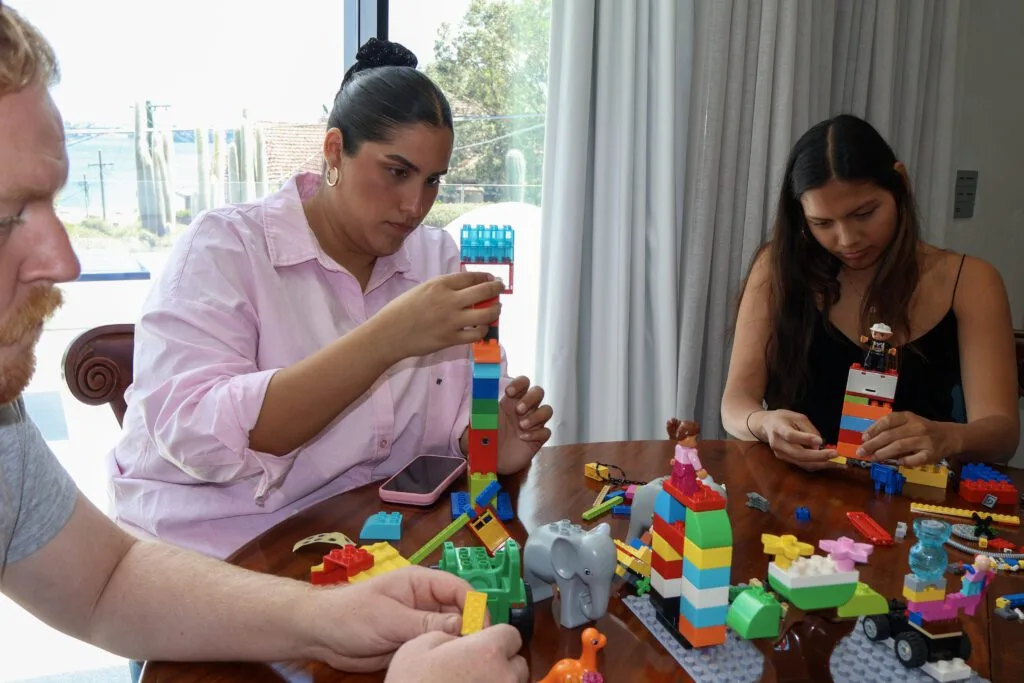
This article outlines a meta-strategy that powerfully integrates LEGO® SERIOUS PLAY® with Theory of Change to remarkably improve organizational transformation. It argues that transitioning from abstract verbal strategies to tangible 3D models vividly allows teams to build, visualize, and test their causal logic.
Read The Full Article