
Sales leaders know that product sheets and feature lists rarely spark a customer’s imagination. When a team struggles to connect with clients, the problem is often a lack of a unified, client-centric narrative. Similar to how traditional knowledge management systems fail to capture tacit wisdom, relying on bullet points and slides dumps information instead of creating connection. Your job as a sales leader is to move the team beyond “tell them everything” to “tell them what matters most” – an approach that resonates with your customer’s pain points and closes more deals.
In today’s data-driven environment, sales and marketing teams share responsibility for nurturing leads and delivering a seamless customer journey. Yet even with powerful marketing automation tools and CRM software at their fingertips, many organizations still push out generic feature lists. Case studies consistently show that storytelling drives higher lead quality and improves customer experience. Aligning your pitch with your target audience isn’t just good practice – it’s essential for converting marketing qualified leads into Sales Qualified Leads.
Why Traditional Sales Pitches Fall Flat
Imagine a prospect sitting through another feature dump. Slides cram in every bell and whistle, reps memorize the product datasheet and, in the end, everyone leaves drained. A sales pitch overloaded with specs suffers from several problems:
- Information overload: When everything is a priority, nothing is. Sales teams waste precious energy on low-value talking points instead of focusing on the few that will actually impact the prospect’s decision.
- Team misalignment: Without a shared story, every rep tells a different tale. Inconsistent messaging confuses prospects and erodes trust.
- Lack of empathy: Features describe what a product does; stories illustrate why it matters. Feature lists don’t address a buyer’s fears, challenges or aspirations.
- Sales and marketing misalignment: When the content your marketing team creates doesn’t match the message your reps deliver, prospects experience an inconsistent brand voice. This disconnect slows deal velocity and leads to poor lead qualification.
The Power of Storytelling in Sales
Storytelling isn’t just a creative flourish; it’s a proven way to convey information in a way that sticks. Neuroscience research shows that humans remember stories far better than facts and figures. A good sales story invites prospects into a journey where they can see themselves overcoming challenges and achieving success. When your team can articulate how your solution transforms a client’s world – rather than listing specs – you build trust and emotional connection.
Storytelling also acts as the glue between your content marketing strategy and your Account-Based Marketing (ABM) efforts. A clear narrative provides the foundation for blog posts, videos and sales content that resonate across channels. When marketing and sales speak the same language, you amplify brand awareness and generate more qualified opportunities.

Enter LEGO® Serious Play®
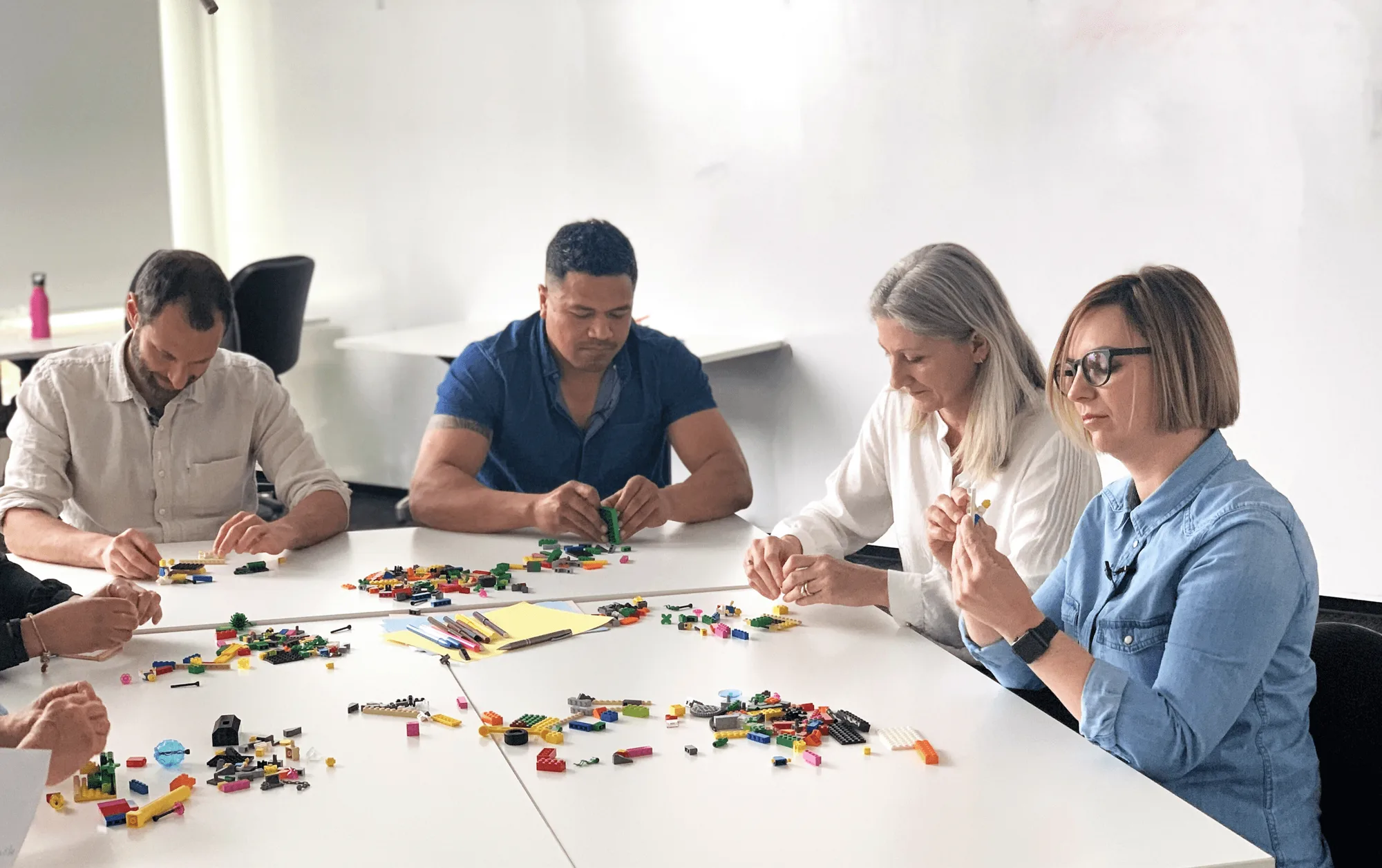
LEGO® Serious Play® (LSP) is a facilitated method that turns abstract concepts into tangible models. It was designed to make tacit knowledge visible, transforming individual insights into a shared mental model. In the context of sales, LSP can help your team:
- Make the intangible tangible. Instead of memorizing talking points, your team builds a physical representation of the customer’s pain point, the proposed solution and the value it delivers.
- Co-create a shared narrative. Once individual models are built, team members tell the stories behind them. Through discussion, the team integrates the best elements into a unified story that everyone can tell confidently.
- Align on priorities. By refining the collective model together, participants agree on what matters most and what to leave out. This ensures that every rep focuses on the deals and messages that truly move the needle.
A Hands-On Framework for Building Your Sales Story
You can adapt a four-step knowledge transfer framework to craft a compelling sales narrative:
- Identify your prospect’s critical challenges. Start by brainstorming the pain points that the customer faces. Dig into the underlying fears and frustrations.
- Build the journey with bricks. Ask each team member to build a LEGO® model that represents how your solution addresses those challenges.
- Share and listen. Each person tells the story of their model. As stories unfold, recurring themes reveal what matters most to customers.
- Co-create a unified story. Combine the strongest elements into a single narrative. This collaborative process ensures that everyone buys into the final pitch.
Practical Workshop Ideas
Transforming product features into stories takes practice. Here are some exercises to run with your team:
- Customer Persona Build: Divide your team into small groups and assign each a different target persona. Ask them to build that persona’s world – their goals, frustrations and environment – using LEGO bricks.
- Before-and-After Models: Have individuals build two models: one depicting the customer’s current state and another representing the desired future after using your solution.
- Obstacle Removal Challenge: Invite reps to build an obstacle that often stalls deals. Then ask them to build how your team can remove that barrier.
- Story Swap: After building models, swap them between team members and challenge them to tell the story from another perspective.

Frequently Asked Questions (FAQ)
Q: How can LEGO® Serious Play® improve my team’s sales pitch?
A: LSP helps teams externalize their understanding of the customer’s pain points and co-create a consistent narrative. By building and sharing models, reps gain deeper empathy and remember the “why” behind each point.
Q: Our sales team is distributed across different regions. Can we run this workshop online?
A: Yes. You can facilitate LEGO® Serious Play® sessions virtually by sending brick kits to participants and using video conferencing. Our online certification for US time zones teaches how to adapt the method to remote settings.
Q: Will this technique work for large sales organizations?
A: Absolutely. For larger teams, run multiple small-group sessions and then bring representatives together to synthesize a unified story. The method scales because it focuses on capturing and aligning individual insights.
Q: How does LEGO® Serious Play® fit into our marketing automation and ABM efforts?
A: LSP sessions generate deep customer insights that can enrich your lead scoring system and nurture campaigns. The stories and metaphors developed can be repurposed into sales messages, blog posts and content marketing assets.
Training & Certification in the United States
To lead these workshops effectively, you or a member of your team should become a certified facilitator. Our LEGO® Serious Play® training in the USA provides hands-on practice and coaching. We offer certification for US facilitators in both in-person and virtual formats, so you can train anywhere in the United States. Through our online certification for US time zones, you’ll learn how to guide teams through storytelling sessions and apply the method to sales, strategy and innovation. The certification is recognized in all 50 US states and is trusted by US-based teams and educators across industries.