

Why AI Adoption Stalls in Teams — and How to Facilitate the Conversation That Fixes It
Organizations are buying AI faster than their teams are absorbing it. Gallup's 2026 workforce data shows 47% of US employees say their organization has integrated AI tools, and 52% use AI in their role at least a few times a year — yet only 12% strongly agree the AI era has changed how work actually gets done.
The bottleneck is not the technology. It is the conversation that never happens: the objections, the quiet preference for existing methods, and the manager who has not visibly taken a position. This article sets out why those objections stay unspoken, and gives a five-stage workshop structure for getting them into the room.
AI rollouts stall because adoption is decided inside teams, not at the platform level — and the reasons people don't adopt are rarely said out loud in a normal meeting. The fix is a session format where every person has to produce an answer before anyone comments on it, which is what facilitated methods like LEGO® SERIOUS PLAY® are built to do.
- Global employee engagement fell to 20% in 2025, its lowest level since 2020 and the first back-to-back annual decline Gallup has recorded.
- Manager engagement dropped from 31% in 2022 to 22% in 2025 — and manager support is one of the strongest predictors of whether AI use takes hold in a team.
- Among employees who have AI tools available but don't use them, 46% say they prefer to work the way they currently do.
- Research on employee silence has found that 85% of employees have withheld feedback for fear of negative consequences, which is why these reasons rarely surface in standard meetings.
What the 2026 data actually says about AI at work
The numbers no longer describe an adoption problem. They describe a translation problem — tools are present, individual use is climbing, and organizational change is not following.
Access is up. Transformation is not.
Gallup's Q2 2026 workforce survey of 22,573 employed US adults found that 52% use AI in their role at least a few times a year, 30% use it weekly or more, and 15% use it daily. Organizational adoption reached 47%, the sharpest quarterly jump Gallup has recorded.
Against that, only 12% of employees strongly agree the AI era has transformed how work gets done. Gallup's State of the Global Workplace 2026 frames this directly: AI is improving individual productivity more than organizational performance.
The stall happens at the manager layer
The same report identifies where the translation fails. Manager engagement fell from 31% in 2022 to 22% in 2025, while engagement among individual contributors stayed roughly flat. Managers have lost the engagement premium they historically held.
That matters because manager-led adoption is one of the top two drivers of frequent AI use in Gallup's Q1 2026 US data. Yet fewer than one in three employees strongly agree their manager actively supports AI use.
- Global engagement: 20% in 2025, down from a 23% peak in 2022
- Estimated cost: around $10 trillion in lost productivity, roughly 9% of global GDP
- Scale of each point: one percentage point of global engagement represents about 21 million employees
- Best-practice organizations: manager engagement of 79%, nearly four times the global average

Why the real objections never reach the room
Ask a team why AI adoption is slow and you will usually get a resourcing answer: not enough training, not enough time, unclear use cases. The survey data points somewhere less comfortable.
What people say when they aren't in front of their manager
Among employees whose organizations provide AI tools but who choose not to use them, 46% say they simply prefer to work the way they currently do. Around four in ten cite ethical concerns, data privacy worries, or skepticism that AI can help with their specific work. Roughly a quarter tried it and weren't convinced.
None of those are training problems. They are positions — and positions have to be argued with, not scheduled around.
The meeting format is doing the filtering
Research on employee silence has found that 85% of employees have withheld feedback because they feared the consequences. The information existed. It just never made it into the room.
Standard meetings compound this. The most senior person frames the topic first, and everything that follows becomes commentary on that frame. The honest version of the discussion happens afterward, privately, where it cannot change anything.
| What happens | Standard team discussion | Facilitated build session |
|---|---|---|
| Who speaks first | The most senior person in the room, setting the frame | Everyone, simultaneously, before anyone hears another view |
| Airtime | Pools at the top of the org chart | Distributed by structure — each person presents their own model |
| What gets surfaced | Positions that are already safe to say | Preferences, doubts, and trade-offs that were previously private |
| What the group questions | The person who spoke | The object on the table |
An AI rollout does not fail at the license count. It fails at the point where a team decides, quietly and without saying so, that the new way is not worth the disruption to the old one.
How LEGO® SERIOUS PLAY® changes who speaks
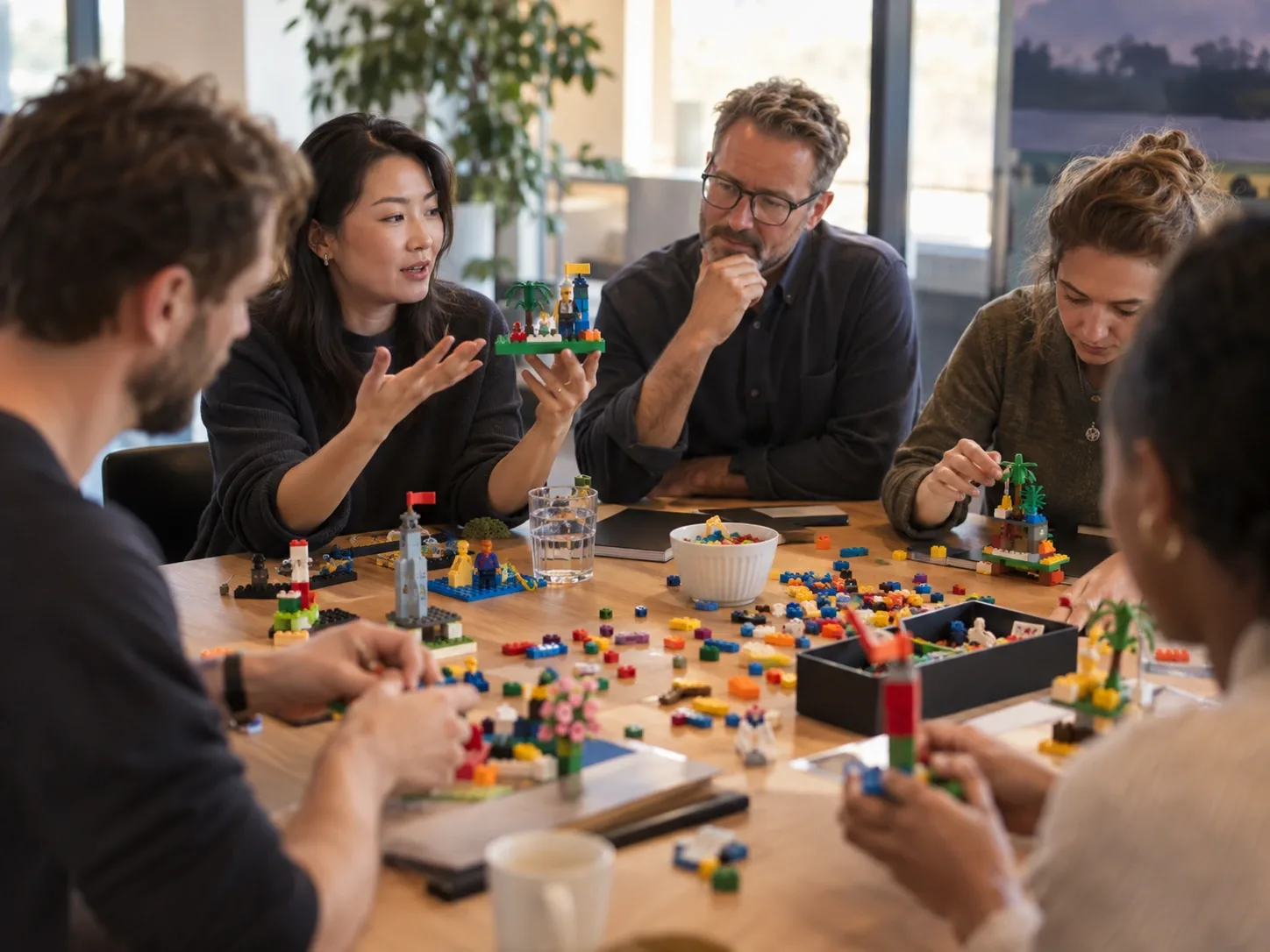
LEGO® SERIOUS PLAY® is a facilitated method in which every participant builds a physical model in answer to a question, then explains what they built. Its relevance here is structural rather than creative.
Everyone builds, so everyone has to speak
Because the building happens simultaneously and before any discussion, each person commits to an answer without first hearing the senior view. By the time sharing begins, there are as many positions in the room as there are people, and no single frame has been established for others to align to.
The model carries the risk, not the person
When a participant explains a model, the group questions the model. That distance is small but it changes the risk calculation that keeps people quiet — a question about why a piece sits where it does is easier to field than a challenge to your judgment in front of your manager.
The point of building is not creativity. It is that a group cannot defer to the highest-paid opinion in the room if everyone has already committed to an answer.
Running the session: a five-stage structure
The sequence below follows the core process of the methodology, applied to an AI adoption question. Timings suit a half-day session with six to twelve participants.
Frame the challenge
State the question the session exists to answer, in terms that admit a negative answer. "How should we use AI in this team?" presumes the conclusion. "What would have to be true for you to use these tools daily?" does not.
Build individually
Every participant builds their own response. No discussion, no looking across the table for a signal about what the acceptable answer is. The constraint is the point: everyone arrives at the sharing stage already committed.
Share each model
Each person explains what they built and why. The facilitator's job is to hold the order and prevent early evaluation, so that the fifth person to speak is not simply agreeing with the first.
Question the models
The group asks questions about what is on the table. This is where the unspoken material tends to appear — the workflow someone doesn't want to give up, the client data they won't put into a tool, the previous rollout that was abandoned.
Agree what changes
Convert what surfaced into decisions with names attached: which workflows are in scope, which are explicitly out, what the manager will back visibly, and what gets revisited and when.
How to choose a facilitator for this kind of session
A session that surfaces resistance is harder to run than one that gathers ideas. If the facilitation is weak, the result is not a neutral outcome — it is a room that has now learned its objections are unwelcome. These are the questions worth asking any provider.
Questions to ask before you book
- How long have they been delivering this work? Longevity signals refinement rather than tenure alone. Serious Play Business has been training facilitators in the methodology for over 18 years.
- How many facilitators have they trained, and in what contexts? More than 2,000 facilitators across 25+ countries, spanning independent consultants, HR and Learning & Development professionals, and academics.
- What real-world facilitation sits behind the training? Dr. Denise Meyerson has facilitated groups of varying size internationally for organizations including Microsoft, Coca-Cola, SAP, and Cisco.
- What is the credential actually based on? Results-focused certification matters more than membership of an association. Dr. Meyerson was one of only four Master Trainers of the method selected by the LEGO® Group before it went open source.
- Can they adapt to your group? Skilled facilitation means planning for different group sizes, compositions, and contexts — and adjusting during the session rather than running a fixed script.
What to be careful of
The methodology went open source, which means anyone may run it and the quality range is wide. Having read the books or attended a single training is not the same as having facilitated a senior team through a disagreement it was avoiding.
Transform Your Strategy Conversations
If your AI rollout has gone quiet, the missing input is usually in the room already. We design and facilitate sessions that get it onto the table.
To understand the full methodology behind the workshop design described above, read the LEGO® SERIOUS PLAY® method explained.
Frequently asked questions
Why do AI rollouts stall even when the tools work?
Because adoption is decided locally, inside teams, not at the platform level. Gallup's 2026 data shows 47% of US employees say their organization has integrated AI tools, but only 12% strongly agree the AI era has changed how work gets done. The gap sits between access and daily practice, and that gap is governed by what a team believes about the tools and whether its manager visibly backs them.
What is the most common reason employees avoid AI tools they already have?
Preference for existing ways of working. Among employees whose organizations provide AI tools but who choose not to use them, 46% say they simply prefer to work the way they currently do, according to Gallup's February 2026 workforce survey. Around 4 in 10 cite ethical concerns, data privacy worries, or doubt that AI helps with their specific work.
Why don't these objections come up in normal team meetings?
Because raising them is an interpersonal risk. Research on employee silence has found that 85% of employees have withheld feedback out of fear of negative consequences. In a standard meeting the most senior person usually frames the topic first, and everything after that becomes commentary on their frame rather than independent input.
What is LEGO® SERIOUS PLAY® and how does it apply to AI adoption?
LEGO® SERIOUS PLAY® is a facilitated method in which every participant builds a physical model in response to a question, then explains it to the group. Applied to AI adoption, it changes who speaks: everyone builds, so everyone has something to present, and the discussion attaches to the model on the table rather than to the person who made it.
How long does an AI adoption workshop take?
The session outlined in this article runs about two and a half hours across five stages: framing the challenge, individual building, sharing models, questioning the models, and agreeing what changes. Longer formats allow more build rounds; the structure stays the same.
What should I look for when choosing a LEGO® SERIOUS PLAY® facilitator or training provider?
Ask how long the provider has been delivering facilitator training, what real-world facilitation experience sits behind it, and whether the certification is results-focused rather than association membership. Serious Play Business has trained more than 2,000 facilitators over 18 years across 25+ countries, and Dr. Denise Meyerson was one of only four Master Trainers of the method selected by the LEGO® Group before it went open source.