
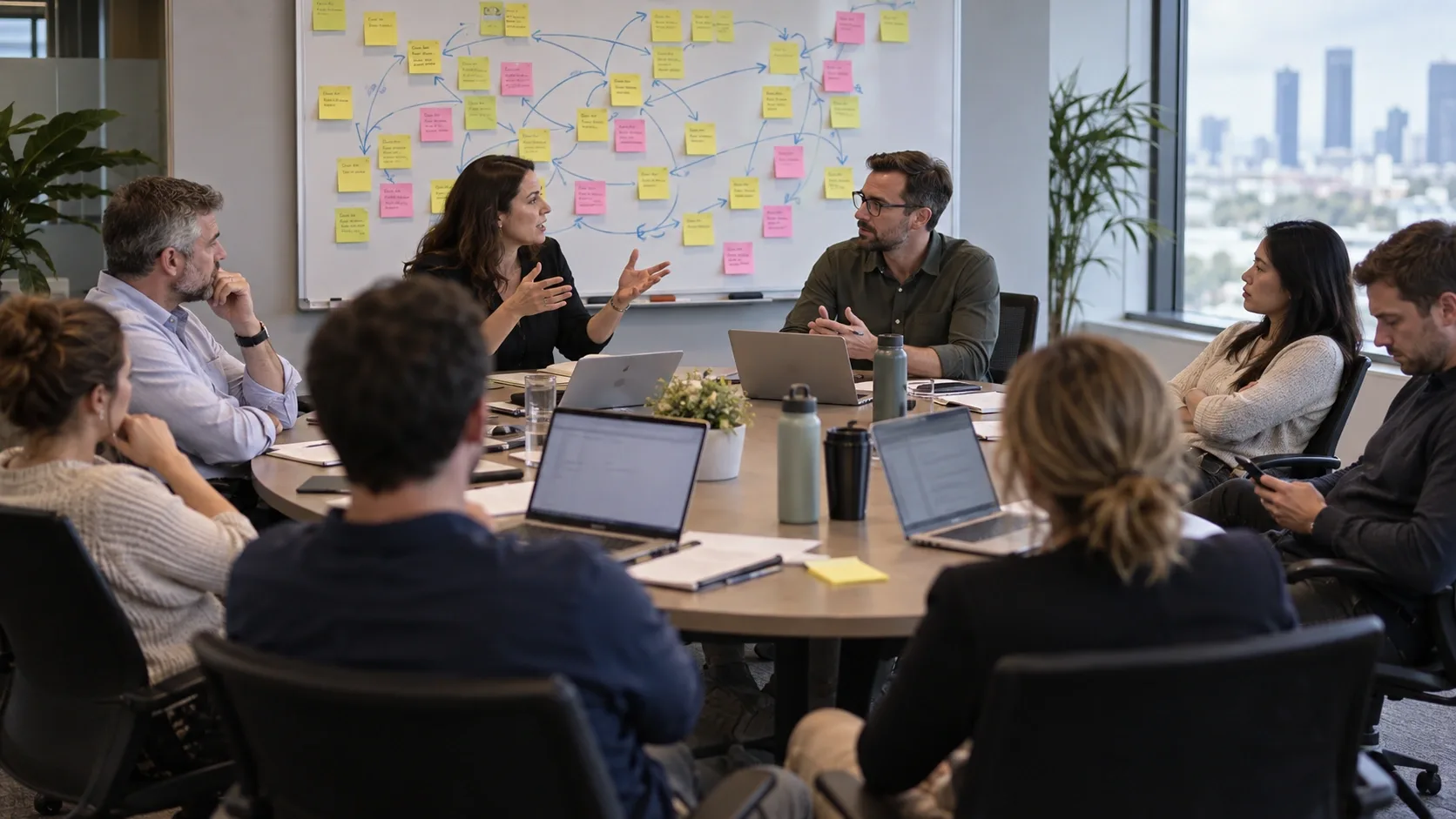
Why Most Strategic Planning Offsites Don't Change Anything
Part 1 of 3 in our series on strategic planning offsites. This post covers why the standard format fails. Part 2, later this week, covers how to design a workshop that fixes it, and Part 3 covers turning that workshop into a plan your team actually executes.
Most companies run some version of the same strategic planning offsite every year: a day or two off-site, a facilitator with a deck, a handful of breakout discussions, and a set of priorities everyone nods along to by the final session. Then the team goes back to their desks, and within a few weeks the offsite's output is a PDF nobody reopens.
The problem usually isn't the strategy itself — it's the format the strategy got built in. A conversation-based offsite tends to produce whatever the most confident people in the room believe, dressed up as consensus. This is the first post in a three-part series on what a strategic planning offsite needs to do differently, starting with why the standard format keeps producing plans that don't survive contact with the rest of the year.
Most strategic planning offsites fail to change anything because the format rewards whoever talks most confidently, produces alignment that isn't tested until people are back at their desks, and ends in a document rather than a decision anyone is accountable for acting on.
- A typical planning offsite is built around discussion, which means the outcome tends to reflect whoever was most persuasive in the room, not necessarily the best-informed view.
- Alignment reached in a room full of politely nodding people often doesn't survive first contact with the actual work three weeks later.
- The real output of most offsites is a slide deck, and slide decks are easy to file away and hard to hold anyone accountable to.
What a Typical Strategic Planning Offsite Actually Looks Like
Strip away the location and the catering, and most offsites follow a familiar shape: a leader opens with context, the group works through a handful of discussion prompts — often some version of SWOT or a prioritization matrix — and a facilitator or the leadership team synthesizes the conversation into a set of priorities by the final afternoon. It reads as thorough. It usually isn't the same as decided.
The Loudest Voice Problem
Open discussion formats have a structural bias: whoever speaks first, speaks most, or holds the most positional authority tends to set the direction the rest of the conversation moves in. Quieter participants — who may have the clearest read on what's actually happening with customers, in the market, or on the team — often don't get heard until the direction is already set, if they get heard at all. This shows up most visibly in senior LEGO® Serious Play® leadership offsites specifically, where positional authority and confident delivery are easy to mistake for the best answer.
Alignment That Doesn't Survive the Flight Home
Nodding in a room is not the same as agreeing with a plan. It's common for a team to leave an offsite appearing aligned, only for the same disagreements to resurface in the first execution meeting back at the office, because the offsite format never actually forced anyone to commit to a specific, checkable position in front of the group.
Patterns that show up again and again in offsites that don't produce lasting change:
- The loudest or most senior voice in the room ends up setting the direction, whether or not it was actually the most informed
- Disagreement gets smoothed over in the room instead of surfaced and resolved
- The final output is a deck or a set of slides, not a specific set of owned commitments
- Nobody in the room can say, three weeks later, exactly what was decided and why
- The same open questions from last year's offsite show up again this year, unresolved

Why the Format Works Against the Goal
The stated goal of a planning offsite is usually alignment and direction. But a format built around open conversation and a synthesized summary optimizes for something else entirely: a comfortable-sounding consensus that's easy to present, not a tested, specific plan that's easy to execute.
What Gets Optimized Instead of What Should
Because the room has limited time and someone trying to reach a landing point by the end of the day, the natural pressure is toward smoothing disagreement rather than resolving it, and toward broad language rather than specific commitments. "Focus on customer retention" survives an offsite. A specific, owned initiative with a deadline is harder to reach in a conversation-only format, and more likely to get cut for time.
| Dimension | What a Discussion-Based Offsite Optimizes For | What Actually Drives Follow-Through |
|---|---|---|
| Input | Whoever speaks up in the room | Every participant's view, captured before group discussion |
| Disagreement | Smoothed over for time | Surfaced and worked through directly |
| Output | A synthesized summary or deck | A specific plan with named owners |
| Ownership | Leadership's plan, team's task | A plan the team built and can point back to |
What "Success" Should Actually Look Like After an Offsite
A planning offsite has actually worked if, weeks later, the team can still describe the specific priorities, who owns what, and why those choices were made — not just recall that a good conversation happened. That's a different bar than most offsites are designed to hit.
A plan the team can recite from memory in week three is worth more than a plan that photographed well on the whiteboard in hour one.
The Test Worth Applying to Your Last Offsite
A useful gut-check: pick three people at random from your last offsite and ask them, separately, to name the top three priorities that came out of it. If the answers don't largely match, the offsite produced a feeling of alignment rather than an actual shared plan.
What Changes When Individual Positions Get Built Before They Get Discussed
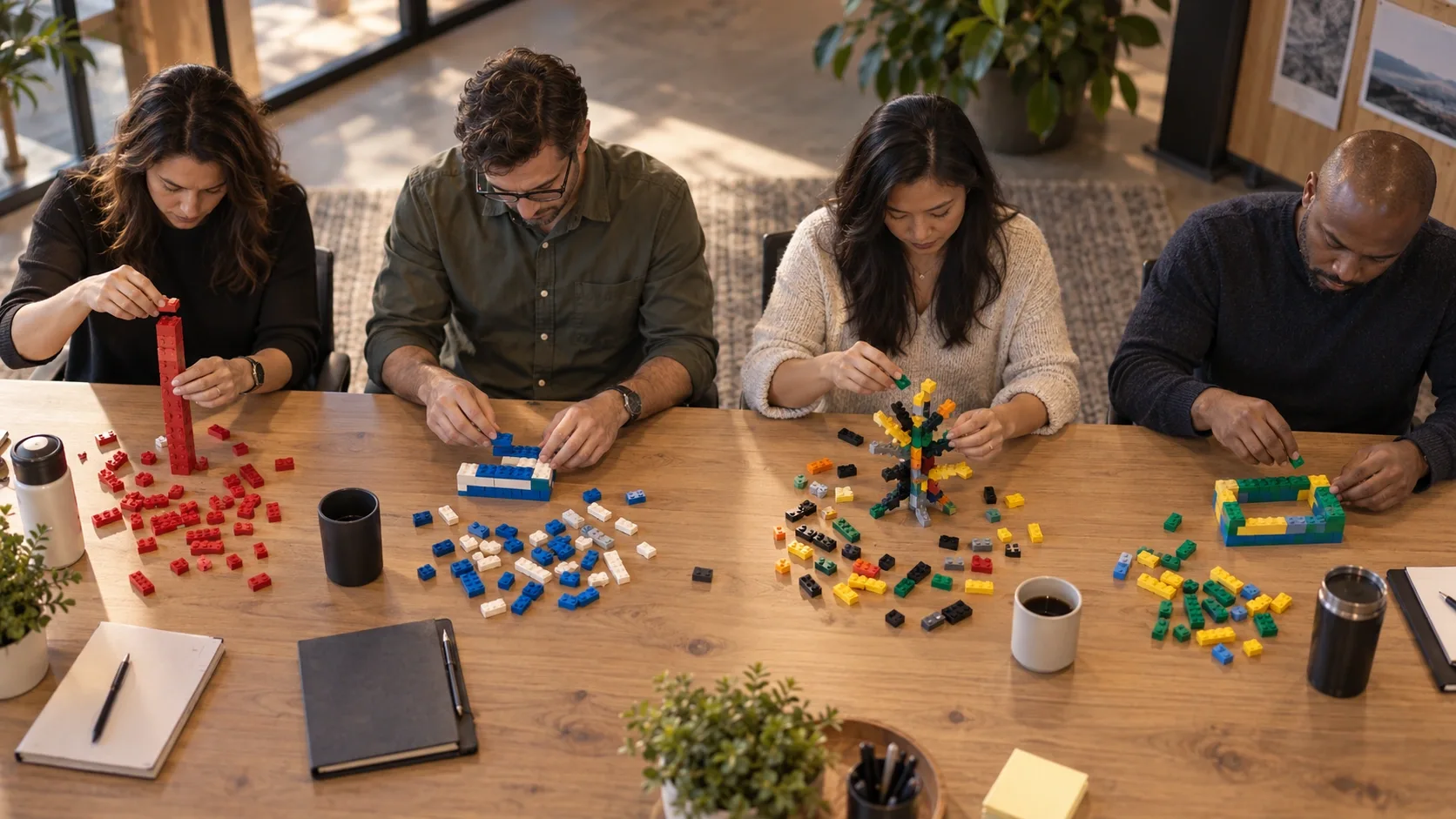
The core issue isn't the people in the room or the quality of the strategic thinking — it's that open discussion, by itself, doesn't force individual positions to become visible before the group starts converging on one answer. When every participant has to build and show a concrete representation of their view before any group discussion starts, disagreement becomes visible early, quieter perspectives get equal airtime, and the group works from what's actually on the table instead of from whoever spoke first. That's specifically the gap a structured, hands-on workshop format is built to close, which is what the next post in this series covers in detail.
If three people from the same offsite can't independently name the same top three priorities, the offsite produced agreement in the room, not agreement in the organization.
Is Your Team's Offsite Due for a Different Approach?
Not every planning cycle needs an overhaul. It's worth rethinking the format when last year's offsite produced a deck that quietly disappeared, when the same debates keep resurfacing year over year without resolution, or when a handful of voices tend to dominate the room regardless of who has the most relevant information.
Signals It's Time to Change the Format
- Last year's offsite priorities can't be recalled accurately by most of the people who were in the room
- The same one or two people tend to set the direction of every planning conversation
- Follow-through consistently stalls within the first month after the offsite
- Disagreement during planning tends to surface after the offsite instead of during it
See How a Structured Workshop Changes What Comes Out of Planning
Part 2 of this series covers exactly how a LEGO® Serious Play® workshop is designed to fix these problems. In the meantime, if your team's next planning offsite is coming up, our facilitator training programs can help you build that capability internally, or we can facilitate it directly.
To understand the full methodology behind the workshop design described above, read our full explanation of how the LEGO® Serious Play® method works.
Frequently asked questions
Why do most strategic planning offsites fail to produce lasting change?
Most offsites are built around open discussion, which tends to reflect whoever is most confident or senior in the room rather than the most informed view. The result often looks like alignment inside the room but doesn't hold up once the team is back doing the actual work.
How can we tell if our last planning offsite actually worked?
Ask a few people who attended, separately, to name the top three priorities that came out of it. If their answers don't largely match, the offsite likely produced a feeling of agreement rather than a shared, specific plan.
What's the difference between alignment in the room and alignment that lasts?
Alignment in the room is often just people not objecting out loud. Alignment that lasts requires each person to commit to a specific, visible position that the rest of the group can see and respond to, which a purely conversational format rarely forces.
Does a better facilitator fix the loudest-voice problem?
A skilled facilitator helps, but the deeper issue is the format itself: open discussion structurally favors whoever speaks first or most. Formats that have every participant commit to an individual position before group discussion starts address the problem more directly than facilitation skill alone.
What should replace a purely discussion-based planning offsite?
A structured, hands-on format, like a LEGO® Serious Play® workshop, that has every participant build and share an individual view before the group works toward a shared plan. The next post in this series covers how that workshop is actually designed.
Is this a criticism of strategic planning itself, or just the typical offsite format?
The format, not the goal. Strategic planning offsites exist for a good reason: teams do need dedicated time to set direction together. The issue is that the conversation-only format most offsites use works against the alignment and follow-through it's meant to produce.